

Risk Based Validation Approach: 4 Steps to Optimize Compliance Costs
Updated: 3 days ago
Adopting a risk based validation approach allows life science organizations to reduce validation documentation overhead by up to 40% while maintaining full regulatory compliance. By shifting focus from generic testing to critical data integrity and system impact, you eliminate redundant execution steps without sacrificing audit readiness. The decision you face is simple: which systems deserve deep testing, and which only need proportionate controls?
Key Takeaways: A risk based validation approach prioritizes testing rigor based on a system's impact on patient safety and data integrity rather than performing exhaustive manual testing.
Avoid over-validating low-risk systems unless they directly touch critical GxP data paths or batch release.
Use ICH Q9-style matrices to calculate Risk Priority Numbers before you allocate manual test scripts.
The comparison table in this article shows how automated script packages accelerate execution speed over traditional models.
Table of contents
Match validation depth to your GxP scale and stop wasting effort
Pick the validation depth that fits how complex your equipment is and how wide your operations run. Three situations show up often: a low-risk off-the-shelf instrument (apply lighter controls and skip exhaustive script packs), configurable GxP software tied to batch release (scope rigorous testing to intended use and critical data paths), and a mixed estate of legacy plus cloud tools (run a gap analysis first so hidden CSV gaps surface before an inspector does). With clients we see that over-validating low-risk systems wastes internal resources, while under-validating critical assets triggers audit observations. Balancing your approach protects product quality while streamlining validation steps (validation lifecycle).
Scale determines your documentation load. Standard GxP-regulated environments need flexible scoping based on intended use. Configuring software calls for rigorous testing; off-the-shelf equipment needs lighter controls. A clear ICH Q9-aligned risk assessment keeps focus on impact to critical data.
Avoid unvetted regulatory advisers who charge high fees without delivering concrete, compliant artifacts. Poor consulting leaves teams unprepared for inspections. You can secure real regulatory alignment through our CSV consulting packages.
APS Compliance Consultants Inc. uses proven GAMP 5 templates to accelerate eQMS projects by 40 percent. Prioritize speed and rigor when you choose who supports your next release.
In the alignable.com discussion titled "What Are You Looking for in a Compliance Consultant?", one participant noted:
"This question covers a lot of ground. What type of compliance consultant are you looking for?" (source)
Seek specialized GxP compliance consultants who offer proven GAMP 5 templates and hands-on computer system validation rather than generic advisory firms. Expert partners deliver concrete regulatory artifacts that directly accelerate project timelines. Similarly, when organizations navigate wider corporate system modernization, specialists such as HRIS Audit provide client-side leadership and advisory services for enterprise HR technology transformation.
Why traditional validation models break on modern systems
Traditional, linear validation models fail modern software because they treat dynamic, cloud-based systems like static hardware. Legacy approaches pile up rigid paperwork instead of assessing real-world software impact, so you pay for pages that never reduce patient or product risk.
If a compliance consultant previously burnt your budget on non-critical documentation without improving system reliability, that distrust is understandable. Paper-heavy, generic testing creates unnecessary drag on operational efficiency. A risk-based approach shifts your focus toward data integrity controls where non-compliance actually threatens patient safety.
According to the Wikipedia entry on the Risk-based approach to EMC regulation and standardization (2026), modern regulatory frameworks rely on proportional risk management rather than standardized, exhaustive testing protocols. Applying validation steps through a targeted lens ensures critical components receive rigorous testing while low-risk functions remain agile.
Our team works as a collaborative partner to streamline compliance activities. Choosing a specialized CSV consultant guide keeps your testing scope aligned with intended system use. Proven ICH Q9-style frameworks help strip unnecessary documentation burdens by up to 40%. Put effort on critical process decisions instead of rubber-stamping low-risk functionality; targeted controls protect quality where it counts.
What a risk-based validation mindset changes in practice
A risk-based validation mindset means prioritizing system testing based on potential impact to patient safety and data integrity, not on how many protocols you can fill.
An overlooked strategy is the risk assessment guide (ICH Q9) framework, which helps quality teams cut validation steps documentation loads by as much as 40 percent. Treating compliance as a generic paper-pushing routine wastes critical engineering resources. Over-validating low-risk systems is as dangerous as ignoring high-risk processes because it distracts from critical quality defects. Focusing critical thinking on high-risk functions protects product quality and speeds up system deployment.
When external advisors deliver rigid, one-size-fits-all templates, internal teams face audit anxiety and delayed software releases. Relying on GAMP 5 principles avoids those bottlenecks by matching testing rigor directly to system complexity. Managing complex software workflows, for example, needs structured technical oversight. You can review our detailed breakdown in the Empower CDS validation guide to see how targeted risk controls streamline computerized systems.
Our experts focus on critical quality attributes rather than exhaustive non-GxP documentation. That focus helps your quality assurance team establish defensible, audit-ready validation frameworks aligned with modern international standards. For organizations managing digital infrastructure alongside regulated pipelines, enterprise compliance validation platforms like CWORT streamline requirements across cybersecurity and operational governance.
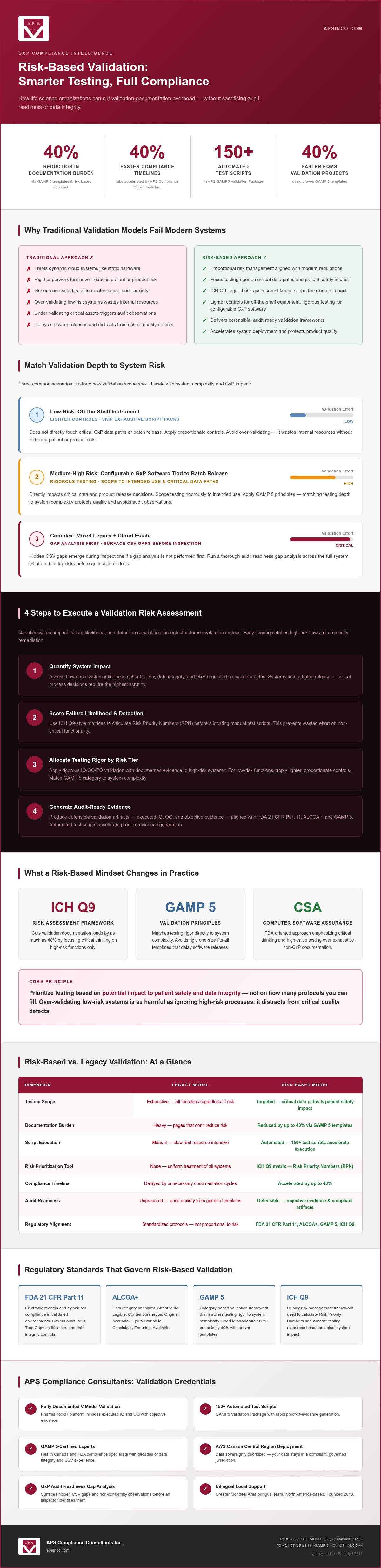
4 Steps to execute a detailed validation risk assessment
You can execute a detailed validation risk assessment by quantifying system impact, failure likelihood, and detection capabilities through structured evaluation metrics. Early scoring acts as a filter: it catches high-risk flaws before you spend on costly validation steps, and it stops you from over-testing functions that never touch patient safety or product quality.
During consulting engagements, our teams evaluate how functional workflows impact critical process parameters and patient safety before assigning testing protocols. This structured approach prevents over-validating non-critical functions while ensuring audit readiness.
Identify system functions: Document all intended uses, user interactions, and automated workflows within the software.
Evaluate impact severity: Determine the potential damage to patient safety, product quality, or data integrity if a functional failure occurs.
Score failure probability: Rate how frequently a specific system mechanism or feature is likely to fail based on historical performance and vendor reliability.
Determine risk priorities: Calculate total scores to categorize system components into distinct risk levels for targeted testing.
To streamline this process, teams calculate scores using a standard ICH Q9-style matrix. Deploying proven templates from the eQMS GAMP 5 guide helps structure these calculations.
Focus testing where risk score severity is highest. APS Compliance Consultants Inc. provides tailored frameworks to evaluate operational risks accurately when you need defensible scoring, not generic checklists.
Tip: Calculate your Risk Priority Number by multiplying Severity, Occurrence, and Detectability scores before allocating manual test scripts.
Where the risk based validation approach cuts cost versus legacy models
Risk-based Computer Software Assurance replaces manual testing overhead with targeted control verification. During compliance remediation projects, we observe how legacy computer system validation stalls critical operational timelines. Focusing on high-impact functional areas protects your submission schedule while maintaining strict regulatory conformity.
Traditional validation steps rely heavily on repetitive, paper-based proof. Modern Computer Software Assurance focuses execution on critical process risks. Automated script packages can cover documentation and functionality for GAMP5 Category 4 software and 21 CFR Part 11 compliance.
Choosing automated verification fits busy regulated facilities, whereas legacy models suit low-complexity manual processes. Our team can help your quality operations transition without risking project deadlines.
Tip: Use pre-automated GAMP5 Category 4 script packages to meet Part 11 electronic-record requirements without rebuilding every protocol from scratch.
A commenter in the alignable.com thread "What Are You Looking for in a Compliance Consultant?":
"Often, these organizations require compliance advisory services to remediate regulatory findings and/or enhance internal controls, or for assistance with regulatory examinations or enforcement actions." (source)
Unplanned regulatory scrutiny needs rapid deployment of validated controls to restore Agency confidence. Moving from paper-heavy validation steps to automated risk-based packages resolves open observations while protecting strict submission deadlines.
How risk-based CSV plays out on real systems
You execute practical computer system validation by focusing resources on critical functions that directly impact patient safety and product quality, then proving those controls before an inspector asks.
Situation: during a regulatory review, hidden deficiencies sat inside a facility's legacy protocols. Solution: our audit readiness gap analysis identified those issues before they could trigger an official 483 observation, and we implemented a remediation framework that resolved every finding. Result: the client reached a clean inspection outcome without rework loops. Targeted testing saved calendar time that blanket revalidation would have consumed.
Evaluating pre-validated software such as PharmaRockIT EWB lets you concentrate on user workflows. That solution supplies Part 11-ready controls in a validated environment, protecting audit trails and electronic signatures without redundant testing.
Validate critical path items first, then decide what can stay light-touch. Reach out to APS when you want that sequencing applied to your estate.
Frequently asked questions
What is risk-based validation?
A risk-based approach aligns testing rigor with product safety and data integrity. Instead of applying identical protocols across every system, your team focuses resources on critical components that directly impact patient safety and quality. According to a case study, a biotech organization undergoing an FDA review achieved a clean inspection outcome and significantly optimized its internal validation project timelines by identifying hidden legacy deficiencies early.
Why do traditional validation models no longer fit modern systems?
Static testing models create excessive documentation burdens while failing to address dynamic, software-driven operational risks. Modern GxP-regulated environments demand flexible strategies like Computer Software Assurance that prioritize critical thinking over repetitive, manual test execution. For complex software, automated validation script packages supply the documentation and functionality needed for GAMP5 Category 4 software and Part 11 electronic records, so modern systems stay audit-ready without unnecessary administrative delay.
What does a risk-based validation mindset actually mean?
It means evaluating potential impacts on GxP processes before initiating formal validation steps. Your team evaluates intended use and data flows using a structured ICH Q9-aligned method to guide testing decisions. Systems like PharmaRockIT EWB support this approach by providing a fully validated environment with compliant electronic signatures, secure audit trails, and complete Part 11 controls. That setup protects operational integrity.
How does risk-based validation prioritize validation efforts?
Validation activities are directed toward critical process parameters and system functions that present the highest potential risk to product quality. Low-risk operations receive streamlined verification, while critical data integrity controls undergo rigorous Operational Qualification. This prioritization helps quality teams prevent product recalls while accelerating compliance project execution.
Which risk assessment tools are used in risk-based validation?
Quality teams rely on proven tools such as Failure Mode and Effects Analysis and functional risk evaluations to pinpoint system vulnerabilities. These tools allow you to map critical data workflows and establish objective controls tailored to your equipment setup. Structured templates help you streamline documentation and shorten project timelines without compromising regulatory standards.
Modernize Your Validation Framework in 2026
Adopting a risk based validation approach helps you maintain regulatory compliance while eliminating unnecessary project delays. By prioritizing system controls according to potential impact, your team protects critical processes and secures data integrity: the same decision questions you started with (what is critical, what is proportionate, what is audit-ready).
Under the leadership of Founder and CEO Kia Kahhali, our consultants help you apply efficient validation steps. APS Compliance Consultants Inc. provides complete GAMP5 Category 4 and Part 11 validation documentation to simplify your audit readiness.
If you are ready to modernize your compliance framework and reduce project timelines by up to 40%, contact our validation experts today.


Comments