

Computerized System Lifecycle Management: A GxP Compliance Guide for 2026
- 11 minutes ago
- 8 min read
What if your validation efforts weren't a high-stress hurdle to clear every few years, but a continuous engine for operational excellence? For many quality leaders, the reality of computerized system lifecycle management is often defined by validation projects that drag on for months and the persistent fear of data integrity gaps during an unannounced audit. You've likely felt the strain of high costs while maintaining legacy on-premise systems, yet the transition to modern digital tools feels fraught with regulatory risk.
We understand that the pressure to innovate while staying compliant with GAMP 5 Second Edition and the 2026 EMA Annex 11 revisions is immense. This guide provides a repeatable framework to master the full lifecycle of your regulated systems, ensuring you maintain a constant "validated state" from initial concept to final retirement. We'll explore how to leverage a risk-based approach to reduce audit findings and accelerate the deployment of new digital tools, allowing your team to focus on core operations with complete confidence in your data integrity.
Table of Contents
What is Computerized System Lifecycle Management in a GxP Context?
Computerized system lifecycle management is far more than a simple IT asset disposal schedule. In a GxP environment, it's a structured, end-to-end process that ensures a system’s compliance and operational utility from the moment of its initial concept until it is finally retired. While standard IT might focus on hardware procurement and uptime, regulated life sciences must prioritize the "validated state." This means every software update, configuration change, or user access modification must be documented and verified to ensure it doesn't compromise the integrity of your data.
This distinction is critical. A standard IT department might view a LIMS or CMMS as just another application on a server. However, for a quality professional, that system is a repository of GxP evidence. Maintaining compliance requires professional computer system validation services that align with the latest regulatory expectations. The industry gold standard for this approach is Good Automated Manufacturing Practice (GAMP), specifically GAMP 5. By utilizing risk-based assessments, you can determine exactly how much management a system needs based on its complexity. This strategic focus moves your organization from reactive troubleshooting during a surprise audit to a position of proactive, continuous readiness.
The business impact of a robust lifecycle framework is significant. It reduces the risk of data integrity findings and streamlines the adoption of new technologies. Organizations that embrace these principles find they can scale their digital infrastructure without the traditional bottlenecks associated with legacy validation methods. It’s about building a foundation where compliance is a byproduct of good engineering rather than a separate, painful event.
The Shift from CSV to Computer Software Assurance (CSA)
The modern approach to computerized system lifecycle management is evolving through computer software assurance csa consulting. Unlike traditional, document-heavy validation, CSA focuses on "critical to quality" functions. It streamlines the process by emphasizing critical thinking and unscripted testing over exhaustive, low-value paperwork. This shift allows you to deploy digital tools faster while maintaining a robust compliance posture that regulators now expect in 2026. You're no longer validating for the sake of the document; you're assuring the system works for the patient.
The 4 Stages of the GAMP 5 Computerized System Lifecycle
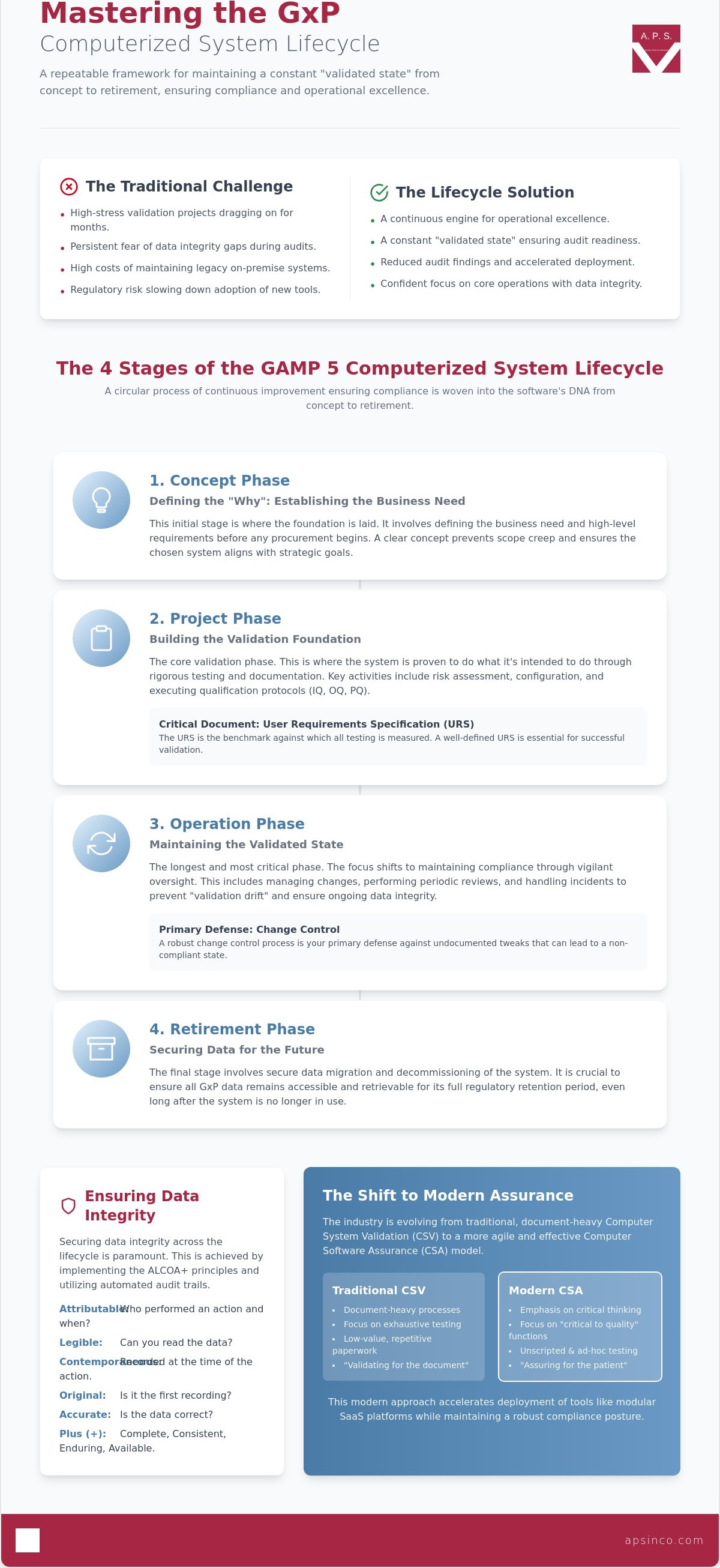
Effective computerized system lifecycle management isn't a linear checklist; it's a circular process of continuous improvement. The ISPE GAMP® 5 Guide provides the industry's most reliable framework for this, dividing a system's life into four distinct stages that ensure compliance is woven into the software's DNA.
Concept: This is where you define the business need and high-level requirements before procurement begins. It's the "why" behind the system.
Project: The core validation phase where risk assessment, configuration, and testing occur. This is where you prove the system does what it's supposed to do.
Operation: The longest phase, requiring vigilant change control, periodic reviews, and incident management to maintain the validated state.
Retirement: Secure data migration and decommissioning. You must ensure that GxP data remains accessible for its full retention period, even after the system is gone.
Project Phase: Building the Validation Foundation
You can't validate what you haven't defined. The User Requirements Specification (URS) is the most critical document in the lifecycle because it provides the benchmark against which all testing is measured. If your software interfaces with laboratory hardware, you must integrate rigorous equipment qualification iq oq pq protocols. This ensures that digital commands result in accurate physical actions, creating a seamless link between your data and your lab results.
Operation Phase: Maintaining the Validated State
Once a system goes live, the real work of computerized system lifecycle management begins. Change control is your primary defense against "unauthorized" system drift, where small, undocumented tweaks eventually lead to a non-compliant state. We recommend performing periodic reviews to verify that the system still meets its intended use and matches current regulatory standards. If you're feeling overwhelmed by the complexity of these ongoing requirements, you can reach out to our consultants for a tailored compliance roadmap that keeps you audit-ready without the stress.
Ensuring Data Integrity Across the System Lifecycle
Data integrity is the heartbeat of compliance. Within the framework of computerized system lifecycle management, this means embedding ALCOA+ principles into every record created or modified. Whether your system is in the initial validation phase or has been active for years, your data must remain Attributable, Legible, Contemporaneous, Original, and Accurate. It’s a continuous commitment that ensures your records tell the true story of your laboratory or manufacturing processes.
Audit trail management serves as your primary tool for maintaining this standard. Every change to GxP data must be tracked, time-stamped, and attributable to a specific user. We often encounter the "validated once, done forever" fallacy, which is a significant risk during inspections. Regulators expect you to actively monitor these trails to catch unauthorized changes or system drift before they become compliance liabilities.
Protecting data throughout the Operation phase also requires a focus on long-term preservation. You must ensure that records remain accessible and enduring even as technology evolves. Key pillars for this stage include:
Regular, verified backups to prevent catastrophic data loss.
Disaster recovery testing to ensure business continuity during unforeseen events.
Strict access controls to prevent accidental or malicious data modification.
If your backups aren't being tested, they don't truly exist in the eyes of an auditor. These measures ensure that your data survives the entire lifecycle intact, regardless of hardware failures or software updates.
Meeting 21 CFR Part 11 Requirements
To achieve full compliance, your software must possess specific technical controls. This includes secure electronic signatures that are uniquely linked to the signer and comprehensive, unalterable audit trails. For a detailed checklist of these essential features, you can review our guide on 21 cfr part 11 requirements. If you're concerned about your current level of risk, contact our data integrity consultants to secure your validated state and ensure your systems are ready for 2026 inspections.
Modernizing Lifecycles with Validated SaaS and Modular Systems
The traditional approach to computerized system lifecycle management often feels like steering a massive, slow-moving ship. Legacy on-premise systems require heavy infrastructure maintenance and exhaustive local validation that can stall progress for months. Modernizing your technology stack with Validated SaaS (Zero-Footprint) models can reduce your "Project" phase effort by up to 30%. This efficiency gain happens because you're leveraging the vendor's underlying infrastructure qualification, allowing your quality team to focus strictly on your specific configurations and intended use.
Adopting a "Lean" approach means replacing monolithic, rigid systems with agile, interconnected modules. Platforms like PharmaRockIT allow for phased rollouts of a LIMS or Electronic Workbook (ELN/LES), while Alleye CMMS handles your maintenance compliance separately. This modular implementation strategy reduces initial CAPEX and significantly simplifies change management. When you update one module, you don't necessarily have to re-verify your entire digital ecosystem. It empowers you to build a specialized environment that grows with your laboratory or production facility.
Leveraging vendor-base validation is another strategic advantage. By utilizing the supplier's robust testing documentation, you can dramatically accelerate your own internal qualification timelines. You aren't starting from zero; you're building on a foundation of proven performance. This collaborative approach between vendor and regulated company is the new standard for 2026, ensuring that your computerized system lifecycle management remains both compliant and competitive.
SaaS vs. On-Premise: The Regulatory Perspective
Many GxP organizations are prioritizing the move to SaaS to improve cybersecurity and data sovereignty. Cloud-native architectures offer superior protection against modern threats compared to aging local servers. A major benefit is the shift to automatic, vendor-managed updates. These updates maintain your validated state through rigorous supplier testing and release notes, removing the need for constant, manual IT intervention. It’s a transition that replaces technical debt with a streamlined, audit-ready digital landscape.
Future-Proof Your Digital Compliance Strategy
Mastering computerized system lifecycle management is no longer a luxury for life science organizations; it's a regulatory necessity for 2026. You've seen how shifting to a risk-based approach and embracing modular, cloud-native platforms can transform your validation process from a bottleneck into a competitive advantage. By focusing on critical-to-quality functions and maintaining a continuous validated state, you protect your data integrity and ensure your systems remain audit-ready throughout their entire lifespan.
Don't let legacy validation hurdles slow your digital transformation. Our team brings decades of GMP expertise and 21 CFR Part 11 compliant SaaS platforms to help you accelerate validation projects by up to 40%. Whether you're implementing a new LIMS or modernizing your CMMS, we're here to provide the supported solutions you need to succeed. It's time to move beyond reactive compliance and start building a more agile, reliable future for your operations.
Streamline your lifecycle with APS GAMP 5 experts today and gain the confidence that comes with professional, results-oriented guidance. You're ready to lead your team toward excellence.
Frequently Asked Questions
What is the primary goal of computerized system lifecycle management?
The primary goal of computerized system lifecycle management is to maintain a continuous "validated state" where the system consistently performs according to its intended use and regulatory requirements. This framework ensures that compliance and operational efficiency aren't just one-time achievements during initial setup. By managing the system from concept to retirement, organizations protect the integrity of their GxP data and ensure every action remains attributable and audit-ready.
How does GAMP 5 influence the system lifecycle?
GAMP 5 serves as the industry-standard framework for applying a risk-based approach to the entire lifecycle. It guides organizations in determining the appropriate level of validation and documentation based on the system's complexity and its impact on patient safety or product quality. This methodology allows your team to focus efforts on high-risk, "critical to quality" functions rather than performing exhaustive, low-value testing on standard software features.
What happens to data during the retirement stage of the lifecycle?
During the retirement stage, GxP data must be securely migrated to a new system or moved into a long-term archive that preserves its systemic integrity. It isn't enough to simply save the files; the data must remain legible and accessible for the entire duration of its required retention period. This often involves verifying that archived records maintain their original audit trails and electronic signatures even after the primary software is decommissioned.
Is validation required for every update in a SaaS-based system lifecycle?
Yes, every update requires a formal assessment, but the scope of validation is often significantly reduced through a "lean" approach. For SaaS solutions, you can leverage the vendor's base validation documentation to streamline your internal qualification efforts. Your team focuses on verifying that the update hasn't negatively impacted your specific configurations or business processes. This allows for faster deployment of new features without compromising your computerized system lifecycle management standards.
What are the risks of poor computerized system lifecycle management?
Poor management leads to "system drift," where undocumented changes create significant data integrity gaps that regulators will identify during inspections. These failures often result in costly warning letters or delays in product releases. Beyond regulatory risk, neglecting the lifecycle can lead to high maintenance costs for legacy systems, increased vulnerability to cybersecurity threats, and the potential for permanent loss of critical laboratory or manufacturing data.


Comments