

Computer System Validation Consulting GxP regulated industries
- 11 minutes ago
- 9 min read
With the FDA's Quality Management System Regulation (QMSR) now fully in effect as of February 2026, the margin for error in your validation lifecycle has effectively vanished. For many manufacturers, the transition to ISO 13485 alignment feels like a moving target, especially when searching for medical device validation consultants who truly grasp the technical nuances of Software as a Medical Device (SaMD). You're likely feeling the pressure of manual, paper-heavy processes that slow your time-to-market and the persistent fear that a single data integrity gap could trigger a costly Health Canada or FDA warning letter.
We understand that the intersection of hardware and software compliance is where most projects stall. It's time to stop viewing regulatory hurdles as roadblocks and start seeing them as strategic engines for growth. This article reveals how specialized validation expertise and digitalized GAMP 5 frameworks can accelerate your project timelines by up to 40% while ensuring your documentation remains perpetually audit-ready. You'll discover a scalable path to compliance that transforms complex requirements into a measurable competitive advantage, allowing your team to focus on innovation rather than paperwork.
Table of Contents
The Strategic Role of Medical Device Validation Consultants in 2026
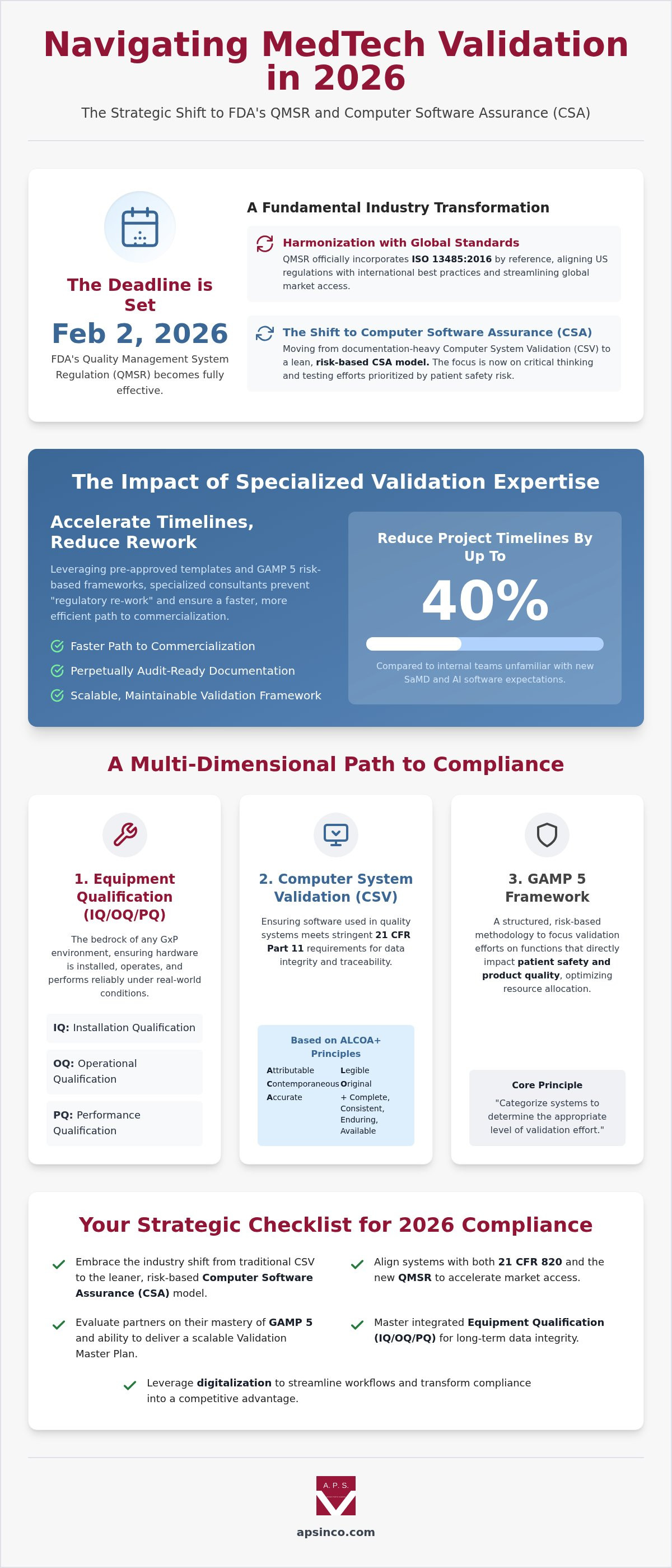
The regulatory landscape for MedTech hasn't just evolved; it's undergone a fundamental shift. As of February 2, 2026, the FDA's Quality Management System Regulation (QMSR) is the new law of the land, officially incorporating ISO 13485:2016 by reference. In this environment, medical device validation consultants serve as more than just technical experts. They are the architects of your market access strategy. These specialists ensure that manufacturing processes and computer systems consistently produce devices that meet stringent quality standards under 21 CFR 820.75. They help you move beyond reactive "check-the-box" compliance and toward a model of operational excellence.
This year marks a definitive turning point for the industry. We're seeing a rapid transition from traditional, documentation-heavy Computer System Validation (CSV) to a lean, risk-based Computer Software Assurance (CSA) model. This shift isn't just about paperwork. It's about focusing testing efforts where the risk to patient safety is highest. Failing to adapt often leads to the most common Form 483 citations, where inadequate process validation or poor data integrity can stall a product launch indefinitely. Expert consultants help you avoid these pitfalls by building quality directly into your system's design.
Navigating Global Regulatory Standards
Aligning with the FDA's new QMSR while maintaining compliance with Health Canada or the EMA requires a sophisticated understanding of regulatory overlap. Experienced medical device validation consultants bridge the gap between 21 CFR Part 820 and ISO 13485:2016, creating a unified quality system. This harmonized approach ensures your validation efforts satisfy multiple global jurisdictions simultaneously. It prevents redundant work, reduces administrative friction, and ensures your documentation stands up to the FDA's revised inspection model under Compliance Program 7382.850.
The ROI of External Validation Expertise
Precision saves time. By leveraging pre-approved templates and GAMP 5 risk-based frameworks, specialized consultants can accelerate compliance projects by up to 40%. This efficiency prevents the "regulatory re-work" that often plagues internal teams who aren't familiar with the latest expectations for SaMD or AI-powered software. You aren't just buying a report; you're securing a faster path to commercialization and a scalable validation framework that your internal staff can maintain long after the project ends.
Core Competencies: From IQ/OQ/PQ to Computer System Validation (CSV)
Validation is a multi-dimensional discipline. It requires a deep understanding of how physical processes interact with the software governing them. Our medical device validation consultants focus on establishing high-degree assurance that every system performs exactly as intended. This begins with Process Validation (PV), ensuring that critical operations like sterilization, packaging, and cleaning remain consistent across every production cycle. When these processes are validated correctly, you eliminate the variability that leads to product defects and regulatory scrutiny.
Successful deployment relies on a rigorous foundation of equipment qualification iq oq pq. This critical path verifies that hardware is installed correctly, operates within specified limits, and performs reliably under real-world manufacturing conditions. It's the bedrock of any GxP environment. Without this baseline, digital systems cannot maintain the data integrity required by global regulators. We ensure your equipment doesn't just work, but stays compliant through its entire operational life.
In the MedTech sector, software used within quality systems must meet the stringent requirements of 21 CFR Part 11. This involves maintaining a data lifecycle that adheres to ALCOA+ principles: Attributable, Legible, Contemporaneous, Original, and Accurate. It's about creating a digital ecosystem where data is secure and traceable from creation to archiving. By implementing robust CSV protocols, you protect your intellectual property and ensure your data stands up to the most rigorous inspections.
The GAMP 5 Methodology for Medical Devices
GAMP 5 provides the structural framework for categorizing systems and determining the appropriate level of validation effort. By focusing on risk-based testing, you can concentrate resources on functions that directly impact patient safety and product quality. GAMP 5 reduces validation burden for Category 4 configurable software by allowing teams to leverage vendor documentation for standard features while focusing internal testing strictly on specific business-process configurations.
Analytical Instrument Qualification (AIQ)
Modern laboratories rely on sophisticated tools that must be as compliant as the manufacturing floor. Implementing analytical instrument qualification services ensures that benchtop instruments are not just accurate, but also securely connected to your digital backbone. This connectivity is vital for maintaining a single source of truth across your LIMS or ELN platforms. If you're looking to bridge the gap between your lab instruments and your quality system, reach out to our team to discuss a tailored qualification strategy.
How to Evaluate and Select Medical Device Validation Consulting Firms
Selecting the right medical device validation consultants is a decision that impacts your entire product lifecycle. It isn't just about hiring technical hands. You need a partner who understands the operational realities of a GxP environment. Start by evaluating their technical depth. Are they still relying on outdated V-model approaches, or have they mastered the shift toward Computer Software Assurance (CSA)? In 2026, the FDA expects a risk-based approach that prioritizes critical system functions over exhaustive, low-value documentation.
Operational practicality is another non-negotiable factor. Many firms deliver impressive documents that internal teams can't actually maintain once the consultants leave. Ensure your partner provides a sustainable validation master plan development strategy. This plan should serve as a living roadmap for your Class II or Class III devices, not a static binder gathering dust. Finally, ask about their digital capabilities. A modern firm should empower you to transition from paper-based chaos to a validated cloud environment, streamlining your future audits.
The 'Supported Solution' Model
Look for consultants who offer more than just a standalone product. The most effective partners provide "supported software" solutions that combine technical platforms with expert guidance. For manufacturers operating in North America, this includes specific attention to Canadian compliance. Local data residency and bilingual support are essential for meeting Health Canada's expectations while maintaining seamless communication across your organization. This localized expertise ensures that your global strategy remains grounded in regional requirements.
Red Flags to Avoid in Validation Partners
Be wary of firms offering "one-size-fits-all" validation packages. If a consultant doesn't start with a thorough risk assessment, they're likely creating a compliance gap that will surface during your next inspection. Another major red flag is a lack of deep experience in 21 CFR Part 11 and data integrity remediation. If they don't understand the nuances of electronic signatures and audit trails, they can't protect your operations. If you want to ensure your validation strategy is both compliant and practical, book a consultation with our experts today.
APS Compliance: Accelerating MedTech Success through Digitalization
APS Compliance serves as more than a traditional consultancy; we're your dedicated partner in GMP digitalization. Our medical device validation consultants combine decades of CSV expertise with the power of the PharmaRockIT ecosystem to rethink how compliance is achieved. By leveraging pre-validated templates and lean methodologies, we've demonstrated the ability to accelerate compliance projects by up to 40%. This efficiency allows your team to focus on core innovation while we handle the technical rigors of regulatory alignment.
We utilize the Alleye CMMS platform to automate equipment qualification and maintenance schedules. This transition removes the burden of manual tracking and ensures your hardware remains in a perpetually validated state. In a recent QC workflow optimization, we helped a client eliminate transcription risks by replacing legacy paper logs with digital entries. This secured their data lifecycle from the moment of capture, effectively removing the human error that often leads to audit findings.
PharmaRockIT: A Modular Approach to Compliance
The PharmaRockIT ecosystem provides a fully connected laboratory environment. Whether you require a comprehensive PharmaRockIT LIMS or the specialized PharmaRockIT Electronic Workbook (ELN/LES), our solutions are modular and built to scale. For instruments that lack native network capabilities, PharmaRockIT LINK provides the necessary bridge to digitize benchtop data securely. This ensures that every piece of equipment contributes to a single, audit-ready source of truth.
Continuous Audit Readiness
Compliance shouldn't be a frantic exercise performed only when an inspection is looming. We empower you to move from project-based validation to a state of continuous audit readiness. The PharmaRockIT Cockpit offers QA managers centralized governance through real-time dashboards. You can monitor system health, track validation status, and address potential gaps before they become regulatory liabilities. This proactive oversight ensures your documentation is always prepared for Health Canada or FDA scrutiny.
Ready to streamline your compliance? Contact APS Compliance Consultants for a gap analysis.
Securing Your Regulatory Future Through Digital Integration
The transition to the FDA's new QMSR and the industry-wide shift toward Computer Software Assurance (CSA) represent a fundamental change in how quality is managed. You've discovered that successful compliance in 2026 requires more than just filling out forms. It demands a risk-based approach that integrates equipment qualification with digitalized workflows. By moving beyond manual processes, you don't just satisfy regulators; you build a more agile, efficient manufacturing operation that is ready for the global stage.
Partnering with specialized medical device validation consultants ensures your team has the guidance needed to bridge the gap between technical standards and operational success. Our experts leverage deep knowledge of GAMP 5 and 21 CFR Part 11 to deliver audit-ready results using our Canadian-hosted LIMS and CMMS platforms. We focus on empowering your organization to achieve up to 40% faster project delivery without compromising on data integrity. Accelerate your validation project with APS Compliance Consultants today. We're here to turn your complex regulatory burdens into a clear path for innovation and growth.
Frequently Asked Questions
What is the difference between medical device process validation and CSV?
Process validation ensures that a physical manufacturing cycle, such as sterilization or injection molding, consistently produces a device meeting its specifications. Computer System Validation (CSV) focuses on the software and automated systems that control these manufacturing steps or manage quality data. While process validation confirms physical outcomes, CSV ensures the digital logic and data integrity meet 21 CFR Part 11 requirements.
When should a medical device startup hire validation consultants?
Startups should ideally engage medical device validation consultants during the design and development phase to implement a "compliance by design" strategy. Waiting until the pre-market submission stage often leads to expensive re-work if the Quality Management System or software architecture doesn't align with the new FDA QMSR standards. Early intervention helps establish a scalable validation master plan that grows with the company's product portfolio.
How does GAMP 5 apply to medical device software validation?
GAMP 5 provides a risk-based framework that categorizes software to define the necessary validation depth. For medical devices, this means focusing testing efforts on functions that directly impact patient safety or product quality. This methodology allows teams to move away from exhaustive testing of standard features; instead, they concentrate on custom configurations and high-risk interfaces, which aligns with the FDA's current push for Computer Software Assurance (CSA).
What are the common FDA 483 citations for process validation?
Top Form 483 citations frequently involve a failure to establish or follow adequate written procedures for process validation under 21 CFR 820.75. Other common issues include inadequate software validation for automated production equipment and missing data integrity controls. These citations often stem from a documentation-only mentality rather than a robust, risk-based validation lifecycle that accounts for the intersection of hardware and software.
How much does medical device validation consulting typically cost?
As of early 2026, industry rates for specialized consultants typically range from $150 to $500 per hour. Junior specialists often fall between $150 and $225, while senior consultants with expertise in Class III devices and complex software architectures command $325 to $500 per hour. Total project costs vary based on system complexity and whether the engagement covers a single submission or a full quality system overhaul.
Can consultants help with both Health Canada and FDA compliance simultaneously?
Yes, consultants can streamline compliance for both agencies by leveraging the global harmonization between the FDA's new QMSR and ISO 13485:2016. Since the FDA now incorporates ISO 13485 by reference, a single, unified validation strategy can satisfy both Health Canada and U.S. requirements. This harmonized approach reduces redundant testing and ensures your documentation is audit-ready for inspections on both sides of the border.


Comments