

How to Accelerate Validation Project Timelines: 2026 Compliance Trends
Updated: Aug 2
Did you know that under the traditional Computer System Validation (CSV) model, quality teams historically spent 80% of their time managing documentation and only 20% on actual testing? It's a lopsided ratio that turns essential compliance into a massive operational bottleneck. You've likely experienced the frustration of manual documentation delays or the high costs of external resources while trying to accelerate validation project timelines. You're not alone in feeling that the burden of paperwork often outweighs the value of the software itself.
We understand the pressure of meeting tight deadlines without inviting the risk of audit findings. It's a high-stakes balance that requires more than just faster typing; it requires a smarter, risk-based methodology. This article outlines how to pivot toward the FDA's February 2026 Computer Software Assurance (CSA) framework to reduce validation durations by up to 40% without compromising GxP integrity. We'll examine the strategic shifts in the new Quality Management System Regulation (QMSR) and the digital tools that deliver audit-ready documentation in weeks rather than months. You'll discover a framework for faster IQ/OQ/PQ that empowers your team to focus on quality instead of just filing.
Table of Contents
The Evolution of CSV: Shifting to CSA for Rapid Compliance
The traditional approach to Computerized System Validation often feels like a race where the paperwork is heavier than the finish line. For decades, the life sciences industry operated under a "documentation-first" mindset, where every software interaction required a scripted screenshot. The FDA's February 3, 2026, guidance on Computer Software Assurance (CSA) officially signals the end of this era. By prioritizing critical-to-quality functions over exhaustive, low-value documentation, organizations can finally accelerate validation project timelines. This shift isn't just a suggestion; it's a strategic response to the new Quality Management System Regulation (QMSR) that became effective on February 2, 2026.
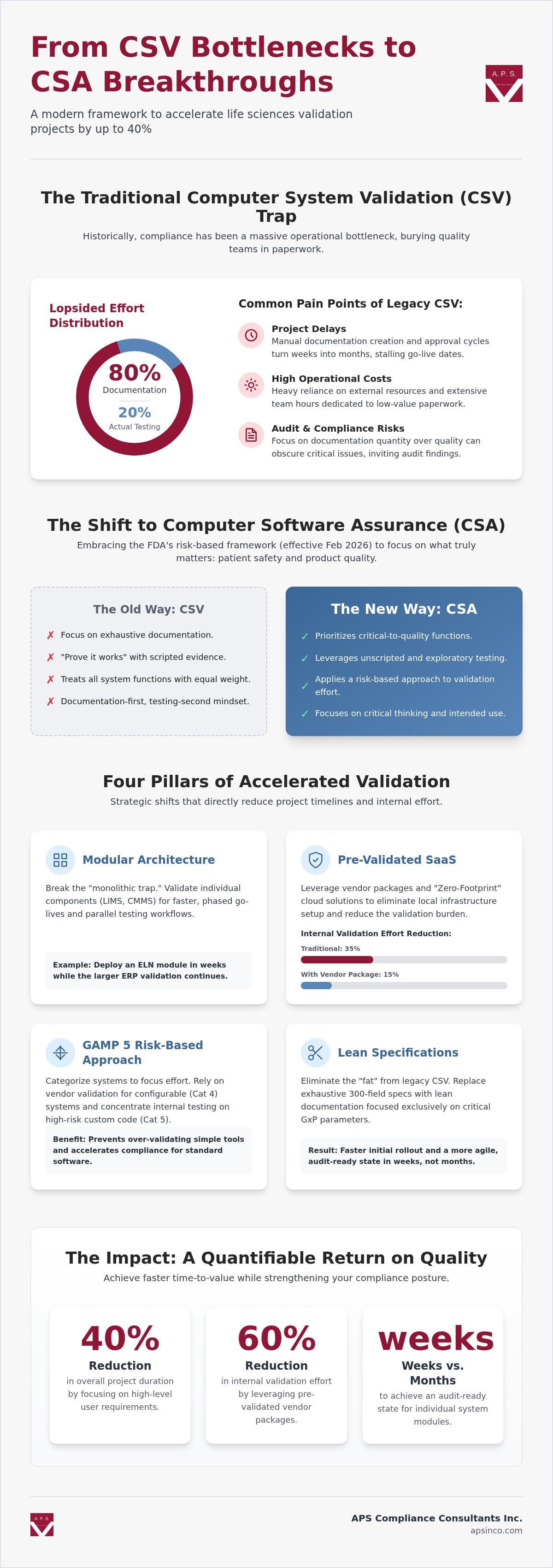
Transitioning to CSA allows you to leverage vendor testing and focus on unscripted, exploratory testing for low-risk features. This directly addresses the "documentation tax" that historically consumed 80% of project hours, leaving only 20% for actual system testing. When you implement Computer System Validation Services grounded in CSA, you move from proving a system works to ensuring it maintains its intended use through critical thinking and risk-based assurance.
The GAMP 5 Risk-Based Approach
Efficiency starts with proper categorization. Under GAMP 5, Category 4 configurable systems offer a much faster path to compliance than Category 5 custom-coded solutions. Configurable software allows you to rely on the vendor's core code validation, focusing your efforts only on the specific business rules you've set. Performing an audit readiness gap analysis helps identify these low-risk acceleration opportunities early, ensuring you don't over-validate simple tools or automation bots.
Eliminating the 'Fat' from Legacy CSV
Traditional 300-field product specifications are often the primary enemy of project speed. They create a maintenance nightmare and slow down the initial rollout. Modern compliance demands lean specifications that focus exclusively on critical GxP parameters. By stripping away the "fat" and focusing on what truly impacts patient safety and data integrity, you can accelerate validation project timelines and achieve a more agile, audit-ready state in weeks rather than months.
Modular Architecture: Breaking the Monolithic Bottleneck
Many life science organizations fall into the "monolithic trap," where a single all-in-one LIMS or ERP system demands months of validation before a single user can log in. These massive systems require extensive cross-functional testing. Any configuration change in one area can trigger a cascade of regression testing across the entire platform. This linear approach is often the primary reason projects stall. By adopting a modular architecture, you can accelerate validation project timelines by isolating specific functional areas for independent deployment. Modular systems enable parallel validation by allowing independent workflows to be tested and documented simultaneously without cross-functional interference. This strategy also supports a phased CAPEX investment, reducing financial and operational risk by delivering value in stages rather than waiting for a "big bang" rollout.
PharmaRockIT: A Case Study in Modular Speed
The PharmaRockIT ecosystem demonstrates this modular speed in action. The PharmaRockIT Cockpit provides a centralized governance layer, while specific modules like the PHarmaRockIT Electronic Workbook (ELN/LES) can be deployed in weeks. For laboratories struggling with manual data entry, PharmaRockIT LINK can digitize benchtop instruments in a single day. This agility aligns with the FDA's General Principles of Software Validation, which encourages focusing efforts on the complexity and risk of the software's intended use. It's a method that turns months of infrastructure prep into days of productive testing.
Interfacing vs. Integration
Instead of heavy custom coding, modern modular systems use REST APIs to interface with existing platforms like Waters Empower. This approach reduces the validation burden significantly because you aren't modifying the core code of either system. It also helps eliminate the risks associated with spreadsheet validation 21 CFR Part 11 by automating data acquisition directly from the source. This targeted approach is essential for those who need to accelerate validation project timelines while maintaining strict GxP integrity. If you're looking to streamline your current infrastructure, we can help you evaluate your modular transition strategy.
Validated SaaS: Reducing Validation Effort by 60%
Deploying software within a GxP environment shouldn't feel like building a data center from scratch. The Zero-Footprint SaaS model is the ultimate way to accelerate validation project timelines because it completely removes the burden of local server installation. In this cloud-native environment, the traditional Installation Qualification (IQ) for infrastructure is handled by the vendor, allowing your team to focus strictly on functional assurance. It's a shift that replaces months of hardware procurement and configuration with a setup process that takes mere days.
One of the most significant advantages of modern SaaS is the ability to leverage vendor validation. By utilizing a vendor’s base validation package, life science organizations can reduce their internal validation effort from a typical 35% of the project scope down to just 15%. This approach is fully supported by the FDA guidance on Computer Software Assurance, which encourages companies to avoid duplicating testing that the software provider has already performed. You'll maintain "Always-On" compliance through automatic updates and integrated disaster recovery, ensuring your system remains in a validated state without the need for manual patching or emergency downtime. For organizations seeking to automate these workflows, Apptimized offers cloud-based software packaging and patch management to support continuous, compliant application deployment.
We often hear concerns regarding data residency and Canadian data sovereignty. Our cloud-native solutions are designed to meet these rigorous standards, ensuring that while your infrastructure is agile, your data remains secure and compliant with local regulatory expectations. If you're ready to move beyond the constraints of on-premise legacy systems, you can contact our team to discuss a SaaS transition plan.
Master Data: The Hidden Timeline Killer
Master Data cut-over is frequently overlooked, yet it accounts for 30-35% of the total implementation effort. Moving from paper logs or fragmented spreadsheets to a digital system like PharmaRockIT LIMS requires a disciplined migration strategy. We use AI-supported suggestion engines to accelerate this transition, identifying patterns in your legacy data to automate the mapping process. This prevents the "garbage in, garbage out" scenario and keeps your project moving toward go-live without data-related delays.
Simplifying Equipment Qualification
Drafting documents from a blank page is a primary cause of project stagnation. By using pre-validated equipment qualification IQ OQ PQ templates, you can bypass the drafting phase and move straight to execution. Tools like Alleye CMMS further streamline this by automating calibration schedules and maintenance triggers. This keeps your laboratory assets in a constant state of audit readiness, ensuring that your equipment never becomes the bottleneck in your validation lifecycle.
Strategic Implementation: The 40% Acceleration Roadmap
Achieving a 40% reduction in your project duration isn't a matter of cutting corners; it's a matter of surgical precision in your execution strategy. To truly accelerate validation project timelines, organizations must move beyond reactive documentation and adopt a proactive, structured roadmap. This process begins with a high-level User Requirements Specification (URS) framework. By clearly defining "must-haves" versus "nice-to-haves" early, you prevent scope creep from bloating your validation effort. Once the scope is locked, selecting a pre-validated SaaS platform allows you to skip the months typically lost to infrastructure setup and local IQ execution.
The roadmap continues with a phased rollout. Instead of attempting a "big bang" release, use modular validation to achieve early wins in specific departments. Finally, partnering with GAMP 5 validation experts ensures that the regulatory heavy lifting is managed by specialists who understand the nuances of the 2026 CSA guidance. This structured approach transforms compliance from a hurdle into a streamlined lane for operational growth.
Choosing the Right Licensing Model
Your licensing choice can impact how quickly you scale. Concurrent license models often support faster team scaling during peak validation periods, as they allow multiple users to access the system across different shifts without the administrative delay of assigning individual seats. Additionally, per-module licensing supports a "crawl-walk-run" strategy. You can validate and deploy a single tool, like the PharmaRockIT Electronic Workbook, before expanding into a full LIMS environment. This keeps your focus narrow and your momentum high.
The APS Compliance Advantage
As a local GMP digitalization partner based in Montreal, APS Compliance Consultants Inc. provides a unique advantage for North American life science firms. Our bilingual (English/French) team eliminates communication delays that often plague international projects. We operate under the "Connect. Comply. Simplify." philosophy, focusing on delivering trustworthy data through operational excellence. We don't just provide software; we provide a partnership that helps you accelerate validation project timelines while ensuring every record is audit-ready and every process is optimized for long-term value.
Mastering the Speed of Modern GxP Compliance
The transition toward Computer Software Assurance (CSA) and modular, cloud-native architectures represents more than just a temporary trend. It's a fundamental shift in how life science organizations maintain systemic integrity. By focusing on critical-to-quality parameters and leveraging vendor-provided validation, you can finally move away from the documentation burdens that have stalled innovation for decades. These strategies don't just shave days off your schedule; they build a more resilient, audit-ready foundation for your entire laboratory and production operation.
This shift towards AI-driven regulatory management is a broader trend; for instance, you can learn more about how specialized AI assistants are simplifying legal research and compliance in other complex fields.
When you choose to accelerate validation project timelines through a structured, risk-based roadmap, you empower your team to focus on what truly matters: patient safety and product quality. APS Compliance Consultants Inc. brings local Canadian GxP expertise and a suite of audit-ready SaaS platforms to help you navigate this evolving landscape with confidence. We've proven that it's possible to reduce project durations by up to 40% while maintaining the highest standards of regulatory adherence.
Accelerate your compliance project with APS today and discover how our "Connect. Comply. Simplify." philosophy can transform your validation lifecycle. Let's work together to turn your complex regulatory requirements into a streamlined competitive advantage.
Frequently Asked Questions
How can I reduce the time spent on IQ/OQ/PQ documentation?
You can reduce documentation time by adopting the Computer Software Assurance (CSA) framework, which focuses on critical-to-quality functions rather than scripted testing for every low-risk feature. Leveraging pre-validated GAMP 5 templates for equipment qualification eliminates the need to draft protocols from a blank page. This shift allows your team to focus on actual system performance while maintaining full GxP integrity without the traditional paperwork burden.
Is Computer Software Assurance (CSA) accepted by Health Canada and the FDA?
Yes, Computer Software Assurance is fully recognized and encouraged by global regulatory bodies. The FDA released its final guidance on CSA in February 2026, aligning expectations with the new Quality Management System Regulation (QMSR). Health Canada similarly supports risk-based approaches that prioritize patient safety and product quality over excessive documentation. Using these frameworks is a primary strategy to accelerate validation project timelines while staying ahead of regulatory expectations.
What is the fastest way to validate a new LIMS or CMMS?
The fastest route is selecting a cloud-native, "Zero-Footprint" SaaS platform like PharmaRockIT or Alleye CMMS. These systems eliminate local server installation and infrastructure IQ overhead entirely. By utilizing a vendor's base validation package, you can reduce your internal effort from 35% to 15% of the project scope. This allows your organization to move from procurement to a validated go-live state in weeks rather than months.
How does modular implementation affect the overall project timeline?
Modular implementation enables parallel validation, allowing independent workflows to be tested and documented simultaneously without cross-functional bottlenecks. Instead of waiting for a monolithic system to be fully ready, you can deploy specific modules like an Electronic Workbook or CMMS for immediate operational gains. This phased approach reduces project risk and ensures that validation activities don't stall due to a single complex configuration issue in an unrelated area.
Can SaaS solutions really be 21 CFR Part 11 compliant?
SaaS solutions are built for 21 CFR Part 11 compliance through integrated technical controls like robust audit trails, electronic signatures, and restricted access levels. Compliance is maintained through the vendor's audited quality management system and automatic updates that keep the software in a validated state. These platforms often improve data integrity by automating data acquisition from benchtop instruments, which removes the risks associated with manual entry and fragmented spreadsheets.


Comments