

LabWare LIMS vs PharmaRockIT for Compliance, Inventory, and Support
The counterintuitive answer in a LabWare LIMS vs PharmaRockIT comparison is that the name alone won’t identify the better fit. Choose by how well each system supports your laboratory’s workflows, compliance evidence, instrument connections, inventory controls, dashboards, analytics, reporting, and support needs. For PharmaRockIT, the available product information includes cloud hosting, maintenance, and 21 CFR Part 11-compliant data management.
A LIMS should do more than record results: it must support reliable data handling and fit the way your teams work. This comparison explains how to assess LabWare LIMS vs PharmaRockIT across compliance and audit readiness, instrument integration, support, inventory, dashboards, analytics, and reporting. You’ll also find a practical decision guide to align system capabilities with your laboratory’s operational and validation priorities.
Key Takeaways
Compare compliance evidence and validation needs against your laboratory’s intended use to identify the stronger operational fit.
Map instrument connections and result-entry workflows before assessing how either system supports reliable data transfer.
Clarify which support activities matter to your team, then weigh them alongside inventory and day-to-day laboratory workflows.
Assess dashboards, analytics, and reporting by the decisions your teams need to make and the records they need to retain.
Table of Contents
Regulatory compliance and audit readiness
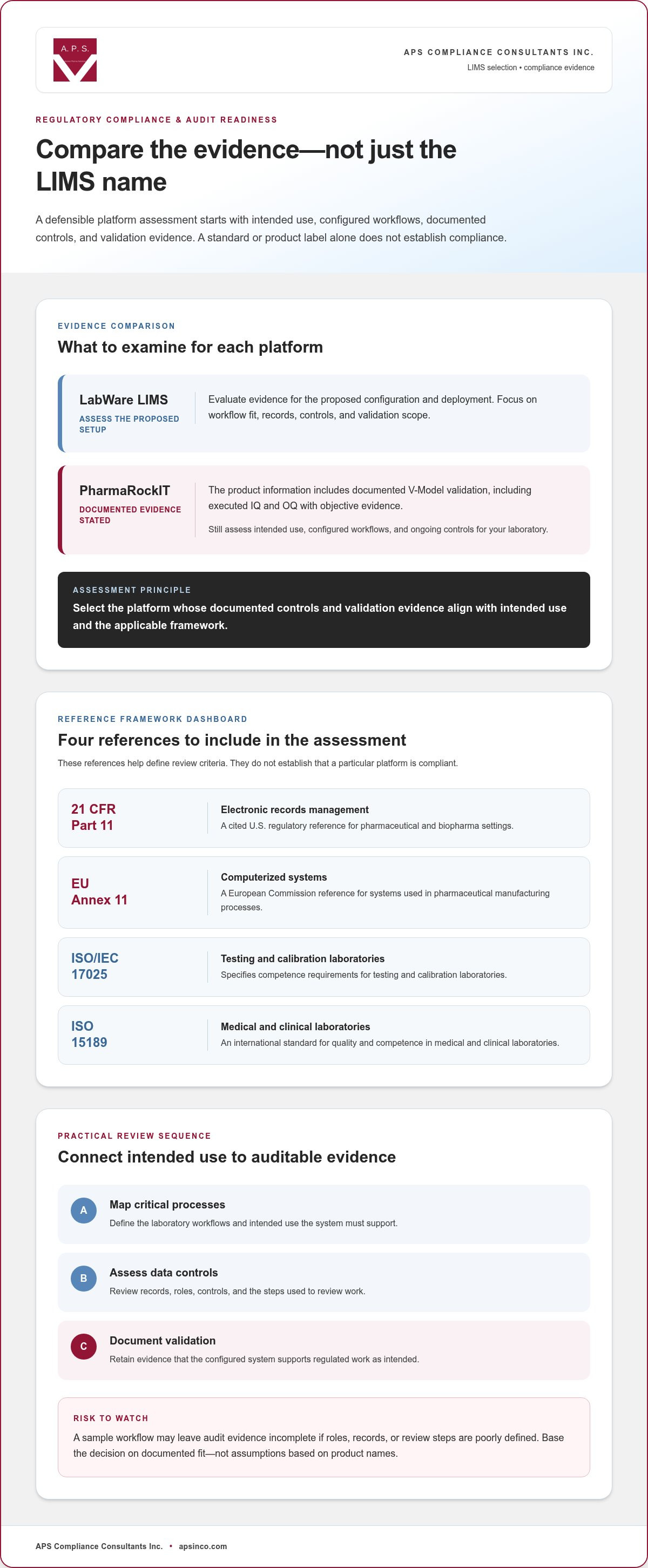
Compliance depends on intended use, controlled workflows, and documented evidence, not a LIMS label alone. In the United States, FDA 21 CFR Part 11 is a cited regulatory reference for electronic records management in pharmaceutical and biopharma settings, according to the U.S. Government. The European Commission cites EU Annex 11 for computerized systems used in pharmaceutical manufacturing processes. These references help define an assessment; they do not establish that a particular platform is compliant. Use LabWare LIMS vs PharmaRockIT as a structured comparison of evidence, configuration, and controls for your intended use.
Laboratory type also matters. ISO/IEC 17025 specifies competence requirements for testing and calibration laboratories, according to the International Organization for Standardization. ISO 15189 is an international standard for quality and competence in medical and clinical laboratories, also according to the International Organization for Standardization. LabWare LIMS is a laboratory information management system; assess its relevant capabilities against your workflows and validation evidence. PharmaRockIT is a LIMS platform with documented V-Model validation, including executed IQ and OQ with objective evidence. Reviewers’ views are most useful when they address comparable workflows, implementation experience, and audit readiness.
For licensing, compare each platform’s model and included scope against your deployment, user needs, support requirements, and validation responsibilities. Assess the operating model alongside the configuration and evidence your laboratory will maintain.
The main risk with either platform is a gap between configured capabilities and intended use. For example, a sample workflow may leave audit evidence incomplete if roles, records, or review steps are poorly defined. Map critical processes, assess data controls, and document validation before relying on the system for regulated work. Base the LabWare LIMS vs PharmaRockIT decision on documented fit, not assumptions based on product names.
Choose the platform whose documented controls and validation evidence align with your laboratory’s intended use and applicable framework.
Instrument integration and result entry
An instrument connection should bring results into laboratory information management workflows with context intact. For LabWare LIMS or PharmaRockIT, map each instrument, result type, and review step before comparing integration fit. A chromatograph, for example, may produce results that need sample identifiers, method details, and analyst review. The system must preserve a traceable relationship between the source output and the reported result.
Integration options include instrument interfaces, HL7, ASTM, ERP systems, SDMS, and ELN platforms. These connections serve different purposes. An instrument interface can transfer analytical results; an ERP connection can align laboratory records with business processes. An SDMS manages scientific files, while an ELN records experimental work. Treat each proposed connection as a defined workflow, not simply a feature name. Confirm the data exchanged, direction of transfer, error handling, and ownership of review.
For LabWare instrument integrations, assess the intended configuration rather than assuming every instrument connects the same way. Compare the instrument’s output format with the interface approach, then test representative records. Check sample identifiers, units, significant figures, timestamps, and rejected-result handling. A mismatched sample identifier, for example, could attach a valid measurement to the wrong record. Document expected results and test exceptions as well as routine transfers.
LIMS: Determine how results enter records and move through review.
ELN: Map how experimental observations link to samples and analytical results.
SDMS: Define how source files relate to result records and reporting.
ELN integration add-ons can extend workflows, but each connection adds configuration and validation work. Define which system owns each record, how users correct errors, and how changes remain traceable. Then test end-to-end automation with representative samples before deployment. For 21 CFR Part 11 environments, include applicable electronic record controls in the validation plan. To align instrument, ELN, and result-entry workflows, discuss your integration requirements.
In the United States, HIPAA governs the handling of protected health information, including patient test results. If an integration carries such results, include that requirement in the workflow review alongside decisions about record ownership, error correction, and traceability. Check how the planned transfer and review process handles this information, and confirm that the resulting workflow meets the laboratory’s applicable requirements.
Included support and services
Support affects whether a laboratory information management system remains dependable after deployment. Compare LabWare LIMS and PharmaRockIT by identifying what assistance covers during configuration, user onboarding, issue resolution, and software changes. Separate routine operational guidance from work that changes a validated process. A user question about a report, for example, differs from a change to sample approval rules. Record the responsible team and escalation route for each case.
For pharmaceutical, biotechnology, and medical-device organizations, workflow fit depends on the laboratory’s purpose. Map activities such as sample receipt, testing, result review, and release reporting, then assess each platform against those steps. Evaluate the systems for the specific operations in scope rather than assuming they support every laboratory type or process. This helps teams determine whether support expertise matches their actual workflows.
Use a short service review to compare the practical support model:
Onboarding: Identify who configures roles, templates, and the user interface.
Training: Define how analysts, reviewers, and administrators learn their assigned tasks.
Issue handling: Document how users report errors and receive status updates.
Change control: Determine how software updates or configuration changes are assessed and recorded.
These criteria connect support to data integrity. If a reviewer cannot resolve an electronic record issue, sample workflows may stall; if a configuration change lacks assessment, validation evidence may no longer reflect operations. Ask each project team to walk through a realistic case, such as correcting a transcription error or revising an approval sequence. Note the required action, documentation, and accountable role.
Then compare service boundaries. Distinguish platform support from laboratory process ownership, local interface maintenance, and validation responsibilities. A written responsibility matrix can show which organization handles each task and what evidence remains available for audits. The best fit is the system and support arrangement that enables your team to maintain controlled workflows, resolve operational issues, and keep procedures aligned with configured software.
Inventory, dashboards, analytics, and reporting
Inventory controls connect laboratory testing with material availability and traceability. In the LabWare LIMS vs PharmaRockIT comparison, map how each system records reagents, standards, samples, and their status. For example, follow a reference standard from receipt through testing and result review. Identify which records need lot details, expiry information, or links to a vendor. Then assess how each platform supports those steps in your configured workflows.
Dashboards should help analysts and managers act on current operational information. Define the decisions each dashboard must support, such as identifying pending result reviews or tracking sample throughput. During a demonstration, use realistic roles and records. Check whether users can distinguish actionable exceptions from routine activity, and whether displayed information matches the underlying records.
Inventory: Trace a reagent or standard from receipt to use and disposition.
Dashboards: Test views for analysts, supervisors, and quality reviewers.
Analytics: Examine how users filter results by method, status, or date range.
Reporting: Confirm that reports present required fields and source records clearly.
Analytics are useful only when definitions remain consistent. Agree on terms such as completed testing, overdue review, and invalid result before comparing reports. A clinical laboratory and a manufacturing quality-control laboratory may need different measures. Test whether each platform can present relevant information without obscuring exceptions or weakening traceability.
Reporting affects audit preparation and daily decisions. Select a representative report, such as a sample history or testing summary, then trace each field to its source record. Check filters, output formats, and user access against the intended workflow. Assess flexibility through real configuration scenarios, not feature labels. In the LabWare LIMS vs PharmaRockIT assessment, a seamless view matters only when users can interpret it and verify its data lineage.
Build a shared comparison script for both platforms: use the same inventory item, dashboard question, and report request. Record where each task requires configuration or manual handling. Discuss your laboratory reporting and inventory workflows to clarify the controls your system needs to support.
Market context can inform planning without replacing workflow evidence: the life sciences LIMS segment was reported to be growing at approximately 12-14% per year. Treat that trend as background when prioritizing inventory, dashboard, analytics, and reporting needs, while grounding platform decisions in the laboratory’s own controls and data.
APS Compliance Consultants Inc.: Computer System Validation (CSV)
APS Compliance Consultants Inc. helps pharmaceutical, biotechnology, and medical-device teams plan and document Computer System Validation (CSV) for systems used in regulated operations. Turn to APS when selecting or configuring a LIMS, changing workflows, or preparing objective evidence for review. A risk-based approach connects intended use, system functions, potential data integrity risks, and verification activities.
For PharmaRockIT LIMS, CSV helps your team maintain evidence that configured processes perform as intended. APS also provides Equipment Qualification (IQ/OQ/PQ) when laboratory equipment requires documented qualification alongside system controls. Define system boundaries, user roles, critical workflows, and acceptance criteria early, then align testing and records with those decisions. This keeps validation connected to laboratory operations instead of treating documentation as a separate task.
To discuss Computer System Validation for your laboratory systems, contact APS Compliance Consultants Inc.
Turn your system choice into a controlled next step
The LabWare LIMS vs PharmaRockIT decision is a starting point, not the end of system planning. Translate your preferred option into a defined implementation path: assign process owners, set validation responsibilities, and document how configuration changes will be assessed. This connects software decisions with your laboratory’s quality system and daily operations.
APS Compliance Consultants Inc. provides Computer System Validation (CSV) to support documented evidence that computerized systems perform as intended. Its offerings also include PharmaRockIT LIMS and Alleye CMMS Software, supporting distinct laboratory information and equipment maintenance needs. Consider which capability addresses your operational gap, then define how it fits your validated processes and data controls.
If your team is ready to clarify validation scope or discuss a suitable system pathway, contact APS Compliance Consultants Inc. A clear next step can help your organization move forward with confidence and keep compliance connected to practical laboratory work.
Frequently Asked Questions
Which industries and laboratory workflows does each platform support?
Pharmaceutical, biotechnology, and medical-device organizations may consider either platform for workflows such as sample receipt, testing, result review, and release reporting. Assess each system’s industry and workflow coverage against your laboratory’s specific requirements.
What is LabWare LIMS and what are its main features?
LabWare LIMS is a laboratory information management system. The comparison focuses on workflow and compliance evidence, instrument connections and result entry, inventory controls, dashboards, analytics, and reporting.
What are the implementation timelines and services for each platform?
PharmaRockIT includes cloud hosting and maintenance, and has documented V-Model validation, including executed IQ and OQ with objective evidence.



Comments