

FDA 21 CFR Part 11: A Practical Guide for GxP Teams
What if your electronic system is working as designed, but your team cannot show that its records are trustworthy? For GxP teams, fda 21 cfr part 11 compliance is not a software checkbox. It depends on identifying which electronic records and signatures support applicable FDA predicate-rule requirements, and whether the systems and procedures that manage them preserve reliable evidence. Uncertainty about scope, audit trails, access controls, or validation can make that difficult to demonstrate during an inspection.
Effective controls must fit the system’s intended use and the regulated process it supports. This guide explains how Part 11 relates to predicate-rule records, how to assess practical controls for electronic records, signatures, user access, and audit trails, and how to maintain validation over the system lifecycle. A risk-based approach, supported by collaboration between quality, operations, and technical teams, helps build an inspection-ready program grounded in actual workflows.
Table of Contents
What FDA 21 CFR Part 11 compliance means for GxP electronic records
FDA 21 CFR Part 11 sets criteria for electronic records and electronic signatures to be considered trustworthy, reliable, and equivalent to paper records and handwritten signatures within the regulation’s applicable scope. For GxP teams, fda 21 cfr part 11 compliance involves more than selecting software with compliance claims. Identify the regulated records a system handles, how users create or change them, and how procedures preserve their integrity.
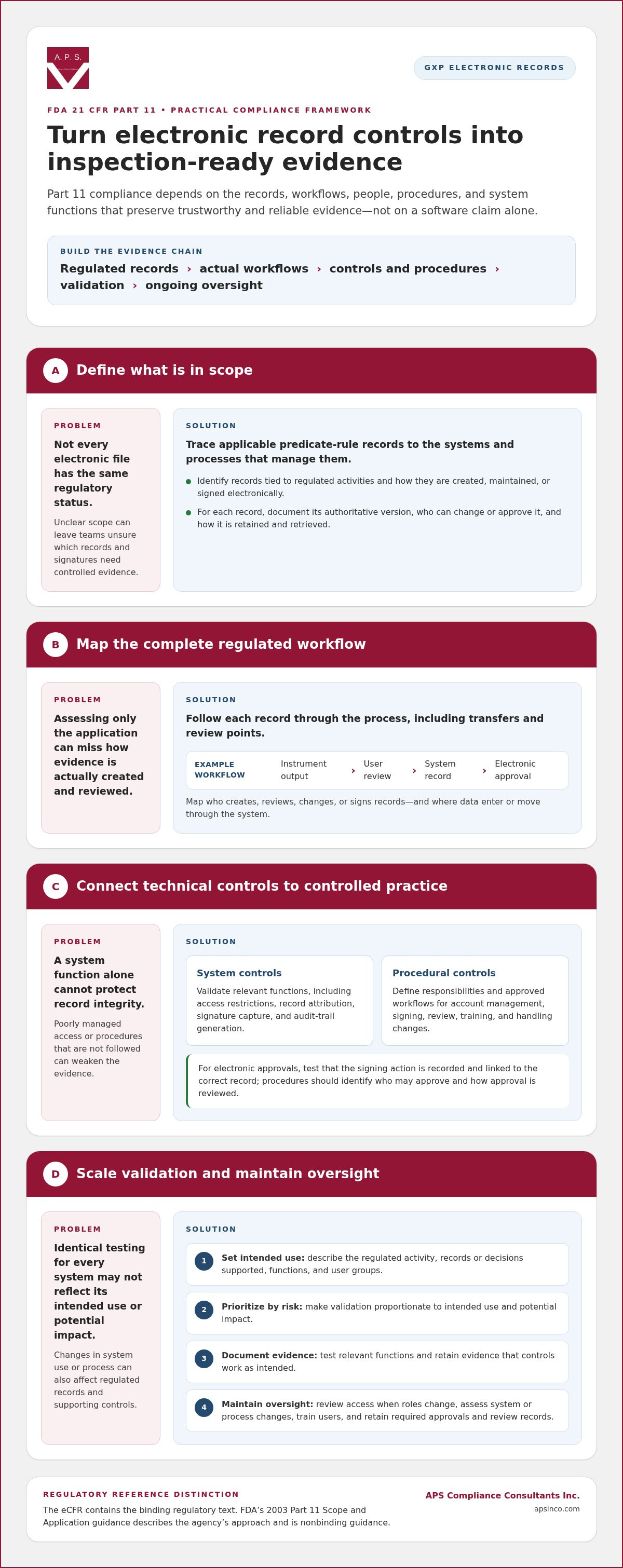
Assess the complete process, not just the application. A laboratory result, for example, may depend on instrument output, user review, a system-generated record, and an electronic approval. Map each step, including data transfers and review points, so controls cover the actual workflow rather than only the software’s individual functions.
Which electronic records may fall within Part 11 scope?
Applicability depends on whether a record is required by an applicable FDA predicate rule and how your organization creates, maintains, or signs it electronically. Not every electronic file has the same regulatory status. Identify records tied to regulated activities, then document the system and process used to manage them. For each record, note where the authoritative version resides, who can change or approve it, and how it is retained and retrieved.
The FDA’s 2003 Part 11, Electronic Records; Electronic Signatures: Scope and Application guidance describes the agency’s approach and is nonbinding guidance, not the regulation itself. The eCFR contains the binding regulatory text. For additional historical context, see the Title 21 CFR Part 11 Wikipedia article.
Why compliance is an ongoing operating responsibility
Technical functions alone cannot protect record integrity if access is poorly managed or procedures are not followed. Assign responsibilities for account management, record review, signature use, and system changes. Train users on approved workflows, and retain evidence that controls work as intended. Practical checks include reviewing user access when roles change and confirming that required approvals are recorded with the relevant record.
When system use or processes change, assess the effect on regulated records and supporting controls. This ongoing oversight helps your team sustain reliable operations and explain how records remain accurate, attributable, and available during an inspection.
How Part 11 connects electronic records, signatures, and system controls
Part 11 controls work together, but they are not interchangeable. A regulated workflow may create a record, restrict who can change or approve it, capture an electronic signature, and preserve activity for review. Your procedures define how people use those functions; validation provides documented evidence that the system performs as intended for that use. The FDA’s FDA Guidance on Part 11 Scope and Application provides the agency’s guidance on applying these controls.
Electronic signatures and attributable records
A signature should be attributable to the person who performed the signing action and remain associated with the relevant record. Define approved signing workflows, user responsibilities, and training in procedures. Then test the system’s signature functions in the context of those workflows. For example, confirm that the system records the intended signing action and links it to the correct record. The function’s presence alone does not show that staff use it consistently or that the resulting record supports review.
Audit trails, access, and record review
Where applicable, audit trails help reconstruct relevant actions, such as creating or changing a record. Access controls help limit system functions to authorized users according to their responsibilities. Define how access is granted, changed, and removed, and establish review practices based on intended use and risk. Reviewers need to know which records or events require attention, how to document the review, and how to escalate an issue.
System controls: Functions such as access restrictions, record attribution, signature capture, and audit-trail generation. Validate that relevant functions operate as intended.
Procedural controls: Approved workflows for account management, signing, review, training, and handling changes. Define responsibilities and maintain the associated records.
For example, a laboratory procedure may require an authorized reviewer to approve a result electronically. The system must support the defined action, and the procedure must explain who may approve and how the approval is reviewed. This connection between technical capability and controlled practice is central to fda 21 cfr part 11 compliance. APS provides scope-specific computer system validation and data integrity support to align validation evidence with actual workflows. Learn about APS validation support.
How to build a risk-based Part 11 compliance approach
Make validation proportionate to intended use and potential impact, rather than applying identical testing to every system. A documented sequence helps your team connect regulated records to controls, testing, and ongoing oversight. Consult the Official 21 CFR Part 11 Regulation alongside applicable predicate rules when defining project scope.
Set scope and prioritize risk
Define intended use. Describe the regulated activity the system supports and the decisions or records it contributes to. Include the functions and user groups involved.
Identify records and workflows. Map applicable electronic records, interfaces, user groups, and steps for creating, reviewing, changing, or signing records. Note where data enter the system and where approved records are retained.
Assess risk. Consider how system failures or record changes could affect data integrity, product quality, and GxP decisions. Use that assessment to prioritize controls and testing.
Implement controls. Specify relevant access, record, signature, and audit-trail functions, along with the procedures governing their use. Assign owners for routine review and follow-up.
This scope-specific process is the foundation of fda 21 cfr part 11 compliance. It also helps quality and technical teams focus computer system validation services on functions that matter to intended use, rather than treating every feature as equally critical.
Document testing and sustain the validated state
Plan and trace the work. Use a Validation Plan and Risk Assessment to define scope, responsibilities, and testing. A Traceability Matrix connects requirements to test evidence.
Execute and resolve testing. Record IQ/OQ documentation, results, deviations, and approvals so reviewers can follow what was tested and how discrepancies were assessed and addressed.
Maintain oversight. Manage changes, periodic review, and routine system use through established site procedures. Reassess impact when intended use, configuration, or connected workflows change.
A documented GAMP 5 approach helps organize evidence around system risk and project scope. APS works collaboratively with client teams to develop validation deliverables that fit the regulated process. Review your Part 11 validation needs with APS.
How APS supports FDA 21 CFR Part 11 compliance work
Turning regulatory expectations into evidence takes coordination across quality, laboratory, and technical teams. APS works with your employees to define a scope-specific computer system validation and data integrity approach, grounded in the system’s intended use, regulated workflows, and risk. This gives your team a documented path to address gaps without treating every system or function as identical.
What APS brings to a validation project
APS applies GAMP 5 expertise to validation work for regulated systems, including laboratory applications. Project evidence can include a Validation Plan, Risk Assessment, IQ/OQ documentation, and Traceability Matrix. Together, these records establish the planned scope, risk-based rationale, executed testing, and links between requirements and results. They support review by your internal quality team while keeping approvals and site procedures within your organization’s established governance.
APS’s GAMP 5 Validation Package includes more than 150 automated test scripts. Scripts are applied in the context of the defined project scope, not as a substitute for assessing intended use or risk. Using proven templates and methods, APS helps labs accelerate compliance timelines up to 40% faster, while maintaining the evidence needed for the work.
Discuss a scope-specific path forward
Bring your system context into the planning conversation: what the system does, which GxP processes and records it supports, how users interact with it, and where your current validation priorities lie. APS collaborates with internal quality, laboratory, and operational staff to shape deliverables around those details. The validation scope is defined by intended use and risk, with relevant controls and evidence tailored to the system and process.
A practical plan for fda 21 cfr part 11 compliance should fit both your system and the way your organization controls it over time. Discuss your Part 11 validation needs with APS.
Turn your next compliance priority into a clear plan
Choose one upcoming system decision as the starting point: a planned change, a new workflow, or a review of a system already in use. Identify who owns the decision, which teams need to contribute, and what information quality leadership needs to set priorities. This turns fda 21 cfr part 11 compliance into a practical governance conversation connected to operational planning.
Next, establish a clear path for decisions and follow-through. Agree on who will assess the impact, how open questions will be escalated, and when progress will be reviewed. Keep the plan responsive to changes in system use and business needs while preserving quality oversight. A defined starting point helps your team maintain attention on its compliance priorities.
APS works alongside your employees to shape validation activities around your organization’s needs and priorities. Plan your next Part 11 validation step with APS and move forward with a focused, collaborative approach.
Frequently Asked Questions
Does FDA 21 CFR Part 11 apply to every electronic record?
No. Start by distinguishing the official record supporting a regulated activity from a temporary working file or a duplicate kept for convenience. These record types may need different handling. Document where the authoritative version resides and how it moves through its lifecycle, including any submission or archival step. This classification gives process owners a consistent basis for assessing record status and retention needs.
Does compliant software alone make an organization Part 11 compliant?
No. A supplier’s compliance claim describes its product, not your organization’s implementation. Before deployment, compare the planned workflow with the system configuration, interfaces, and assigned roles, and record differences from standard product documentation. Locally configured review steps or data transfers, for example, may affect how a process operates. Treat vendor materials as inputs to your assessment, not as a substitute for it.
Is FDA 21 CFR Part 11 a software certification?
No. Part 11 is a regulatory framework, not a general certificate attached to a software product. Assess what system version, configuration, and functions the available evidence addresses, and whether those align with your intended use. Evidence about one deployment should not automatically be assumed to cover another. Retain the basis for your conclusion with the system’s controlled records so reviewers can understand the context.
What validation documents can support a Part 11 assessment?
Useful records make the project’s validation story easier to reconstruct later. Maintain controlled document versions, approval status, and clear links between test results and the system configuration tested. Record how deviations were assessed and resolved, and make evidence retrievable by system and project. The specific document set should follow your site quality processes and reflect the scope and risk assessed for the system.
Does Part 11 replace an organization’s existing quality procedures?
No. Existing quality procedures remain the mechanism for assigning ownership and controlling approved practices. Integrate Part 11-related work into that governance rather than maintaining a disconnected parallel process. For example, route proposed changes to electronic record workflows through the established change process so impact assessment and required approvals can be considered alongside operational planning.



Comments