

Pharma Asset Management Software: A 2026 Guide to Compliance and Efficiency
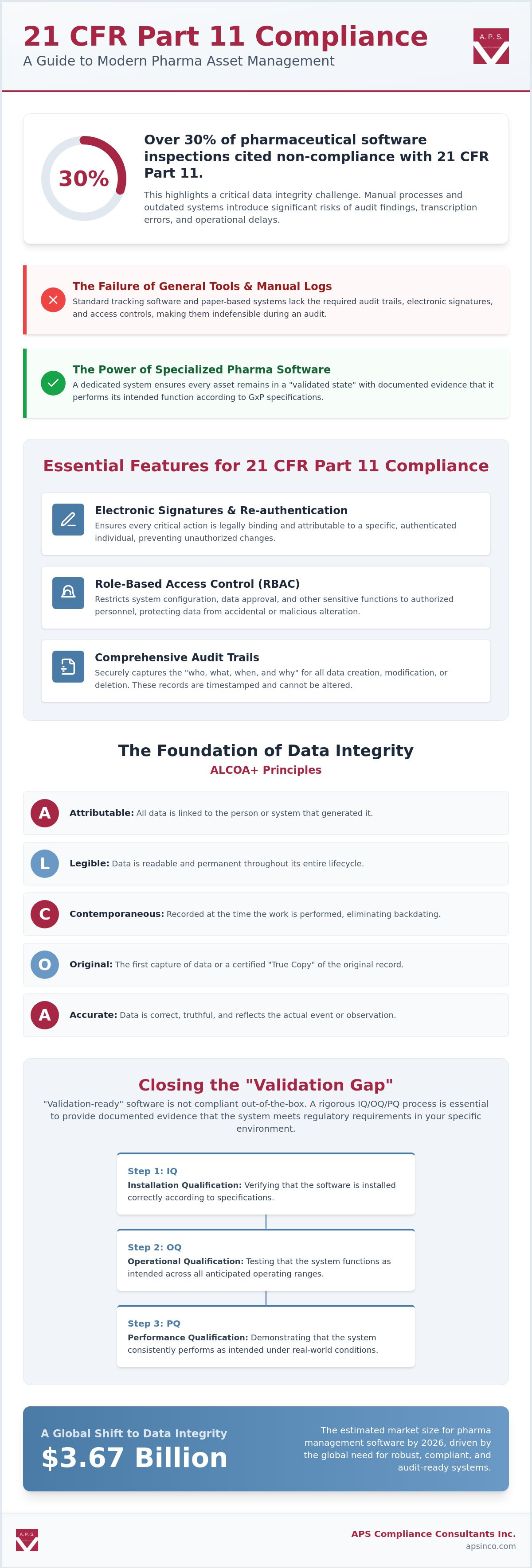
Over 30% of pharmaceutical software inspections in 2025 cited non-compliance with 21 CFR Part 11. This statistic reveals a sobering truth: modern pharma asset management software is a data integrity challenge, not just an inventory solution. You're likely all too familiar with the anxiety of manual transcription errors or the mounting costs of validating outdated legacy systems. It's exhausting to manage complex equipment logs when the threat of an audit finding looms over every calibration record.
We believe compliance shouldn't be a burden that slows your innovation. This guide will help you select and implement a solution that ensures 21 CFR Part 11 compliance while streamlining your entire laboratory operation. We'll walk through the transition to Computer Software Assurance (CSA) methodologies, automated maintenance scheduling, and the strategic steps needed to achieve a truly audit-ready environment in 2026.
Table of Contents
What is Pharma Asset Management Software?
Pharma asset management software is a specialized digital ecosystem designed to manage the entire lifecycle of laboratory and production equipment within GxP environments. Unlike standard inventory tools, its primary function is to ensure that every piece of equipment remains in a "validated state." This means the system provides documented evidence that the equipment consistently performs its intended function according to strict regulatory specifications.
In many modern labs, the transition from fragmented paper logs and manual spreadsheets to integrated software isn't just about efficiency; it's a regulatory necessity. Manual systems are prone to transcription errors and lack the real-time visibility required to prevent the use of uncalibrated or out-of-specification equipment. By 2026, the pharmaceutical management software market is estimated to reach $3.67 billion, reflecting a global shift toward systems that prioritize data integrity over simple list-making.
Why General Asset Tracking Fails in Pharma
General-purpose tracking tools often fall short because they lack the rigorous, timestamped, and attributable audit trails demanded by Health Canada and the FDA. In a regulated environment, if an action isn't documented with a secure electronic signature, it effectively didn't happen. General tools cannot link a specific maintenance event or calibration adjustment directly to the batch records or test results produced by that asset. The validated state of an asset is a non-negotiable regulatory requirement where documented evidence provides a high degree of assurance that the equipment will consistently meet its quality attributes.
EAM vs. CMMS in the Pharmaceutical Context
While often used interchangeably, there's a strategic distinction between Computerized Maintenance Management Systems (CMMS) and Enterprise asset management (EAM). A CMMS typically focuses on the "how" of maintenance, managing work orders and scheduling. In contrast, EAM looks at the "what" and "why," overseeing the entire lifecycle from procurement to decommissioning. Effective computerized system lifecycle management integrates both functions into a single strategy. This ensures that maintenance isn't just performed; it's documented and validated as part of a broader compliance framework that empowers your team to focus on core research rather than administrative burdens.
Essential Features for 21 CFR Part 11 and GxP Compliance
Selecting the right pharma asset management software requires looking beyond simple equipment lists; it's about building systemic integrity into your lab's DNA. Compliance isn't a static goal but a continuous state maintained through specific technical safeguards. To meet the rigorous standards of 21 CFR Part 11, your system must enforce re-authentication for every critical maintenance action. This ensures that every signature is legally binding and attributable to a specific individual.
Key technical requirements include:
Comprehensive Audit Trails: Capturing the who, what, when, and why of every record change without the possibility of deletion or modification.
Role-Based Access Control (RBAC): Restricting system configuration and data approval rights to authorized quality personnel.
ALCOA+ Alignment: Ensuring all data remains attributable, legible, contemporaneous, original, and accurate throughout its entire lifecycle.
Data Integrity and ALCOA+ Principles
Modern software automates the contemporaneous recording of calibration data, removing the lag between an event and its documentation. This is critical because manual data entry is the #1 risk factor for pharma asset management software. Human error during transcription often leads to discrepancies that are difficult to defend during an inspection. Ensuring "True Copy" certification for scanned maintenance documents is also essential for maintaining the integrity of original records when moving to a paperless system.
Instrument Connectivity and Automated Data Capture
The industry is rapidly moving toward direct serial data acquisition. By connecting instruments directly to your management platform, you eliminate the "human-in-the-loop" errors that plague equipment qualification and testing. This automated capture ensures that raw data flows directly into the validated system, providing a level of accuracy that manual logs can't match. Transitioning to these automated workflows provides a sense of security that your data is audit-ready at any moment. If you're struggling to modernize these legacy workflows, we can help you identify the right integration path for your specific lab setup.
The Validation Gap: Why Software Alone is Not Enough
Purchasing pharma asset management software is only the first step toward a compliant laboratory. A common pitfall for many organizations is the assumption that "validation-ready" software is compliant right out of the box. It isn't. In the eyes of regulatory bodies like the FDA, a system isn't compliant until you've proven it works as intended within your specific environment and unique workflows. This proof requires a rigorous documented process that typically accounts for 30% of the total project timeline.
While this timeline might seem daunting, it's a necessary investment to protect your data integrity. One way to accelerate this process is by selecting a saas cmms for pharmaceutical industry deployment. By leveraging a cloud-based model, you significantly reduce the burden of infrastructure validation, as the vendor handles the underlying server and database qualifications. This allows your quality team to focus their energy on the application layer and user requirements mandated by 21 CFR Part 11.
Navigating IQ/OQ/PQ Requirements
To bridge the validation gap, you must execute a three-tiered qualification strategy. Installation Qualification (IQ) verifies that the software is set up correctly in your environment. Operational Qualification (OQ) tests that the asset management features, such as alarm triggers and audit trail captures, function according to the vendor's specifications. Finally, Performance Qualification (PQ) provides documented evidence that the system consistently handles your lab's specific workflows under real-world conditions.
How GAMP 5 Category 4 Software Saves Time
Using GAMP 5 risk-based approaches helps you focus testing where it matters most. By choosing Category 4 software—which is configured rather than custom-coded—you can leverage the vendor's base validation data to reduce your internal testing workload. Partnering with gamp 5 validation experts can reduce validation effort by up to 40% through optimized protocols and strategic risk assessments. If you need to accelerate your deployment without compromising safety, consult our validation team today to build a custom roadmap for your lab.
Choosing the Right Asset Management Strategy for Your Lab
Selecting the right pharma asset management software requires a strategic balance between long-term vision and immediate operational needs. We recommend a modular approach over monolithic, "all-in-one" systems that often overwhelm staff. By rolling out specific modules in phases, you reduce change management friction and allow your team to master one functional area before moving to the next. This controlled momentum prevents the systemic shock that often derails large-scale digital transformations.
Operational practicality is another critical factor that decision-makers frequently overlook. Many enterprise systems require a dedicated IT team just to manage updates and complex configurations. For agile labs, choosing a system that laboratory staff can maintain independently ensures that maintenance workflows aren't bottlenecked by IT tickets. Additionally, ensure your provider addresses data sovereignty. Meeting Canadian or European data residency requirements is essential for maintaining global compliance and protecting your intellectual property.
Total Cost of Ownership (TCO) also looks different in 2026. While on-premises capital expenditure offers a sense of control, the ongoing costs of physical hardware and manual validation cycles often exceed the predictable subscription fees of SaaS models. Cloud-based deployments now account for 61.5% of the market share because they empower organizations to scale without massive upfront investments in infrastructure.
The "Lean" Approach to Digital Transformation
Start with what's critical. Implementing a robust CMMS like Alleye allows you to stabilize equipment maintenance and calibration logs first. Once your maintenance foundation is audit-ready, you can scale into more complex integrations like the PharmaRockIT LIMS. This phased path ensures that your digital infrastructure grows alongside your laboratory's maturity, providing a reliable foundation for future expansion.
Checklist for Evaluating Vendors
When vetting potential partners, use this checklist to ensure they understand the gravity of your regulatory environment:
Does the vendor provide pre-validated templates and comprehensive equipment qualification iq oq pq support?
Is the support team bilingual and deeply familiar with local Health Canada and FDA regulations?
Can the system handle the specific data integrity requirements of your unique laboratory workflows?
Finding the right fit doesn't have to be a high-stakes burden. Contact APS to see how Alleye and PharmaRockIT simplify compliance and help you regain focus on your core operations.
Securing Your Laboratory’s Future
Maintaining a validated state for your laboratory equipment is a continuous journey that requires more than just a digital list. The right pharma asset management software acts as a single source of truth. It bridges the gap between operational efficiency and the strict requirements of 21 CFR Part 11. By prioritizing automated audit trails and a risk-based validation approach, you move away from the stress of manual transcription errors and toward a state of constant audit readiness.
You don't have to navigate these complex regulatory waters alone. Our solutions are designed specifically for lab staff rather than just IT departments, ensuring high adoption and practical daily utility. We empower your team to accelerate validation timelines by 40% using our proven GAMP 5 templates while keeping your sensitive information secure with Canadian-hosted data for total regulatory sovereignty. It's time to transform your compliance burden into a strategic advantage for your organization.
Streamline Your Compliance with PharmaRockIT CMMS
Take the next step toward a more resilient, compliant laboratory environment today.
Frequently Asked Questions
Is pharma asset management software mandatory for FDA compliance?
The FDA does not explicitly mandate the use of specialized pharma asset management software, but they do require you to maintain equipment in a validated state. Proving compliance with 21 CFR Part 11 using manual, paper-based systems is increasingly difficult in 2026. Most organizations adopt digital solutions to ensure their audit trails are immutable and attributable, as manual logs are the most common source of data integrity findings during inspections.
What is the difference between CMMS and EAM in a pharmaceutical laboratory?
A CMMS is your daily tactical tool for scheduling calibrations and managing work orders. An EAM provides a broader strategic view, tracking the total cost of ownership and the qualification status of an instrument across its entire lifecycle. For most labs, the goal is a system that bridges both functions. This ensures every maintenance action is performed on time and documented within a compliant, GxP-ready framework.
How long does it typically take to validate a new asset management system?
The validation phase for a new system typically spans three to six months. This timeline is necessary to complete the rigorous documentation required by GxP standards, including IQ, OQ, and PQ protocols. However, organizations can significantly reduce this window by choosing "configuration-only" systems. These allow you to leverage the software vendor's base validation data, focusing your internal efforts on the specific performance qualification of your unique lab workflows.
Can asset management software help with Health Canada data integrity audits?
Yes, pharma asset management software is specifically designed to address the core concerns of Health Canada’s data integrity guidelines. By automating the capture of maintenance events and calibration results, the software ensures that records are contemporaneous and original. This eliminates the "validation gap" often found in manual logs, providing auditors with clear, timestamped evidence that all equipment has been properly maintained and qualified.
Does the software need to be installed on-premises to be 21 CFR Part 11 compliant?
Cloud-based systems are perfectly suitable for 21 CFR Part 11 compliance provided the vendor follows a validated software development lifecycle. You don't need on-premises servers to satisfy regulatory inspectors. Modern SaaS platforms often offer superior data security and redundancy. They also simplify the validation process by providing a pre-qualified infrastructure, allowing your team to focus exclusively on application-level compliance and your specific user requirements.


Comments