

Validation Master Plan Development: A Strategic How-To Guide for 2026 GxP Compliance
- 13 minutes ago
- 8 min read
What if your most critical compliance document is actually the primary bottleneck holding your laboratory back from 2026 GxP standards? For many quality leaders, validation master plan development often results in "shelfware" that looks impressive during a review but fails to reflect actual operations. It's frustrating to see your team over-validating low-risk systems while struggling to maintain consistency between the lab, IT, and production. You aren't alone in feeling that the traditional, documentation-heavy approach is no longer sustainable under the 2026 FDA Quality Management System Regulation (QMSR) and the latest Computer Software Assurance (CSA) guidance.
We believe your compliance framework should empower your team, not hinder them. This guide provides a methodical roadmap to develop a high-impact plan that streamlines regulatory audits and reduces validation costs by up to 40%. By focusing on critical thinking and risk-based methodologies, you'll ensure full 21 CFR Part 11 compliance while accelerating your time-to-market for new software and equipment. We will walk through establishing clear roles, integrating modular systems like PharmaRockIT LIMS, and building an audit-ready framework that scales alongside your business growth.
Table of Contents
What is a Validation Master Plan and Why Is It the Foundation of GxP Compliance?
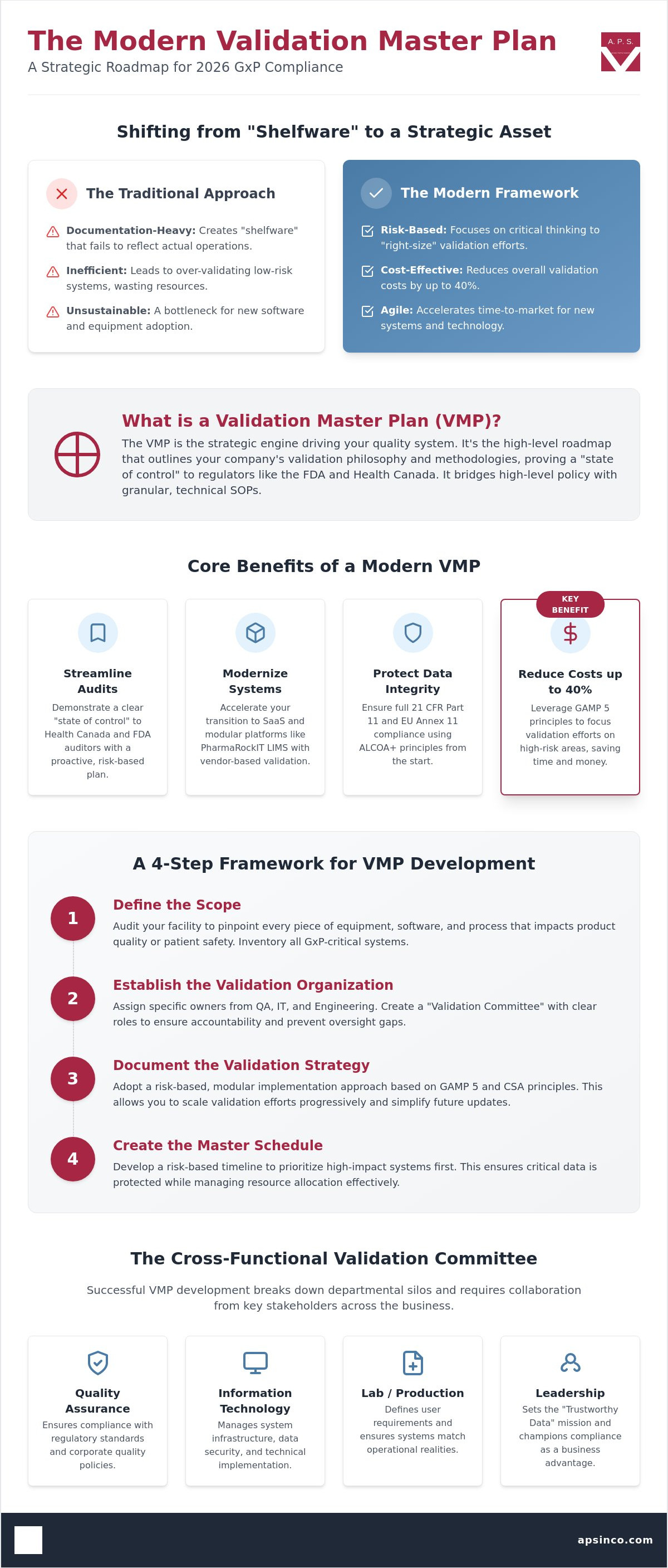
A Validation Master Plan (VMP) isn't just a document; it's the strategic engine driving your entire quality system. At its core, What is a Validation Master Plan is defined as the high-level roadmap that outlines your company's validation philosophy, specific methodologies, and organizational commitments. For firms undergoing validation master plan development, the goal is to create a cohesive narrative that proves a "state of control" to regulators. Whether you're facing a Health Canada inspection or an FDA audit, the VMP is the first document requested because it demonstrates that your validation activities aren't reactive, but planned and risk-based.
While the FDA often focuses on the scientific justification of the lifecycle approach, Health Canada inspectors frequently look for explicit links between the VMP and site-specific operational risks. It's vital to distinguish between a Site VMP, which governs the entire facility's infrastructure, and a Project VMP, which focuses on specific rollouts like a LIMS or CMMS implementation. This document serves as the regulatory roadmap ensuring all equipment qualification iq oq pq activities align perfectly with your site-wide quality goals.
The Regulatory Necessity: FDA 21 CFR Part 11 and EU Annex 11
The VMP acts as the essential bridge between high-level Corporate Quality Manuals and the granular, technical Standard Operating Procedures (SOPs). It translates broad quality policies into actionable data integrity expectations. By centering the plan on ALCOA+ principles, you ensure that every computerized system complies with FDA 21 CFR Part 11 and EU Annex 11 from the start. It's about building accuracy and reliability into the process rather than trying to inspect quality in at the end.
Key Stakeholders: Who Owns the VMP?
Successful validation master plan development requires a cross-functional "Validation Committee" that breaks down departmental silos. This group typically includes representatives from Quality Assurance, IT, and Lab Operations to ensure that technical requirements match operational realities. Leadership plays a critical role here too. The President or Founder, such as Kia Kahhali, sets the tone for a "Trustworthy Data" mission, ensuring that compliance is viewed as a business-centric advantage rather than a bureaucratic hurdle.
A Step-by-Step Framework for Effective Validation Master Plan Development
Effective validation master plan development isn't a linear checklist; it's a strategic architecture that supports the foundation of GxP Compliance. By treating the VMP as a living framework rather than a static document, you transform compliance from a bureaucratic burden into a competitive advantage. This structured approach ensures every system, from the smallest lab scale to complex enterprise software, remains in a validated state throughout its lifecycle.
Step 1: Define the Scope — Audit your facility to pinpoint every piece of equipment, software, and process that impacts product quality or patient safety.
Step 2: Establish the Validation Organization — Assign specific owners from QA, IT, and Engineering. Clear mapping of roles ensures accountability and prevents gaps in oversight.
Step 3: Document the Validation Strategy — Adopt a modular implementation approach. This allows you to scale validation efforts progressively, reducing upfront CAPEX and simplifying future updates.
Step 4: Create the Master Schedule — Use a risk-based timeline to prioritize high-impact systems first. This ensures your most critical data remains protected while managing resource allocation effectively.
Defining the Validation Lifecycle for 2026
Modern compliance requires moving beyond the rigid V-Model. By integrating Computer Software Assurance (CSA) principles into your VMP, you focus on critical thinking rather than excessive documentation. It's about ensuring every system has a clear, traceable path from the initial User Requirements Specification (URS) to the final Traceability Matrix. This agile lifecycle approach keeps your operations nimble while satisfying the rigorous expectations of 2026 GxP standards. If you're struggling to map out your site-wide strategy, connecting with a specialist can help clarify your next steps.
Templates and Accelerators: Reducing Effort by 40%
You don't need to re-invent the wheel for every new equipment purchase. Utilizing proven, pre-validated templates for analytical instrument qualification services can reduce your team's administrative effort by up to 40%. Standardized documentation ensures consistency between departments and accelerates your time-to-market. By leveraging these accelerators, your validation master plan development becomes a streamlined engine for growth rather than a drain on internal resources.
Integrating GAMP 5 Risk Management into Your VMP Strategy
Risk management isn't a hurdle; it's a shield for your operations. In the context of validation master plan development, integrating the latest ISPE GAMP 5 guidelines allows you to "right-size" your effort based on system complexity. You shouldn't treat a simple temperature logger the same way you treat an enterprise-wide LIMS. By focusing resources on patient safety and data integrity, you satisfy both Health Canada and FDA expectations while effectively countering the common objection that "validation takes too long." Scientific scoping allows you to move faster without compromising regulatory safety.
A Data Integrity Risk Assessment (DIRA) must serve as the heartbeat of your VMP. It identifies exactly where data is vulnerable and dictates how to apply appropriate controls across the lifecycle. This is how we approach computer system validation services; we ensure that complex GAMP 5 Category 4 and 5 systems receive rigorous scrutiny while simpler systems move through the pipeline with efficiency. It's about precision, not just volume of documentation.
Categorizing Systems: From Off-the-Shelf to Bespoke
Your VMP should clearly define GAMP categories for your entire inventory to prevent over-validating low-risk tools. Category 3 systems (non-configured) require minimal testing, whereas Category 4 systems like PharmaRockIT LIMS benefit from modular designs. Because PharmaRockIT is pre-validated, it can reduce the client's validation effort from 35% down to 15%. This modularity is a core tenet of modern validation master plan development that minimizes upfront CAPEX and accelerates your digital transformation.
ALCOA+ and the DTALE Engine
Compliance in 2026 demands that data remains Attributable and Legible at every stage. Your VMP must dictate how automated audit trails are managed to meet ALCOA+ principles. Our proprietary DTALE engine supports this by providing hierarchical event dependency tracking. This makes complex investigations straightforward and ensures your data governance meets the highest global standards. If you're ready to modernize your risk strategy, schedule a strategic consultation with our compliance experts.
Modernizing Your VMP for SaaS, LIMS, and Modular Digital Ecosystems
Modernizing your validation master plan development strategy requires a shift from viewing software as a static installation to seeing it as a dynamic, scalable service. Transitioning from traditional on-premises systems to cloud-native SaaS models significantly accelerates your deployment timeline, often reducing installation setup effort from 25% down to just 5%. This efficiency is achieved by updating your VMP to reflect "Vendor Base Validation." By leveraging the rigorous groundwork and pre-validation activities already completed by APS Compliance Consultants Inc., you eliminate redundant testing and focus your internal resources on site-specific user requirements.
Data sovereignty is another non-negotiable factor for 2026 GxP compliance. Your modernized plan must specify the use of Canadian-hosted infrastructure, such as AWS Montreal or Calgary regions, to satisfy local regulatory expectations and ensure data integrity. This strategic framework serves as the essential foundation for a "Paperless Laboratory." By integrating modular tools like PharmaRockIT EWB and LINK, you create a seamless digital thread that connects every experiment and data point directly to your master quality goals.
The Modular Advantage: Phased Rollouts
Adopting a modular approach allows you to validate independent systems like LIMS, CMMS, or electronic workbooks in manageable phases. This strategy spreads out your CAPEX over time rather than requiring a massive upfront investment. It also reduces the "cognitive shift" for your staff. By introducing a unified digital ecosystem gradually, your team can adapt to new workflows without the productivity dip often associated with monolithic system overhauls.
Audit Readiness and the 'Living' VMP
Establishing periodic review cycles ensures your VMP remains a "living" document that is audit-ready at a moment's notice. It shouldn't just sit on a shelf; it should actively reflect your current operational state. Our Alleye CMMS software supports this by ensuring that all equipment maintenance and calibration records are always linked back to the VMP requirements. This creates a closed-loop system of accountability that impresses inspectors and simplifies internal oversight. Ready to evolve your strategy? Contact APS Compliance Consultants Inc. to build a custom, GAMP-5 compliant Validation Master Plan for your facility.
Securing Your Laboratory's Future Through Strategic Compliance
A robust VMP is no longer just a static requirement for an auditor's checklist; it's the strategic blueprint for your laboratory's digital evolution. By embracing a lifecycle approach that prioritizes critical thinking over excessive paperwork, you ensure your operations remain agile and audit-ready at all times. We've explored how transitioning to modular, SaaS-native environments can drastically reduce validation timelines while maintaining the highest data integrity standards. Successful validation master plan development transforms compliance from a source of organizational friction into a scalable foundation for sustainable growth.
As Health Canada and FDA specialists, we help you navigate these complex regulatory shifts with confidence. Our GAMP 5 validation experts at APS Compliance Consultants Inc. specialize in accelerating 21 CFR Part 11 compliance, allowing your team to focus on core innovation rather than administrative burdens. Accelerate your compliance project by 40%—Request a VMP Consultation with APS Compliance Consultants Inc. We're ready to help you build a resilient, future-proof quality system that empowers your business to thrive in 2026 and beyond. Your journey toward a streamlined, paperless laboratory starts with a single strategic step.
Frequently Asked Questions
What is the difference between a Validation Master Plan and a Validation Plan?
A Validation Master Plan serves as the high-level strategic umbrella that defines the overall validation philosophy for an entire site or organization. Conversely, a Validation Plan is a system-specific document that details the precise testing requirements for a single piece of equipment or software. While the VMP sets the standards and organizational roles, individual Validation Plans execute the granular technical activities required for a specific rollout.
How often should a Validation Master Plan be updated?
You should review your VMP at least annually or whenever significant changes occur in your facility, equipment, or regulatory environment. Maintaining a "living" document ensures that your operations remain in a state of control and are always ready for an unannounced inspection. Continuous validation master plan development prevents the document from becoming obsolete "shelfware" that fails to reflect your actual GxP processes.
Does Health Canada require a specific format for a VMP?
Health Canada doesn't mandate a rigid template, but inspectors expect to see specific core elements such as scope, organizational responsibility, and a master schedule. The focus is on clarity and logical flow rather than a specific aesthetic. Following GAMP 5 Second Edition principles is the most reliable way to ensure your format meets both Health Canada and FDA expectations for a risk-based approach.
Can a Validation Master Plan include both equipment and software?
Yes, a comprehensive VMP must integrate both physical equipment and computerized systems to demonstrate a complete "state of control." Modern validation master plan development often categorizes these items into functional groups, such as analytical instruments, production machinery, and software platforms. This integrated approach ensures that data integrity is maintained as information travels from a physical sensor through to a digital report.
How do I include SaaS-based LIMS or CMMS in my VMP?
Including SaaS-based systems involves documenting how you leverage "Vendor Base Validation" to streamline your internal testing efforts. Your VMP should specify that you've audited the vendor's quality system and that the software is hosted on GxP-compliant infrastructure like AWS Montreal. This allows you to reduce installation effort from 25% to 5% while ensuring full compliance with 21 CFR Part 11 and data sovereignty rules.


Comments