

Computer System Validation Consultant: A Strategic Guide to GxP Compliance in 2026
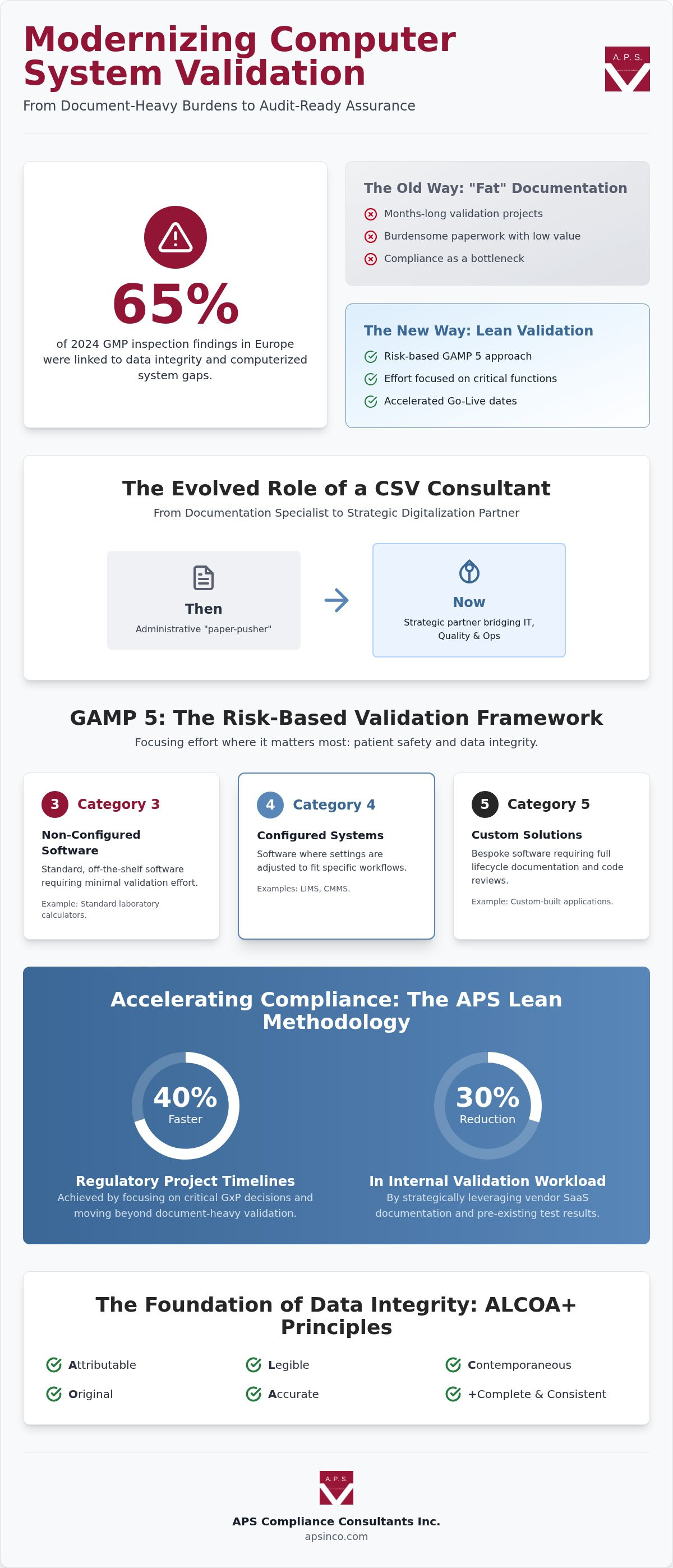
Did you know that in 2024, over 65% of GMP inspection findings in Europe were linked to data integrity and computerized system gaps? It's a sobering statistic that highlights the growing complexity of the regulatory environment. You've likely felt the frustration of validation projects that drag on for months, burying your team under "fat" documentation that offers little operational value. It's often difficult to find a computer system validation consultant who truly understands the balance between complex IT infrastructure and high-precision laboratory operations.
At APS Compliance Consultants Inc., we believe compliance shouldn't be a bottleneck. We've refined a GAMP 5 risk-based approach that can accelerate your regulatory projects by up to 40% while maintaining ironclad 21 CFR Part 11 compliance. This strategic guide explores how to leverage lean validation strategies and the updated February 2026 CSA guidance to reach your Go-Live dates faster. We'll show you how to transition from document-heavy burdens to an audit-ready state that focuses effort where it matters most. It's about ensuring your systems remain compliant throughout their entire lifecycle.
Table of Contents
The Strategic Role of a Computer System Validation Consultant in 2026
In 2026, the definition of a computer system validation consultant has evolved significantly. They're no longer just administrative "paper-pushers" tasked with filling out generic templates. Instead, they act as strategic digitalization partners who bridge the technical gap between IT, Quality, and daily Operations. This role is critical. Modern laboratory environments rely heavily on cloud-first architectures where 21 CFR Part 11 and EU Annex 11 compliance must be continuous rather than a one-time event. By integrating regulatory strategy into the early stages of system selection, a specialized consultant prevents "validation drag" and accelerates product time-to-market.
Core Responsibilities: From URS to Validation Summary Reports
An expert consultant ensures that User Requirements Specifications (URS) reflect actual lab workflows rather than generic software features. They manage the Traceability Matrix with precision, ensuring every requirement is verified through rigorous testing. This provides essential independent oversight for internal IT teams. At APS, we focus on delivering "lean" documentation that lab staff can actually maintain. This practical approach ensures that your Validation Summary Reports are robust, accurate, and ready for any regulatory inspection.
Navigating Global Regulatory Standards
Interpreting the nuances of FDA and Health Canada expectations for electronic records requires deep industry expertise. A computer system validation consultant ensures your data integrity adheres to ALCOA+ principles, making records Attributable, Legible, Contemporaneous, Original, and Accurate. Using the GAMP 5 methodology, APS helps you move beyond traditional, document-heavy validation. We focus effort where risk is highest, which allows us to accelerate your regulatory projects by up to 40%. This transition to Computer Software Assurance (CSA) principles ensures your systems remain in a validated state without the friction of excessive, unnecessary paperwork.
Implementing GAMP 5: The Risk-Based Validation Framework
GAMP 5 remains the industry gold standard because it prioritizes critical thinking over rote documentation. A skilled computer system validation consultant uses this framework to implement "Lean Compliance." This involves focusing your testing resources on functions that directly impact patient safety and data integrity. It's a shift from validating every button to validating the logic that drives GxP decisions. By integrating equipment qualification iq oq pq into the broader system lifecycle, you ensure that both the hardware and software are synchronized in a compliant state.
System Categorization and Validation Effort
Categorization is the primary driver for optimizing your validation budget. A computer system validation consultant typically classifies systems into three main groups:
Category 3: Non-configured software, such as standard laboratory calculators.
Category 4: Configured systems, like LIMS or CMMS, where we adjust existing settings to fit your workflow.
Category 5: Custom-built solutions that require full lifecycle documentation and code reviews.
We frequently help clients leverage vendor SaaS documentation and pre-existing test results to reduce internal workloads by 20% to 30%. This efficiency is a core component of how APS achieves a 40% acceleration in project timelines. If you're unsure where your current software falls, you can speak with our specialists to define your validation scope.
Risk Assessment: The Heart of GAMP 5
Functional Risk Assessments identify "hot spots" where a software failure could compromise your laboratory data. Instead of blanket testing, we mitigate specific risks through technical controls, like automated Audit Trails, or procedural controls, such as targeted SOPs. This methodical approach follows the GAMP 5 Second Edition guidelines, ensuring your system is audit-ready without creating unnecessary operational friction. It empowers your laboratory staff to maintain the system's validated state long after the initial project is complete.
Selection Criteria: How to Evaluate a CSV Consulting Firm
Choosing a computer system validation consultant is about more than checking a resume for years of experience. You need a partner who understands the granular reality of your laboratory operations. Evaluation should focus on four specific pillars:
Industry Expertise: Do they understand the specific nuances of systems like Waters Empower or LabX?
Modern Methodology: Do they use Computer Software Assurance (CSA) principles to minimize scripted testing?
Proven Templates: Can they provide pre-validated protocols to jumpstart your project?
Technical Reach: Can they manage complex 21 cfr part 11 requirements for SaaS?
This multi-faceted approach, combined with our proven GxP templates, is how APS achieves a 40% project acceleration for our clients. We ensure that your validation strategy aligns with both technical capabilities and regulatory expectations.
The Importance of Operational Practicality
A high-level computer system validation consultant doesn't just hand over a final report and disappear. They design systems that your lab staff can actually maintain without constant IT intervention. We prioritize "supported solutions" that empower your team to handle routine updates and data reviews. This approach ensures long-term integrity and prevents the "validation drag" that occurs when systems are too complex for daily users.
Local Support and Bilingual Advantages
For Quebec-regulated entities, local Montreal-based expertise is a distinct advantage. APS provides bilingual (English/French) support and documentation for multi-site organizations. This ensures your teams remain compliant across different regions without the friction of translation delays or cultural misunderstandings. It's about building a partnership based on proximity and shared regulatory understanding. If you're ready to streamline your next project, contact our Montreal team today to discuss your validation needs.
Accelerating Compliance: The APS "Lean" CSV Methodology
APS Compliance Consultants Inc. doesn't just provide a service; we offer a competitive edge. Our "Lean" CSV methodology is designed to eliminate the document-heavy "waterfall" approach that often stalls Go-Live dates. By acting as your computer system validation consultant, we help you achieve a "Zero-Footprint" SaaS advantage. This specific strategy reduces the total validation effort from a typical 35% of project scope down to just 15%. We leverage the PharmaRockIT ecosystem to ensure your laboratory is connected, audit-ready, and fully integrated. This approach allows us to accelerate your regulatory projects by up to 40% using proven GxP templates.
The APS Step-by-Step Validation Roadmap
Our methodical approach moves your project forward with controlled momentum through three distinct phases:
Phase 1: We perform a Regulatory Gap Analysis and develop high-level User Requirements Specifications (URS) that reflect your actual laboratory workflows.
Phase 2: Our team handles Risk-Based Validation Planning and generates all necessary protocols, including IQ/OQ/PQ, focusing effort where risk is highest.
Phase 3: We manage execution, deviation resolution, and final Summary Reporting to ensure a defensible, audit-ready state.
Beyond CSV: Data Integrity and Digital Transformation
Digital transformation shouldn't compromise regulatory safety. Our gamp 5 validation experts ensure ALCOA+ compliance across every digital asset, from legacy instruments to modern cloud databases. By using PharmaRockIT LINK, we bridge connectivity gaps that often lead to manual data transcription and silos. This modular, scalable approach to GMP digitalization allows your laboratory to grow without outrunning its compliance framework. It's time to stop viewing validation as a burden and start seeing it as a foundation for long-term operational excellence. Partner with APS for accelerated CSV services to streamline your next project and secure your data integrity.
Secure Your Compliance Future with Strategic Validation
Navigating the complex regulatory landscape of 2026 requires more than just following a checklist. It demands a proactive, risk-based strategy that prioritizes data integrity and operational efficiency. By shifting toward "lean" compliance and leveraging modern Computer Software Assurance (CSA) principles, your laboratory can move beyond the burden of document-heavy validation. A specialized computer system validation consultant acts as a bridge between your technical infrastructure and rigorous GxP standards, ensuring your systems are both audit-ready and functional for daily use.
APS Compliance Consultants Inc. combines deep GAMP 5 and ALCOA+ expertise with a practical, collaborative approach. Based in Montreal with extensive global experience, our team is dedicated to empowering your operations through streamlined digitalization. We use proven templates and refined methodologies to accelerate your validation projects by 40%, allowing you to focus on your core mission. Ready to eliminate "validation drag" and secure your data? Contact APS Compliance Consultants for a CSV Gap Analysis today. We're here to help you build a more agile, compliant, and connected laboratory environment.
Frequently Asked Questions
What is the difference between CSV and CSA in 2026?
In 2026, the primary difference lies in the shift from a documentation-centric approach to a risk-based, critical-thinking model. While traditional CSV often prioritizes generating massive amounts of paper for every software function, CSA focuses on ensuring software assurance through targeted testing of high-risk areas. This modern approach, solidified by the FDA's February 2026 updated guidance, reduces unnecessary scripted testing while maintaining high levels of data integrity and patient safety.
How much time can a CSV consultant save during a LIMS implementation?
A specialized computer system validation consultant can accelerate your LIMS implementation timeline by up to 40% using proven GxP templates and lean methodologies. By leveraging pre-existing validation assets and risk-based strategies, consultants eliminate the validation drag that typically delays Go-Live dates. This efficiency is particularly evident when implementing modular systems like PharmaRockIT LIMS, where the deployment phase is measured in weeks rather than the months required by legacy waterfall projects.
Does a CSV consultant handle hardware qualification (IQ/OQ/PQ) as well?
Yes, an expert consultant manages both the software validation and the physical equipment qualification. This integrated approach ensures that your laboratory instruments, such as those connected via PharmaRockIT LINK, are properly qualified through Installation, Operational, and Performance Qualification (IQ/OQ/PQ) protocols. Coordinating these activities under a single validation strategy prevents synchronization gaps and ensures that your entire digital ecosystem is audit-ready and compliant with 21 CFR Part 11 requirements.
Why is GAMP 5 still relevant for cloud-based SaaS systems?
GAMP 5 remains the industry gold standard because its risk-based framework is technology-agnostic and perfectly aligns with modern cloud architectures. The GAMP 5 Second Edition specifically addresses the nuances of SaaS, including vendor assessment and the Zero-Footprint model. By following this methodology, a computer system validation consultant can leverage a vendor's base validation documentation. This strategy significantly reduces the internal validation effort from 35% down to roughly 15% for SaaS-based laboratory systems.
What are the most common findings in a Health Canada data integrity audit?
Common findings often center on gaps in audit trail reviews, inadequate user access controls, and a lack of data traceability. Auditors frequently identify issues where electronic records don't meet ALCOA+ standards, particularly regarding contemporaneous recording and attribution of actions. In 2024, over 65% of GMP inspection findings in Europe were linked to data integrity and computerized system gaps. Ensuring your systems use centralized authentication and robust audit trails is essential for passing these inspections.


Comments