

Data Integrity Remediation Plan: A Strategic Framework for Pharma Compliance in 2026
Updated: Sep 4
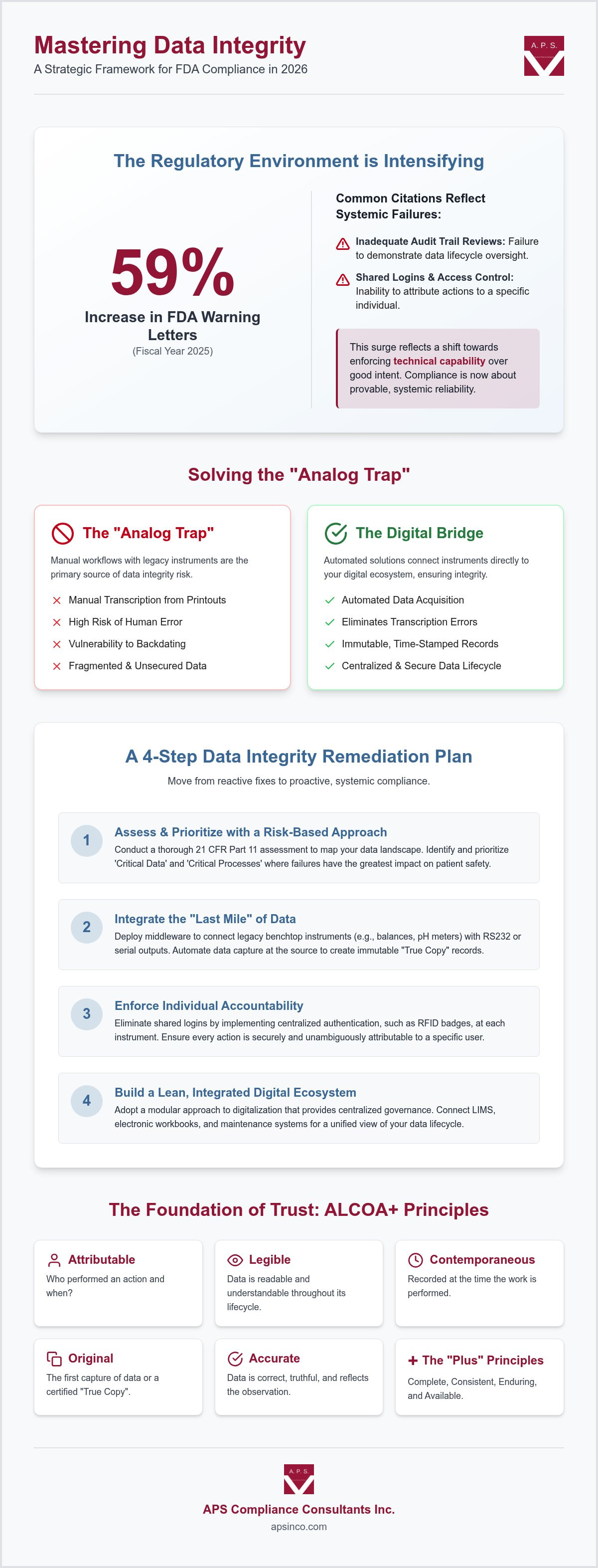
In fiscal year 2025, the FDA issued 303 warning letters, a 59% increase from the previous year. This surge reflects a regulatory environment that's becoming more precise and less forgiving, particularly regarding how data is captured and stored. You've likely felt the mounting pressure of managing hybrid systems while worrying about transcription errors or the technical hurdles of connecting legacy instruments. It's stressful to face a 21 CFR Part 11 audit when your data feels fragmented. We understand that compliance isn't just about following rules; it's about securing your operational future.
This guide provides a strategic framework to master ALCOA+ principles and develop a comprehensive data integrity remediation plan that bridges the analog-to-digital divide. You'll learn how to integrate digital transformation with regulatory expectations to ensure your systems remain resilient. We will examine the specific steps required to modernize your data lifecycle, from instrument-level connectivity to the latest EU Annex 11 requirements, ensuring you're prepared for the 2026 compliance landscape.
Table of Contents
Beyond ALCOA+: The Modern Landscape of Data Integrity Remediation
Data integrity is no longer a static goal. In 2026, regulators view it as a dynamic lifecycle rather than a simple collection of paper records. While the core principles of What is Data Integrity? remain the foundation, the industry has moved toward ALCOA+ as a mere baseline. A robust data integrity remediation plan must now account for technical controls that prevent errors before they happen. It's about building a system where reliability is baked into the architecture.
Regulatory focus has sharpened significantly. It's no longer enough to prove good intent; you must demonstrate technical capability through rigorous, frequent audit trail reviews. This evolution makes computer system validation services the essential starting point for any modern lab. You need systems that are validated not just for basic functionality, but for persistent, systemic reliability across the entire data stream.
The Cost of Non-Compliance: FDA 483s and Warning Letters
Governance vs. Operation: Why Policy Alone Fails
Solving the 'Last Mile': Digitalizing Benchtop Instruments and Serial Data
Many pharmaceutical labs fall into the "analog trap" where benchtop instruments like balances or pH meters produce paper printouts. These manual transcriptions are the primary source of data integrity risk because they invite human error and backdating. A modern data integrity remediation plan must address these non-networked units directly. By using PharmaRockIT LINK, you can bridge RS232 or serial instruments to the cloud, automating data acquisition and removing the "human-in-the-loop." This transition ensures that every record meets the "True Copy" requirements outlined in the FDA guidance on data integrity through secure, encrypted transmission.
Connectivity Strategies for Legacy Equipment
Legacy equipment often lacks the native networking needed for modern compliance. Simply parsing exported files is risky because the source data can be altered before it reaches the server. Direct serial acquisition creates an immutable record at the point of origin. Middleware devices provide a trusted, synchronized timestamp that prevents any ambiguity about when a measurement occurred. If you're struggling to connect older systems, you can consult with our specialists to explore your options.
RFID Authentication at the Bench
Shared logins on basic laboratory units are a major red flag during audits. If three different analysts use the same terminal, the data isn't truly "Attributable." We solve this by implementing centralized, RFID-based identification. A simple tap of a badge replaces the insecure practice of shared passwords. This ensures that every action, even on the simplest benchtop unit, is linked to a specific user, fulfilling a core ALCOA+ requirement without slowing down your workflow.
Remediating Data Integrity Gaps: A Risk-Based Framework
A successful data integrity remediation plan begins with a granular look at your current digital landscape. You should first conduct a thorough 21 CFR Part 11 requirements assessment to identify where electronic records are vulnerable. It's impractical to fix every minor gap simultaneously. Instead, prioritize your efforts by identifying 'Critical Data' and 'Critical Processes' where errors directly impact patient safety. This methodology aligns with the FDA Data Integrity and Compliance Guidance and EU Annex 11 standards.
Implementation involves deploying technical controls like Single Sign-On (SSO) and secure electronic signatures. Once these are active, validate the remediated state using GAMP 5 risk-based principles to ensure full ALCOA+ compliance. This structured approach moves you from a reactive posture to a state of controlled momentum. To further enhance your organization's data literacy during this transition, you can learn more about Momentum One and their specialized training for corporate teams. It ensures that your resources are focused where they provide the highest return on compliance investment.
Audit Trail Review: The New Regulatory Frontier
Regulators now expect 'meaningful' audit trail reviews rather than simple spot checks. It's about reconstructing the entire history of a record. Our proprietary DTALE engine facilitates this by providing hierarchical event tracking, allowing you to visualize data dependencies. This technical capability ensures that your data integrity remediation plan isn't just a paper exercise but a functional shield against citations.
Health Canada and Canadian Data Residency
In 2026, sovereign compliance is paramount for Canadian pharmaceutical firms. Utilizing AWS Canada Central for data hosting meets strict Health Canada residency requirements. Our team in Montreal provides local, bilingual support in both English and French, which helps streamline complex projects and ensures clear communication with local stakeholders. Connect with our Montreal team to discuss your local compliance needs.
The Future of Compliance: Building an Integrated Digital Ecosystem
Modern pharmaceutical laboratories are moving away from "Fat" LIMS architectures that are often too rigid and complex to maintain. Instead, a lean, modular approach allows you to digitize specific workflows without the overhead of a massive monolithic system. This shift is a core component of a future-proof data integrity remediation plan, often requiring the strategic digital transformation expertise offered by LACSE CONSULTING. By using PharmaRockIT Cockpit, you gain centralized governance across your LIMS, Electronic Workbook (EWB), and CMMS, ensuring a single source of truth for all compliance data.
One of the most significant benefits of this modular shift is the drastic reduction in validation overhead. Traditional on-premise systems often require validation efforts that consume up to 35% of the total project timeline. By leveraging pre-validated SaaS models, we can reduce that effort to approximately 15%. Partnering with GAMP 5 validation experts ensures that your transition to the cloud remains fully compliant with both 21 CFR Part 11 and EU Annex 11 standards while accelerating your time to value.
Modular Phased Rollouts vs. Monolithic Implementation
Choosing a phased rollout is the superior strategy for managing capital expenditure and reducing change management friction. Rather than a "big bang" implementation that disrupts the entire lab, you can validate and deploy modules independently. This minimizes project risk and allows your team to adapt to new digital workflows at a manageable pace. It's a pragmatic way to build a robust data integrity remediation plan that delivers immediate results without overwhelming your operational staff.
Continuous Compliance in a Cloud-Native World
SaaS platforms offer an "always-current" validation state through automated updates, eliminating the need for periodic, massive re-validation projects. Infrastructure-as-Code (Terraform) ensures repeatable, validated environments by automating the setup of your underlying cloud resources. This technical precision provides the relief of knowing your infrastructure is as robust as the data it carries, allowing you to focus on core laboratory operations rather than server maintenance.
Securing Your Regulatory Future Through Strategic Digitalization
The path to 2026 compliance requires a shift from reactive patching to proactive, systemic integrity. You've seen how bridging the "analog trap" with proprietary PharmaRockIT LINK technology eliminates the risks of manual transcription while ensuring every record is truly attributable. By adopting a lean, modular ecosystem, you reduce the validation burden and create a foundation that grows with your laboratory requirements.
Successfully executing a data integrity remediation plan is a complex undertaking, but you don't have to navigate it alone. Our GAMP 5 certified experts and Health Canada and FDA compliance specialists are here to guide your transition from legacy systems to a secure, cloud-native future. We focus on streamlining your workflows so you can maintain your focus on core operations with total confidence in your data reliability.
Schedule a Data Integrity Readiness Assessment with APS Compliance Consultants Inc. to begin your journey toward a more resilient, compliant laboratory environment today. We're ready to help you turn compliance into a competitive advantage.
Frequently Asked Questions
What are the primary triggers for a data integrity audit in pharma?
Audit triggers often include previous Form 483 observations, whistleblower reports, or inconsistencies found during a CMC review. Routine inspections now focus heavily on technical controls like audit trail reviews. If an auditor identifies shared logins or "orphan" data files during a walk-through, it often triggers a deeper, site-wide investigation. Our consulting services help you identify these red flags early to ensure your laboratory is always audit-ready.
How does 21 CFR Part 11 apply to benchtop lab instruments?
Any instrument generating electronic records used for GxP decisions must meet 21 CFR Part 11 standards. This means you need unique user IDs, secure audit trails, and electronic signatures for every action. Since many benchtop units lack these features, we use PharmaRockIT LINK middleware to capture serial data directly. This ensures the data is transmitted to a secure, compliant cloud environment without any manual transcription or human-in-the-loop errors.
What is the difference between data integrity and data security?
Data security focuses on protecting information from unauthorized access, while data integrity ensures that information remains accurate, complete, and reliable throughout its entire lifecycle. Security is the shield, but integrity is the substance. For instance, a secure database might still suffer from poor integrity if users can edit records without leaving a trace. Our framework harmonizes these two disciplines to satisfy both IT and quality requirements.
Can we remediate data integrity gaps without replacing our legacy LIMS?
You can often remediate significant gaps without a total system overhaul by integrating modular digitalization tools. We specialize in layering secure middleware and electronic workbooks over legacy LIMS to capture data at the source. This strategy addresses critical compliance risks while allowing you to spread out capital expenditure. It's a pragmatic way to build a data integrity remediation plan that modernizes your lab without the disruption of a monolithic implementation.
How long does a typical data integrity gap assessment take?
A typical assessment generally takes between two and four weeks, depending on the scale of your facility and the number of validated systems. We utilize GAMP 5 risk-based principles to focus on your most critical data streams first. By using our proven templates and specialized expertise, we can reduce the assessment timeline by up to 40%. This provides you with a rapid, actionable data integrity remediation plan to begin your journey.



Comments