

EQMS Validation for Medical Devices: GAMP 5 Guide 2026
Updated: Sep 6
The transition to the FDA Quality Management System Regulation (QMSR) on February 2, 2026, fundamentally changed the compliance landscape. If you're still relying on traditional, document-heavy eQMS validation for medical devices to satisfy these new requirements, you're likely facing ballooning costs and the persistent fear of a Form 483 observation. We understand that the complexity of 21 CFR Part 11 and the updated Annex 11 can feel like a moving target. It's frustrating when the very systems meant to ensure quality become a bottleneck to your operations.
This guide will help you master the validation process by adopting a risk-based GAMP 5 approach that prioritizes critical thinking over rote documentation. You'll learn how to leverage the FDA's Computer Software Assurance (CSA) guidance to ensure compliance with ISO 13485 while significantly reducing manual paperwork. We'll preview how APS Compliance Consultants Inc. uses proven templates and modular solutions like PharmaRockIT to accelerate validation timelines by up to 40 percent. By the end of this article, you'll have a clear roadmap to a validated, audit-ready eQMS that supports your business growth rather than hindering it.
Table of Contents
The Regulatory Imperative: Why eQMS Validation for Medical Devices is Non-Negotiable
eQMS validation for medical devices is the documented proof that your quality system performs exactly as intended. It's no longer just a best practice; it's a legal necessity. The FDA Quality Management System Regulation (QMSR), which became effective on February 2, 2026, harmonizes US requirements with ISO 13485:2016. This shift makes global compliance more streamlined but also raises the stakes for system integrity. If your system isn't validated, you're vulnerable to data silos, transcription errors, and failed inspections. Everything starts with defining your "intended use." This baseline determines the scope of every testing activity and ensures the software supports your specific business processes without unnecessary complexity.
Navigating 21 CFR Part 11 and EU MDR Compliance
Modern cloud systems must meet rigorous 21 CFR Part 11 requirements to ensure electronic records remain trustworthy and secure. This involves implementing robust audit trails and attributable electronic signatures that link every action to a specific user. We utilize ALCOA+ principles, Attributable, Legible, Contemporaneous, Original, and Accurate, to maintain data integrity throughout the device lifecycle. It's about ensuring your records are not just accurate, but also enduring and available the moment an auditor requests them. This level of precision is essential for meeting both FDA and EU MDR standards in an increasingly digital landscape.
The Shift from CSV to Computer Software Assurance (CSA)
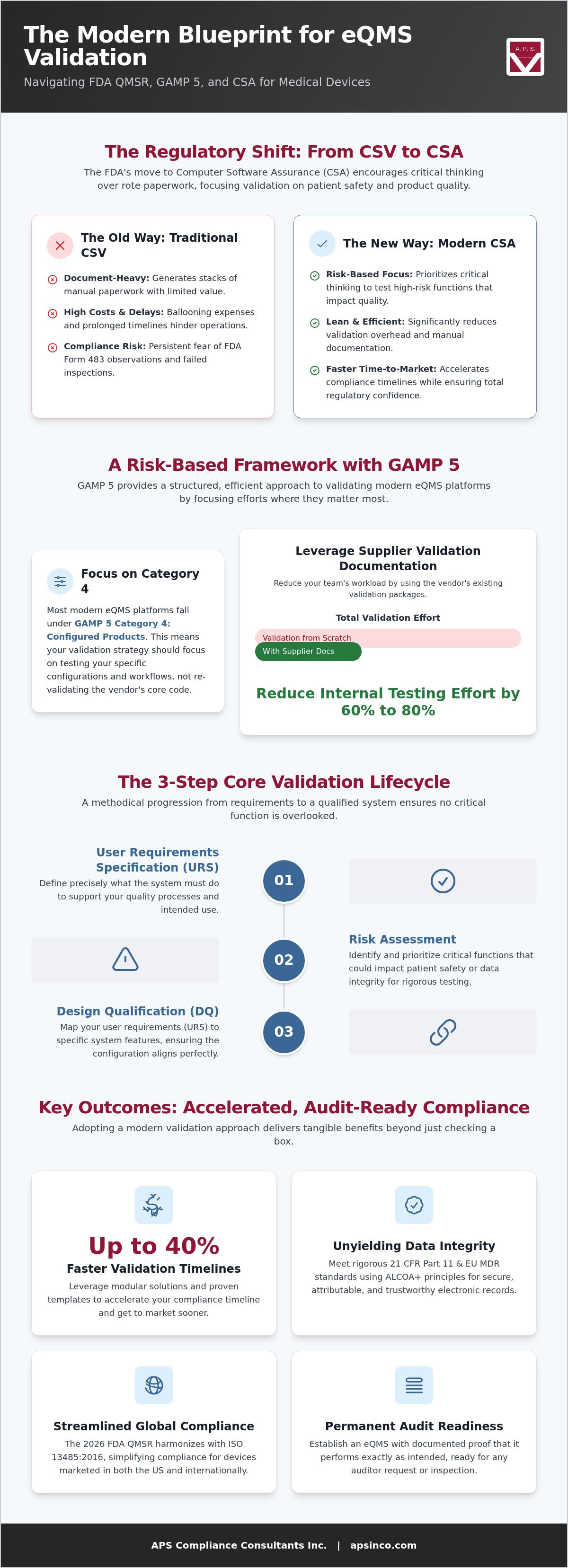
The industry is moving away from document-heavy Computer System Validation (CSV) toward Computer Software Assurance (CSA). This transition, supported by the FDA's updated 2026 guidance, encourages critical thinking over rote paperwork. By focusing testing efforts on high-risk functions that directly impact patient safety or product quality, you can significantly reduce validation overhead. It's a faster, smarter way to achieve compliance. This approach allows your team to focus on systemic integrity rather than just generating stacks of manual documentation, ultimately accelerating your time to market while maintaining total regulatory confidence. To ensure your broader operational environment also meets high safety and quality standards, you can find out more about specialized consultancy services.
A Risk-Based Framework: Implementing GAMP 5 for eQMS Validation
GAMP 5 Category 4, Configured Products, is the industry standard for the majority of modern eQMS platforms. Since these systems are pre-built and then tailored to your specific workflows, your validation strategy should focus on the configuration rather than the underlying code. A comprehensive Validation Master Plan (VMP) serves as your roadmap, defining project scope and responsibilities to keep everyone aligned. Adopting a modular approach to eQMS validation for medical devices allows for phased rollouts, which reduces CAPEX risk by letting you validate and deploy high-impact modules first. Engaging gamp 5 validation experts ensures your risk assessment is both efficient and thorough.
The 5-Step Risk-Based Validation Lifecycle
The lifecycle begins with the User Requirements Specification (URS), where we define exactly what the system must do to support your quality processes. Next, we conduct a formal Risk Assessment to identify critical functions that could impact patient safety or data integrity, prioritizing them for rigorous testing. Finally, Design Qualification (DQ) involves mapping your URS to specific system features, ensuring the configuration aligns perfectly with your intended use. This methodical progression ensures that no critical requirement is overlooked during the implementation phase.
Leveraging Supplier Validation Documentation
You don't have to start from scratch. By leveraging a vendor's base validation documentation, you can reduce your internal testing effort by 60 to 80 percent. The GAMP 5 framework encourages the use of supplier audit reports and assessments to verify that the core software is already robust. This allows your team to focus exclusively on your unique configurations and high-risk integrations. If you're looking to optimize your eQMS validation for medical devices, contact our experts to discuss a streamlined approach that prioritizes efficiency and accuracy.
Executing IQ, OQ, and PQ: Technical Deliverables for Audit Readiness
Executing the technical qualification phases is where your Validation Master Plan meets reality. Installation Qualification (IQ) verifies correct deployment within your environment, while Operational Qualification (OQ) challenges functional requirements under both normal and worst-case conditions. Performance Qualification (PQ) confirms the system performs consistently within your specific manufacturing workflows. Central to this process is the Traceability Matrix (TM). This document acts as the definitive map, linking every requirement to its corresponding test case. It's essential for proving the integrity of your eQMS validation for medical devices during an inspection.
The Advantage of Validated SaaS and Zero-Footprint Architecture
Cloud-native systems like PharmaRockIT, which is powered by APS, provide a strategic advantage by eliminating local infrastructure validation. By utilizing zero-footprint architecture, manufacturers can reduce validation effort from 35 percent to just 10 percent of the project timeline. This is achieved through managed server-side maintenance. We prioritize data sovereignty by hosting data in the AWS Canada Central Region (Montreal), ensuring quality data remains secure under Canadian jurisdiction.
Common Validation Pitfalls to Avoid
A common pitfall is over-validating low-risk functions while under-testing critical audit trail features. It's also vital to maintain the validated state during software updates. A fragmented approach often leads to compliance gaps. Your equipment qualification iq oq pq must be integrated with the eQMS to ensure maintenance data flows seamlessly into quality records. If you need to streamline technical deliverables, contact our validation specialists.
Accelerating Compliance: The APS Approach to GMP Digitalization
APS Compliance Consultants Inc. simplifies the journey toward digital maturity. For organizations looking to align their broader business strategy with a robust technological infrastructure, resources like ebsaconsult.net provide essential guidance. By leveraging proven templates, we accelerate eQMS validation for medical devices by up to 40 percent. This methodology moves beyond traditional hurdles, transitioning your facility from fragmented paper records to a fully paperless, validated laboratory environment. Central to our approach is the PharmaRockIT ecosystem, which features the DTALE engine. This proprietary technology manages hierarchical event dependency, ensuring that even the most complex investigations remain transparent and audit-ready. It's a system built for precision and reliability.
A unified ecosystem is essential for data integrity across the entire lifecycle. Our lims software and cmms validation for fda compliance strategies work in tandem to eliminate data silos and ensure systemic integrity. We utilize smart, AI-supported specification blocks that significantly reduce manual data entry and transcription risks. These systems are built for operational practicality; they're designed to be maintained by QC staff rather than requiring constant IT intervention. This approach empowers your team to own their quality processes while maintaining a high degree of professional authority.
Partnering for Long-Term Regulatory Confidence
Achieving compliance is not a one-time event but a continuous commitment to excellence. APS offers bilingual support and local Canadian expertise to guide you through every regulatory shift. We recommend phased implementation strategies to help manage change effectively while spreading CAPEX investments over time. This controlled momentum ensures your team isn't overwhelmed during the transition. Our goal is to instill a sense of security and long-term value in your operations. Contact APS Compliance Consultants Inc. to schedule a regulatory gap analysis and begin your transition to a modern, validated quality system.
Future-Proof Your Compliance Strategy
The regulatory landscape of 2026 demands a shift from document-heavy processes to critical, risk-based thinking. By embracing GAMP 5 principles and the FDA's CSA guidance, your organization can turn eQMS validation for medical devices into a competitive advantage rather than a regulatory burden. We've explored how a robust Traceability Matrix and integrated technical qualifications ensure your system remains audit-ready under the harmonized FDA QMSR and ISO 13485 standards. These elements form the foundation of a reliable, high-integrity quality system.
Transitioning to a digital, paperless environment doesn't have to be a slow or painful process. With our expertise in 21 CFR Part 11 compliant, Canadian-hosted infrastructure, we help you maintain total data sovereignty while optimizing your quality workflows. You can streamline your eQMS validation with APS Compliance Consultants Inc. and accelerate your project timelines by 40 percent using our proven GAMP 5 templates. Let's work together to build a resilient quality framework that empowers your team and protects your patients.
Frequently Asked Questions
What is the difference between CSV and CSA for medical device eQMS?
Computer Software Assurance (CSA) shifts the focus from excessive documentation to critical thinking and risk-based testing. While traditional Computer System Validation (CSV) often leads to a "one-size-fits-all" approach, CSA prioritizes testing for functions that directly impact patient safety or product quality. This modern methodology reduces validation overhead by allowing unscripted testing for low-risk features, ensuring that eQMS validation for medical devices is both efficient and compliant with the latest FDA guidance.
How long does it typically take to validate a new eQMS?
Validation timelines vary based on system complexity and the chosen deployment model. Traditional on-premises implementations often take six months or longer due to infrastructure setup and manual testing. However, by using a validated SaaS solution like PharmaRockIT, organizations can go live in a month or less. APS Compliance Consultants Inc. utilizes proven GAMP 5 templates to accelerate these projects by 40 percent, significantly reducing the time required to reach an audit-ready state.
Does a SaaS eQMS require a full IQ/OQ/PQ cycle?
Yes, but the burden is significantly reduced for SaaS environments. The vendor typically handles the Installation Qualification (IQ) and core Operational Qualification (OQ) on the server side. As the manufacturer, your responsibility focuses on Performance Qualification (PQ) to ensure the system meets your specific intended use. Leveraging a vendor's base validation can reduce your internal testing effort by 60 to 80 percent, allowing you to focus on high-risk, site-specific configurations.
What are the most common audit findings related to eQMS validation?
Common findings often include a lack of a comprehensive Traceability Matrix or insufficient audit trail reviews. Inspectors frequently identify gaps where user requirements aren't clearly linked to test results, making it difficult to prove the system's intended use. Additionally, failing to maintain the validated state during software updates or missing 21 CFR Part 11 compliant electronic signatures are recurring issues. Ensuring your eQMS validation for medical devices addresses these technical deliverables is critical.
How does GAMP 5 categorize modern cloud-based eQMS software?
Most modern cloud-based eQMS solutions fall under GAMP 5 Category 4, which covers Configured Products. This category applies to software where the underlying code is standard, but the system is tailored to meet specific business processes through configuration rather than custom programming. Focusing your validation efforts on these configurations, rather than the core software code, allows for a more streamlined, risk-based approach that aligns with international regulatory expectations and GAMP 5 best practices.



Comments