

Common FDA 483 Observations for Data Integrity: Examples and Remediation in 2026
- 2 days ago
- 8 min read
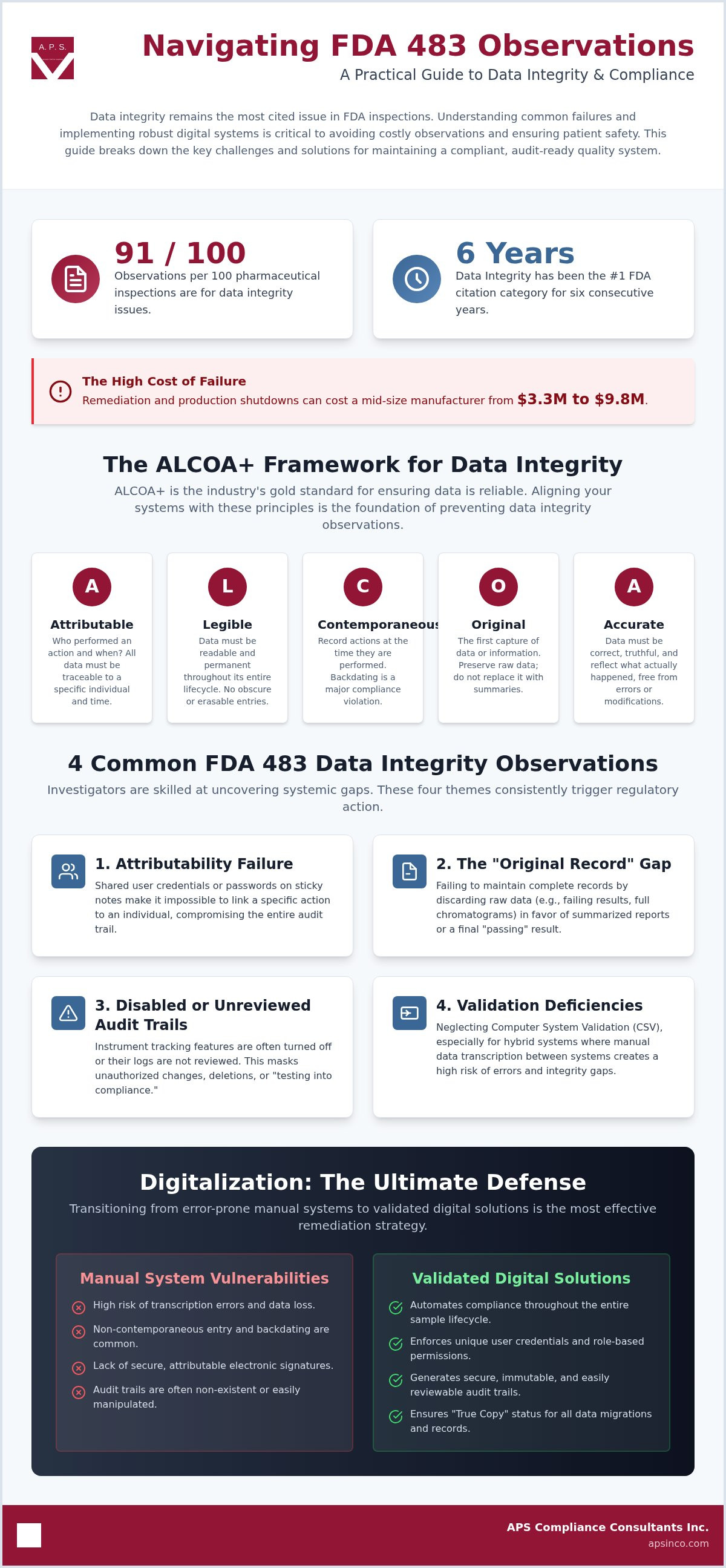
Did you know that data integrity has remained the most cited category for FDA citations for six consecutive years, climbing to 91 observations per 100 pharmaceutical inspections? It's understandable why anxiety over audit trail gaps and common FDA 483 observations data integrity issues keeps many quality managers awake at night. You've likely felt the pressure of maintaining "True Copy" status while navigating the high risk of product recalls due to unvalidated results. The burden of regulatory precision can feel overwhelming, but it doesn't have to be a solo struggle.
In this guide, we'll analyze the most frequent DI citations and demonstrate how to implement ALCOA+ compliant digital solutions to ensure you're always audit-ready. We'll examine real-world examples of recent citations, explore the impact of the new Quality Management System Regulation (QMSR), and provide a roadmap for automating your audit trail reviews. By the end, you'll have the technical and logical framework needed to achieve a seamless, zero-observation inspection with total confidence in your validated data ecosystem.
Table of Contents
The Landscape of FDA 483 Observations and Data Integrity in 2026
An FDA Form 483 serves as a formal list of "objectionable conditions" observed by investigators during a facility inspection. It's vital to remember that these aren't final legal conclusions; rather, they're a critical window for remediation before the agency escalates to a Warning Letter. In 2026, the regulatory focus has evolved. We've moved past simple human errors like missing signatures. Instead, investigators are targeting systemic audit trail failures within complex digital ecosystems. This scrutiny ensures the "trustworthiness" of electronic records under 21 CFR Part 11. Ignoring common FDA 483 observations data integrity gaps is a high-stakes gamble. Recent data suggests remediation and production shutdowns for a mid-size manufacturer can range from $3.3 million to $9.8 million, often compounded by import bans or stalled product approvals.
Why Data Integrity is the Primary Focus of Modern Inspections
Modern inspections rely on Quality by Design (QbD). This framework demands untampered raw data to prove product safety throughout its lifecycle. To speed up the process, the FDA now employs Remote Oversight Tools. These digital scanners flag integrity gaps before investigators even set foot on-site. If your system lacks robust controls, you're already behind before the opening meeting.
21 CFR Part 11 vs. ALCOA+: Understanding the Frameworks
While 21 CFR Part 11 provides the legal regulation for electronic signatures and records, ALCOA+ serves as the industry's practical roadmap for compliance. ALCOA+ represents the gold standard for data reliability, ensuring every record is attributable, legible, contemporaneous, original, and accurate. Successfully navigating common FDA 483 observations data integrity requires aligning your technical controls with both the regulation and this rigorous standard. We've seen that systems lacking these controls often trigger the most severe enforcement actions in 2026.
4 Common FDA 483 Observations for Data Integrity (With Examples)
Investigators in 2026 are increasingly skilled at uncovering systemic gaps. These common FDA 483 observations data integrity citations often stem from a lack of technical controls rather than intentional fraud. We see four recurring themes that consistently trigger regulatory action:
The Original Record Gap: Failing to maintain complete records when raw data is discarded in favor of summarized reports.
Attributability Failure: Shared user credentials make it impossible to link a specific action to an individual analyst.
Disabled Audit Trails: Laboratory instrumentation often has tracking features turned off, which masks unauthorized changes to results.
Validation Deficiencies: Firms often neglect computer system validation services for hybrid systems, where manual transcription creates high error risks.
Failure to Review Audit Trails
A frequent citation involves "testing into compliance." In these scenarios, analysts delete failing results before committing a final run to the permanent record. To combat this, current FDA guidance on data integrity emphasizes that periodic audit trail review is a mandatory QA expectation. It's no longer enough to simply have an audit trail enabled; you must prove you're actively monitoring it for anomalies or deletions that suggest data manipulation.
Control of Electronic Signatures and Passwords
Simple oversights frequently lead to common FDA 483 observations data integrity issues. Investigators still find sticky notes with passwords or shared administrative accounts on benchtop PCs. These practices compromise the entire security architecture of the lab. In paper-based systems, this lack of control often leads to non-contemporaneous entry, where analysts backdate records to hide delays. If you're concerned about your site's current level of control, you can consult with our specialists to identify hidden vulnerabilities before your next inspection.
Remediation Strategies: Applying ALCOA+ to Your Quality System
Remediation requires more than just a quick fix; it demands a fundamental shift in how your organization handles information. To effectively counter common FDA 483 observations data integrity issues, start by conducting a comprehensive data integrity risk assessment gmp to map every critical touchpoint where data could be altered or lost. Following this assessment, your team should focus on these four pillars:
Implement "True Copy" protocols: Establish rigorous verification steps for all data migrations and backups to ensure the content and meaning remain identical to the source.
Eliminate hybrid systems: Transitioning to fully electronic workflows removes the inherent transcription risks associated with manual paper records.
Establish a "Quality Culture": Encourage a transparent environment where reporting errors is seen as a continuous improvement tool rather than a cause for reprisal.
The Role of GAMP 5 in Remediation
Our gamp 5 validation experts use risk-based testing to focus efforts on the systems with the highest impact on patient safety. GAMP 5 is a lifecycle approach rather than a one-time event. This ensures that compliance is integrated from the initial system design through to eventual retirement, preventing the gaps that lead to common FDA 483 observations data integrity citations.
Remediating Legacy Equipment with Middleware
Many laboratories struggle with legacy instruments that lack native audit trails. Middleware solutions can bridge this gap by capturing raw data directly from the instrument port, ensuring ALCOA+ compliance without replacing expensive hardware. For organizations prioritizing data sovereignty, our Canadian-hosted infrastructure provides a secure, local environment for your digital records. Aligning your remediation plan with the official FDA Guidance on Data Integrity ensures your systems meet the highest global standards. If you're ready to secure your data lifecycle, contact our validation specialists today.
Digitalization as the Ultimate Defense Against 483s
Manual systems are inherently prone to common FDA 483 observations data integrity citations because they rely on human vigilance in an era of automated scrutiny. PharmaRockIT LIMS automates the entire sample lifecycle from reception to the final Certificate of Analysis, removing the opportunity for transcription errors. For equipment maintenance, Alleye provides a robust, validated framework for cmms validation for fda compliance. PharmaRockIT LINK further secures this landscape by enabling direct data acquisition from benchtop instruments, ensuring every result is captured directly from the source without manual intervention.
Accelerating Validation with Pre-Validated SaaS
In addition to maintaining equipment performance, it is vital to manage the financial lifecycle of your laboratory assets accurately. For those looking to automate fixed-asset depreciation for tax and GAAP reporting, you can check out Cellutionware Software to ensure your financial records are as robust as your quality data.
Our team accelerates projects by up to 40% using proven GAMP 5 templates and pre-configured SaaS environments. The "Zero-Footprint" architecture is a game-changer for rapid deployment, allowing your lab to go live in weeks rather than months. This model eliminates the need for heavy local IT infrastructure, providing a cost-effective route to a fully validated state. It empowers your staff to focus on their core scientific work while we manage the complex technical requirements of the digital transition.
Integrating LabX and Empower into a Unified Ecosystem
Fragmented software often forces a "cognitive shift" on lab analysts, which is a primary driver of common FDA 483 observations data integrity errors. By integrating platforms like LabX and Empower into a unified ecosystem, we ensure consistent terminology and integrated workflows across the laboratory. This seamless harmony reduces the likelihood of human error and significantly strengthens your overall compliance posture. If you're ready to modernize your laboratory and secure your regulatory future, Contact APS Compliance Consultants Inc. to remediate your data integrity gaps today.
Securing Your Laboratory's Regulatory Future
Transitioning from manual workflows to a validated digital landscape is no longer optional; it's a strategic necessity for survival in 2026. By addressing the root causes of common FDA 483 observations data integrity issues, you move beyond simple remediation and toward operational excellence. We've discussed how aligning technical controls with ALCOA+ principles and GAMP 5 methodologies creates a resilient quality system that withstands the most rigorous inspections. This proactive stance ensures your data remains trustworthy and your products stay on the market.
APS Compliance Consultants Inc. is your dedicated partner in this journey toward digitalization. Our Montreal-based team provides bilingual support and deep expertise in 21 CFR Part 11 and EU Annex 11 requirements. We can accelerate your compliance projects by 40% using proven templates, ensuring your data sovereignty remains intact. You don't have to navigate these complex regulatory waters alone.
Request a Data Integrity Gap Analysis from APS Compliance Consultants Inc. today. Your commitment to data integrity is the foundation of patient safety and business success.
Frequently Asked Questions
What is the most common data integrity issue cited in FDA 483s?
In 2026, the most frequent issue is the failure to maintain complete and accurate records, often manifesting as audit trail gaps. Investigators often find that users share login credentials or that audit trails are disabled entirely on benchtop instruments. These common FDA 483 observations data integrity failures prevent the attribution of actions to specific individuals. Addressing these gaps requires robust technical controls like those found in the PharmaRockIT ecosystem.
How much time do I have to respond to an FDA 483 observation?
You have exactly 15 business days to submit a formal written response to the FDA. While a 483 isn't a final legal determination, your response must be thorough and address the root cause of each observation. Providing a clear corrective and preventive action (CAPA) plan within this window is crucial. It demonstrates your commitment to quality and can often prevent the issuance of a more severe Warning Letter.
Can an FDA 483 lead to a Warning Letter for data integrity?
Yes, an FDA 483 frequently escalates to a Warning Letter if your response fails to address systemic root causes. If investigators identify widespread common FDA 483 observations data integrity issues, they'll look for evidence of management oversight failures. Warning Letters carry significant risks, including import bans and stalled product approvals. To navigate the financial and strategic implications of these regulatory setbacks, engaging with an advisory firm like Samios Partners ensures your business remains resilient. Partnering with specialists to implement validated digital solutions ensures your remediation is comprehensive enough to satisfy regulatory scrutiny.
What is the difference between ALCOA and ALCOA+ in FDA compliance?
ALCOA is the foundational framework requiring data to be attributable, legible, contemporaneous, original, and accurate. The ALCOA+ standard expands this by adding requirements for data to be complete, consistent, enduring, and available. These additional four pillars ensure that records remain trustworthy throughout their entire lifecycle. Our data integrity consulting focuses on implementing these principles through automated workflows that reduce the human error inherent in manual paper systems.
How does computer system validation (CSV) prevent data integrity failures?
Computer system validation (CSV) ensures that your digital tools operate exactly as intended within a GxP environment. By following GAMP 5 risk-based methodologies, we identify where data could be compromised and implement technical controls to prevent it. This process includes verifying audit trails, electronic signatures, and access levels. Validated systems like PharmaRockIT LIMS provide a zero-footprint defense, automating compliance and eliminating the transcription risks that trigger regulatory citations.


Comments