

Equipment Qualification Protocol Development and IQ Documents
A qualification protocol is more than a checklist: it connects equipment requirements to documented evidence that installation and operation meet site expectations. Effective equipment qualification protocol development defines the scope, prerequisites, test steps, measurable acceptance criteria, results, and deviation records, with responsibilities and approvals clear before execution.
For IQ, documentation typically includes equipment identification and specifications, supplier records, installation checks, relevant drawings and utility details, software identification where applicable, and deviation records with their impact. Supplier documents support qualification, but must be reviewed against the equipment’s intended use and site procedures.
You’ll learn how IQ documents fit into the wider IQ/OQ/PQ lifecycle, how protocols organize functional tests and acceptance criteria, and what makes test evidence useful for quality review and audit readiness. We’ll also explain how a risk-based approach keeps qualification focused on intended use, and how professional qualification support can align the protocol, execution, and final documentation.
Table of Contents
Functional test procedures and acceptance criteria
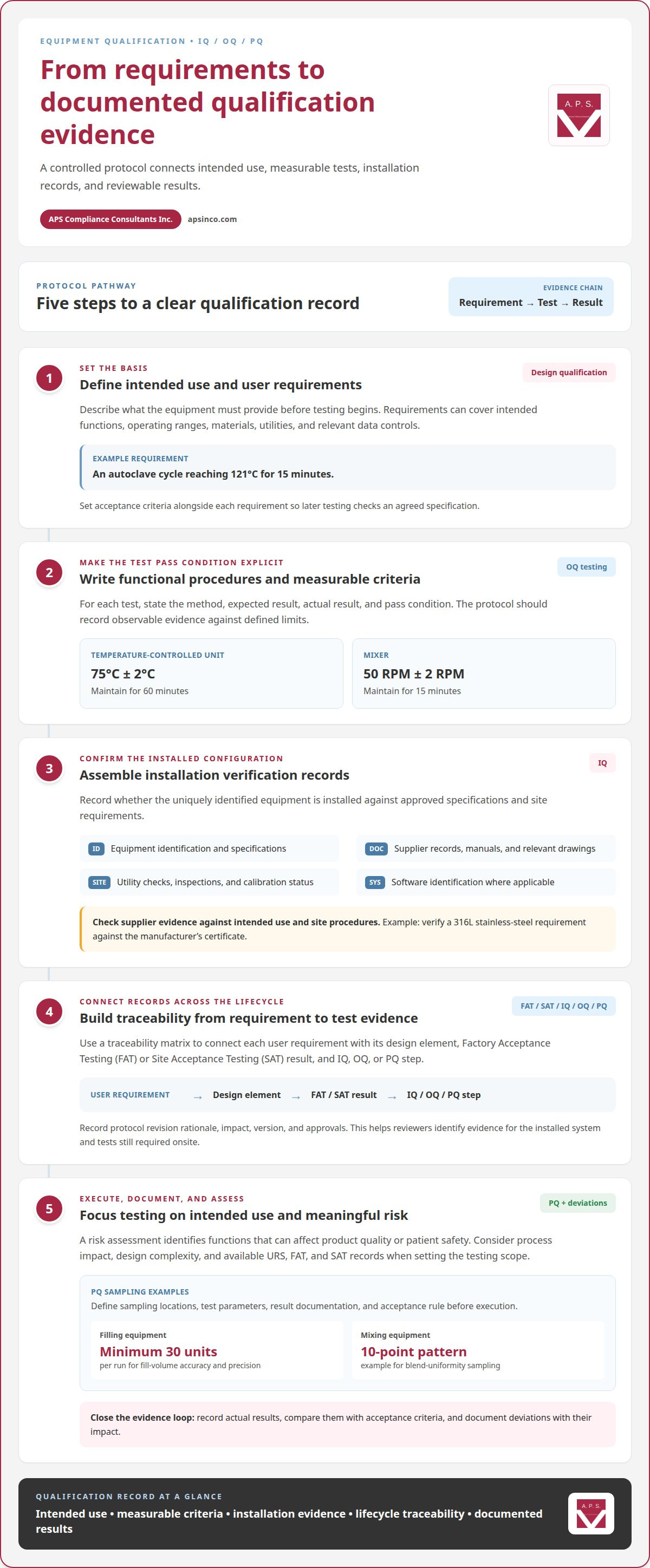
A provider defines acceptance criteria from approved user requirements, equipment specifications, and intended use. Each test states its method, expected result, actual result, and pass condition.
Functional Test Procedures
Functional test procedures describe how each equipment function is challenged and how results are recorded. For a temperature-controlled unit, a protocol can specify the setpoint, measurement method, test duration, and documented result. FDA 21 CFR Part 211 is the current good manufacturing practice regulation for finished pharmaceuticals, according to the Electronic Code of Federal Regulations. Procedures connect that regulatory context with observable evidence of equipment performance.
Measurable Acceptance Criteria
Acceptance criteria define the measurable limits that separate a passing result from a failure. A test might require a system to maintain 75°C ± 2°C for 60 minutes; the protocol records the expected range and observed readings. For a mixer, an example criterion is 50 RPM ± 2 RPM for 15 minutes. Clear limits support consistent testing, review, and deviation assessment.
Equipment Requirements and Criteria
Equipment requirements state what the unit must provide, while acceptance criteria translate those needs into verifiable checks. For medical device manufacturers, the International Organization for Standardization identifies ISO 13485 as a quality management system standard. The U.S. Food and Drug Administration states that its Quality Management System Regulation updates 21 CFR Part 820 and is effective February 2026. The U.S. Food and Drug Administration also describes the QMSR as harmonized with ISO 13485:2016. Protocols should therefore link applicable requirements to test evidence without treating a standard as a substitute for equipment-specific criteria.
PQ Sampling Plans
PQ sampling plans define which production outputs are examined and what results qualify as acceptable under intended operating conditions. For filling equipment, a test example uses a minimum of 30 units per run to assess fill-volume accuracy and precision. A blend-uniformity plan for mixing equipment may use a 10-point sampling pattern. The protocol should identify sampling locations, test parameters, result documentation, and the acceptance rule before execution. These details help reviewers assess whether collected evidence supports consistent process performance.
Qualification protocol structure and required documentation
A controlled protocol connects equipment, process, and design records to qualification evidence. Effective equipment qualification protocol development aligns applicable requirements with the equipment’s intended use and site procedures.
Installation Verification Documentation
Installation verification records whether equipment is uniquely identified and installed against approved specifications and site requirements. The IQ file can include manuals, drawings, utility checks, inspection records, and calibration status. For example, a 316L stainless-steel requirement can be checked against the manufacturer’s certificate. These records help demonstrate that the installed unit matches its intended configuration and is ready for qualification testing.
FAT and SAT Records
Factory Acceptance Testing (FAT) and Site Acceptance Testing (SAT) records capture tests performed before and after equipment reaches the manufacturing site. A traceability matrix can link each user requirement to a design element, FAT or SAT result, and IQ, OQ, or PQ step. This helps reviewers identify evidence relevant to the installed system and tests that still need to be performed onsite.
Traceability and Protocol Maintenance
Traceability connects each requirement to its design basis, test result, and approval, while controlled revisions preserve the record as equipment changes. The U.S. Food and Drug Administration states that the Quality Management System Regulation updates 21 CFR Part 820 and is effective February 2026. The U.S. Food and Drug Administration also describes the QMSR as harmonized with ISO 13485:2016. Protocol revisions should document rationale, impact, version, and approvals.
Risk-Based Testing Scope
A risk assessment identifies equipment functions that can affect product quality or patient safety, then focuses testing on those functions and intended use. The assessment considers process impact, design complexity, and available URS, FAT, and SAT records. Complex medical device equipment qualification projects commonly take 3-6 months when they involve complex equipment, process definition gaps, or incomplete upstream documentation. Equipment qualification protocol development should account for these project-specific factors. A protocol scope discussion can clarify evidence and review needs.
What Is Equipment Qualification?
Equipment qualification documents whether equipment is suitable for its intended use. It connects user requirements and design decisions to evidence from installation, operational, and performance testing.
Design Qualification and User Requirements
Design qualification evaluates whether the proposed design can meet approved user requirements before equipment is accepted for use. Those requirements describe intended functions, operating ranges, materials, utilities, and relevant data controls. For example, an autoclave requirement might specify a cycle reaching 121°C for 15 minutes. Teams define acceptance criteria alongside each requirement, so later testing assesses an agreed specification rather than a new expectation.
Cross-Functional Requirements Development
Requirements development brings together functions that understand different operational and compliance risks. Quality defines documentation and control expectations; engineering assesses design and utilities; production explains intended workflows; and IT addresses connected systems and data. Their review can uncover conflicting specifications before procurement or testing. Documenting a decision for each critical requirement gives the qualification team a clear basis for assessing equipment performance in its actual operating context.
Requirements Traceability
A requirements traceability matrix links each user requirement to design elements and qualification evidence. It can map a requirement to a drawing, factory or site test, and relevant IQ, OQ, or PQ step. This helps reviewers spot requirements without supporting evidence and tests without a defined purpose. Establish acceptance criteria during URS development, then carry them through the protocol and record the results.
Include data integrity requirements in the design and traceability process when equipment creates or manages regulated records. Requirements can identify expected access controls, audit trails, record retention, and electronic signatures, where applicable. For computerized functions, computer system validation provides documented evidence that the system performs its intended function. Linking these controls to requirements and tests makes data handling part of qualification, not an afterthought.
Equipment qualification within the validation lifecycle
Equipment qualification provides documented evidence about a unit’s suitability for intended use. It supports validation, but does not by itself demonstrate that an entire manufacturing process consistently produces acceptable results. The lifecycle links equipment requirements, installation, operational testing, and performance under actual process conditions. This distinction helps quality teams define what each qualification stage must confirm.
Protocol development and execution are connected activities: development establishes scope and test methods, while execution records evidence against approved criteria. Installation Qualification confirms that equipment and components are installed as specified. Operational Qualification follows completed installation and tests functions across specified operating ranges. A calibrated instrument can verify a critical parameter, with the record identifying the instrument and result.
Operational testing alone cannot establish process performance. Performance Qualification evaluates the complete process under actual production conditions, including trained operators, actual raw materials, and real environmental conditions. A performance plan should assess relevant product and process data, rather than rely only on equipment displays. The guide describes PQ as typically requiring a minimum of three consecutive successful production batches to demonstrate a pattern, not a single successful run.
Qualification evidence also informs the equipment’s continued validated state. Maintenance, calibration, and review of process and product data can reveal changes that warrant assessment. Replacing a critical component, changing an operating range, or seeing recurring deviations may affect the original assumptions. An impact assessment determines whether targeted testing or renewed qualification is appropriate. Document the rationale, review, and disposition in controlled records.
Keep qualification connected to process validation: equipment records show that the unit performs as specified, while process evidence addresses consistent results under routine conditions. If a deviation occurs, document it promptly, investigate its cause, and assess its effect before approval. For a project that needs lifecycle planning across IQ, OQ, and PQ, discuss your qualification requirements.
APS Compliance Consultants Inc.: Equipment Qualification (IQ/OQ/PQ)
APS Compliance Consultants Inc. provides Equipment Qualification (IQ/OQ/PQ) for pharmaceutical, biotechnology, and medical device organizations that need documented evidence of equipment suitability for intended use. Turn to the team when protocol development, execution, or qualification records need to align with site requirements and the equipment’s operational role.
The work connects IQ installation evidence with OQ functional testing and PQ performance under intended process conditions. This lifecycle view helps keep requirements, test results, deviations, and approvals traceable across qualification stages. Where equipment includes regulated computerized functions, Computer System Validation (CSV) can address the system’s intended function alongside equipment qualification.
Share the equipment’s intended use, available technical documentation, and relevant site requirements to support project scoping. Contact APS Compliance Consultants Inc. to discuss your equipment qualification needs.
Keep Qualification Evidence Connected to Operations
Qualification records remain useful when teams can interpret them after the original project closes. Assign document ownership, specify where approved records are maintained, and establish how operational changes trigger an impact review. This gives maintenance, engineering, and quality personnel a consistent basis for decisions throughout the equipment’s working life.
For future upgrades, preserve the link between the equipment’s current configuration and its qualification history. Record the rationale for changes, identify affected procedures, and clarify review responsibilities before implementation. This creates a practical handoff between project teams and the staff responsible for routine operation, without treating qualification as a one-time administrative milestone.
Equipment qualification protocol development can establish this foundation by making decision ownership and record control part of project planning. As equipment and processes evolve, keep those controls active and reviewable. A disciplined handoff helps teams make future qualification decisions with context, traceability, and confidence.
Frequently Asked Questions
What IQ documentation should you provide to an equipment qualification provider?
Provide a controlled document set that lets the qualification team identify the exact asset and its configuration. Include document titles, revision numbers, approval status, and the equipment tag or model identifier. A brief index can mark records as current, superseded, or not applicable, noting the reason. This helps the team distinguish genuine documentation gaps from records stored under another site or asset reference.
Can IQ/OQ/PQ be performed on equipment that skipped FAT and SAT?
Yes, qualification can proceed without FAT or SAT records if the evidence plan addresses the resulting gaps. The qualification team can assess available design information, identify risks, and define suitable onsite inspections or tests. The protocol should explain which evidence is unavailable, how alternative testing addresses relevant functions, and whether any limitations remain. This ties qualification conclusions to evidence rather than assumptions about factory testing.
What are IQ, OQ and PQ, and why are they critical to the pharmaceutical manufacturing industry?
IQ is Installation Qualification, OQ is Operational Qualification, and PQ is Performance Qualification. Together, they help pharmaceutical teams make distinct decisions: whether installation matches the approved configuration, functions operate as specified, and equipment performs in its production role. Separating these decisions helps quality reviewers identify where evidence supports release and where further assessment is needed before routine manufacturing use.
What does IQ/OQ/PQ stand for in medical device manufacturing?
In medical device manufacturing, IQ/OQ/PQ means Installation Qualification, Operational Qualification, and Performance Qualification. These terms apply to production and laboratory equipment used in regulated operations, not to the device’s design stages. For example, a manufacturing test station may need qualification evidence for its setup and operation, distinct from evidence concerning the medical device being produced.
What is a Pharmaceutical Equipment Validation (IQ OQ PQ) Protocol?
A qualification protocol is the controlled, equipment-specific record used to authorize and capture qualification execution. The approved version identifies the asset, test responsibilities, prerequisites, and recording method; the executed copy preserves observations, supporting evidence, and reviewer approvals. Linking the approved and completed versions helps prevent an uncontrolled draft from being mistaken for the protocol that governed testing.
What is a deviation during IQ/OQ/PQ and how is it handled?
A deviation is an unexpected event or result that departs from the approved execution plan. A useful deviation record classifies its criticality, captures the affected test and evidence, and documents the investigation and disposition. Review and approval by the system owner, validation, and Quality Assurance help establish accountability. For example, an interrupted test should retain its original observation and explain the rationale for any repeat.


Comments