

UpKeep vs Alleye for biotech applications and benefits
The best biotech maintenance platform isn’t necessarily the one with the longest feature list. In UpKeep vs Alleye for biotech, the right fit depends on how well each system supports your equipment, maintenance workflows, and documentation needs. Neither is automatically the right choice for every laboratory or manufacturing operation.
Biotech teams need reliable equipment and traceable maintenance records, while adapting to changing processes. This matters in personalized medicine and biomanufacturing, where maintenance practices must match operational needs and applicable quality controls.
This comparison explains how to assess the two systems for regulated biotech work, where each may fit, and what pharmaceutical companies can gain from a suitable CMMS. It also covers why intended use, data integrity, and validation considerations matter when selecting a system for laboratory or production equipment.
Table of Contents
Which platform offers better maintenance management for biotech labs and facilities?
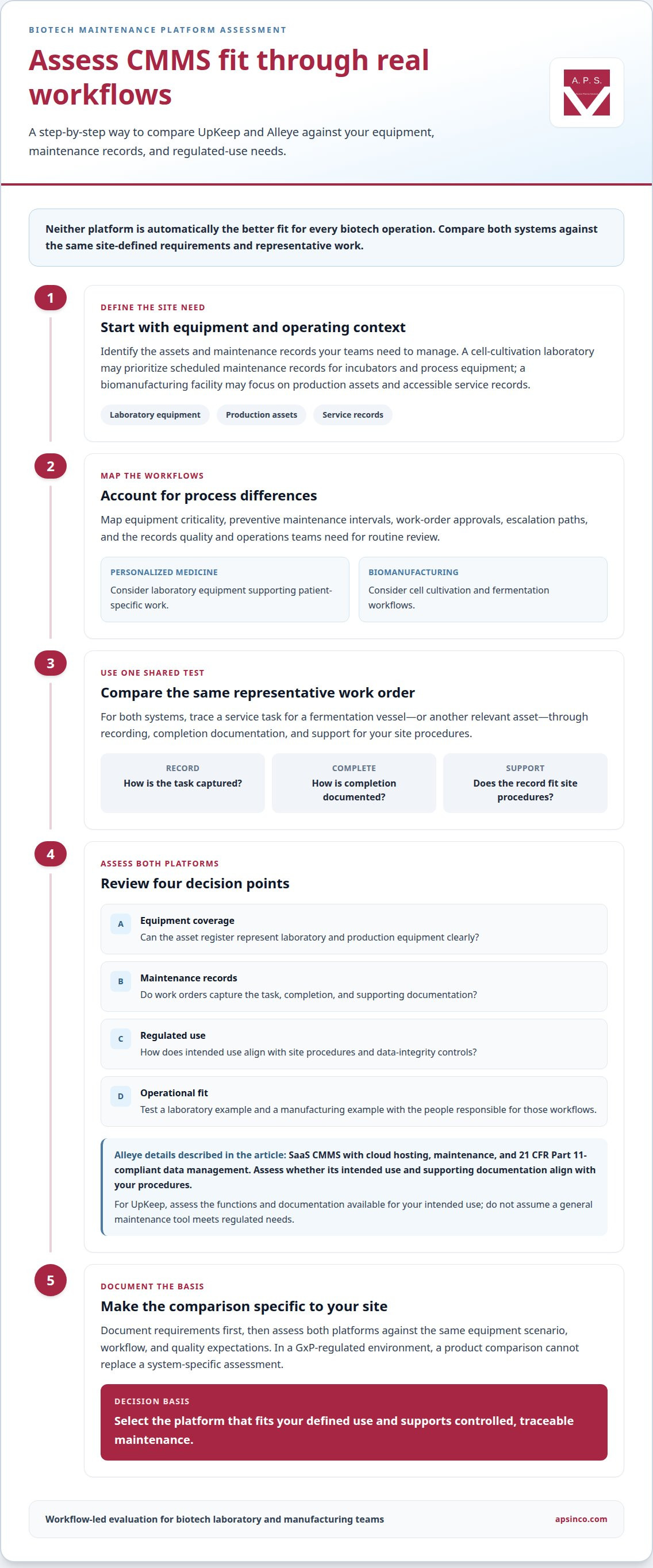
Neither platform is automatically the better fit for every biotech operation. The right choice depends on how each supports your equipment, maintenance workflows, and documentation needs. A cell-cultivation laboratory, for example, may prioritize scheduled maintenance records for incubators and process equipment. A biomanufacturing facility may focus on maintaining production assets and keeping service records accessible. Start the UpKeep vs Alleye for biotech decision with these site-specific needs.
Alleye is a SaaS CMMS, a cloud-hosted maintenance management system for regulated equipment and activities. Its offering includes cloud hosting, maintenance, and 21 CFR Part 11-compliant data management. Those details make its approach relevant when a biotech team wants maintenance records managed within a cloud-based system. They do not, on their own, establish that it is the right choice for every facility.
For UpKeep, assess the functions and documentation available for your intended use rather than assuming a general maintenance tool meets regulated needs. Compare both systems using the same representative work order, such as a service task for a fermentation vessel. Trace how the task is recorded, how completion is documented, and how the record supports your site’s procedures. This grounds the UpKeep vs Alleye for biotech comparison in actual workflows, not assumptions.
Biotech processes vary. Personalized medicine workflows may depend on laboratory equipment supporting patient-specific work, while biomanufacturing can involve cell cultivation and fermentation. For each use case, map equipment criticality, preventive maintenance intervals, work-order approvals, and escalation paths. Then identify which records quality and operations teams need for routine review. Base the comparison on actual workflows, not a generic feature checklist.
Use these decision points to structure an UpKeep and Alleye assessment:
Equipment coverage: Check whether the asset register can represent laboratory and production equipment clearly.
Maintenance records: Review how work orders capture the task, completion, and supporting documentation.
Regulated use: Determine how each system’s intended use aligns with your procedures and data-integrity controls.
Operational fit: Test a laboratory example and a manufacturing example with the people responsible for those workflows.
The better platform is the one that fits your defined use and supports controlled, traceable maintenance. A product comparison cannot replace a system-specific assessment in a GxP-regulated environment. Document requirements first, then assess each platform against the same equipment scenario, workflow, and quality expectations. This gives biotech teams a defensible basis for choosing a system that supports daily maintenance and audit readiness.
UpKeep vs Alleye customer reviews and biotech case studies
Customer reviews can shed light on daily usability, but rarely establish suitability for biotech maintenance on their own. A reviewer may value a fast work-order process, while a quality team needs traceable records and controlled workflows. Read reviews of UpKeep and Alleye for specific examples, such as logging a repair, assigning follow-up, or finding equipment history. Distinguish firsthand observations from broad praise or criticism.
For each review, note the product, user role, and operational setting, if provided. A facilities technician’s comments about routine repairs may not address a QC laboratory’s documentation needs. Likewise, a general manufacturing review may not reflect cell-culture operations. Look for recurring, specific feedback rather than treating a single account as proof of performance.
Case studies need a different test. A useful biotech example should describe the setting, maintenance problem, system use, and measured result. For instance, a facility maintaining fermenters could explain how work orders were scheduled and how completed work was documented. Without those details, a success story offers limited evidence for teams assessing regulated workflows.
Use a structured review of available material:
Match the context: Identify whether the example concerns biotech, laboratory work, or another operating environment.
Inspect the workflow: Trace a concrete task, such as recording an incubator repair through closure.
Check the evidence: Look for defined outcomes and documentation, not general claims of improved efficiency.
Note the gaps: Distinguish user satisfaction from evidence about data integrity, validation, or audit readiness.
For Alleye, product information describes a SaaS CMMS with cloud hosting, maintenance, and 21 CFR Part 11-compliant data management. Treat those as relevant product details, then assess whether the system’s intended use and supporting documentation align with your procedures. A favorable review cannot establish that alignment for your specific configuration.
Apply the same standard to UpKeep. Compare like with like: weigh a laboratory maintenance workflow against another laboratory workflow, not an unrelated use case. Ask what the review demonstrates, who performed the work, and whether its context resembles your facility. This helps keep general ratings from outweighing operational evidence.
Document your findings in a comparison table, with columns for source, user context, workflow, evidence, and relevance to your site. That record gives maintenance, quality, and laboratory teams a shared basis for discussion. If you want to align the review with your facility’s needs, discuss your biotech maintenance requirements.
Under the US SECURE Rule, the target review timeline for a permit for interstate movement or importation is 45 days, and for the second step of a regulatory status review is 15 months. During FY2023, BRS completed less than 20% of regulatory status reviews within the set timeframe, while 80% of regulatory status review applications were delayed. BRS reported a backlog of less than 50 regulatory status reviews, and 10% of permit reviews were delayed. These figures provide regulatory context, not proof of CMMS suitability.
How long does it take to implement UpKeep or Alleye in a biotech facility?
There is no single implementation timeline for every biotech facility. The work depends on intended use, asset-register quality, maintenance workflows, data migration, and validation scope. A laboratory introducing a basic maintenance process has different preparation needs from a facility coordinating laboratory and production equipment. For UpKeep or Alleye, estimate the work only after defining these variables.
Start by defining which equipment and teams the system will cover. A biotech site might include incubators, freezers, analytical instruments, and fermentation equipment. Decide which assets need preventive maintenance, who can create or approve work orders, and what completion records quality teams need. A clear scope helps avoid loading irrelevant assets or building workflows that do not reflect actual operations.
Next, assess the source data. Existing spreadsheets may contain duplicate asset names, incomplete maintenance histories, or inconsistent location labels. Cleaning records before migration helps reduce rework. For example, standardize how a laboratory identifies a freezer before importing its asset record and linking its maintenance history. The effort also depends on the number of records and the extent of cleanup required.
Configure and test workflows before broad deployment. A representative test could follow an incubator task from work-order creation through assignment, completion, and record review. In a GxP-regulated environment, assess intended use and validation needs alongside configuration. Testing should reflect actual roles and procedures, not merely whether a user can open a screen or close a task.
Scope: Define covered sites, assets, user roles, and maintenance activities.
Data: Review asset identifiers, locations, and available maintenance history.
Configuration: Align work-order steps and permissions with approved procedures.
Testing: Record test results for representative laboratory and production workflows.
Readiness: Train affected users and resolve issues before routine use.
Assess UpKeep and Alleye against the same scope and readiness criteria. A timeline can extend when asset records need substantial cleanup, workflows require multiple review cycles, or testing reveals changes. Clear ownership across maintenance, IT, and quality helps teams resolve decisions without bypassing required controls. Track open actions and owners so progress reflects completed readiness work, not just a planned launch date.
Build an implementation plan around your facility’s assets, data, and validation scope. Discuss your biotech CMMS implementation needs with APS Compliance Consultants Inc. to help define the work.
Keep the implementation timeline tied strictly to actual facility milestones rather than planned activity. Maintain estimates anchored to the facility’s defined scope and readiness work. While external references such as Argentina’s gene-editing regulatory reviews or USDA agricultural data examine long-term adoption trends, they do not provide software deployment timelines. Similarly, aerospace measurements like rocket lengths offer unrelated metrics that cannot establish a maintenance-system schedule. For UpKeep or Alleye, use the site’s reviewed records, tested workflows, and resolved readiness actions to judge whether the implementation is ready for routine use.
APS Compliance Consultants Inc.: Computer System Validation (CSV)
APS Compliance Consultants Inc. helps biotech teams assess whether a computerized maintenance system performs as intended for its regulated use. Turn to Computer System Validation (CSV) when selecting or implementing a CMMS for GxP activities, or when changes affect its configuration, workflows, or records. This work connects intended use to documented requirements, risk-based testing, and evidence to support review.
For teams assessing Alleye CMMS Software, CSV can help define the system’s role, test relevant maintenance workflows, and document results. For example, testing can trace a work order from creation through completion and review against approved procedures. This supports controlled data integrity and audit readiness without treating validation as a one-time task.
Contact APS Compliance Consultants Inc. to discuss CSV for your biotech facility.
Make your next system decision actionable
Your decision about UpKeep vs Alleye for biotech operations should establish intended use, accountable system ownership, and the evidence your quality team needs. This creates a practical foundation for implementation and ongoing control, rather than treating software selection as the finish line.
APS Compliance Consultants Inc. can support the next phase through Computer System Validation (CSV) and Alleye CMMS Software. Where laboratory data workflows also need attention, PharmaRockIT LIMS may be relevant to your broader system environment. Aligning each system with its role helps teams plan validation and maintenance around actual operational needs.
Bring your requirements, workflow priorities, and compliance questions into a focused discussion. Contact APS Compliance Consultants Inc. to discuss your biotech system plans and take the next step with clarity and confidence.
Frequently Asked Questions
Does Alleye support biotech GMP and FDA 21 CFR Part 11 compliance?
Yes, Alleye is designed to support maintenance management in biotech settings with GMP and FDA 21 CFR Part 11 requirements. Your facility remains responsible for assessing the system’s intended use and documenting its implementation within its quality framework. For example, define which maintenance records support GMP activities, then establish review and retention practices that fit your procedures.
What are the data security, validation, and audit-trail risks of using UpKeep or Alleye in biotech?
A key risk is assuming a general maintenance tool meets regulated needs without assessing intended use, documentation, data-integrity controls, and validation requirements. Check whether representative work orders are recorded and completed in a controlled, traceable way that supports your site’s procedures and audit readiness.


Comments