

GAMP 5 Category 4: Guide for Configured Systems 2026
Validating a configured system shouldn't feel like building a custom platform from scratch, yet many life science firms still treat GAMP 5 category 4 validation like a Category 5 project. It's frustrating to watch your project timelines slip because your team is over-validating standard features or struggling to differentiate between configuration and customization. You need a robust, audit-ready package that satisfies FDA 21 CFR Part 11 and Health Canada standards without wasting precious resources on unnecessary testing. We understand that the fear of audit findings often leads to bloated documentation cycles that delay critical software go-lives.
This guide simplifies the complexities of validating your LIMS and CMMS platforms, showing you how to leverage risk-based strategies to accelerate your timeline. We'll explore the latest 2026 regulatory shifts, including the finalized FDA CSA guidance, and provide a clear roadmap to achieve compliance while reducing your validation effort by up to 40%. By focusing on critical thinking over exhaustive paperwork, you can ensure systemic integrity while keeping your project on track.
Table of Contents
What is GAMP 5 Category 4? Defining Configured Products
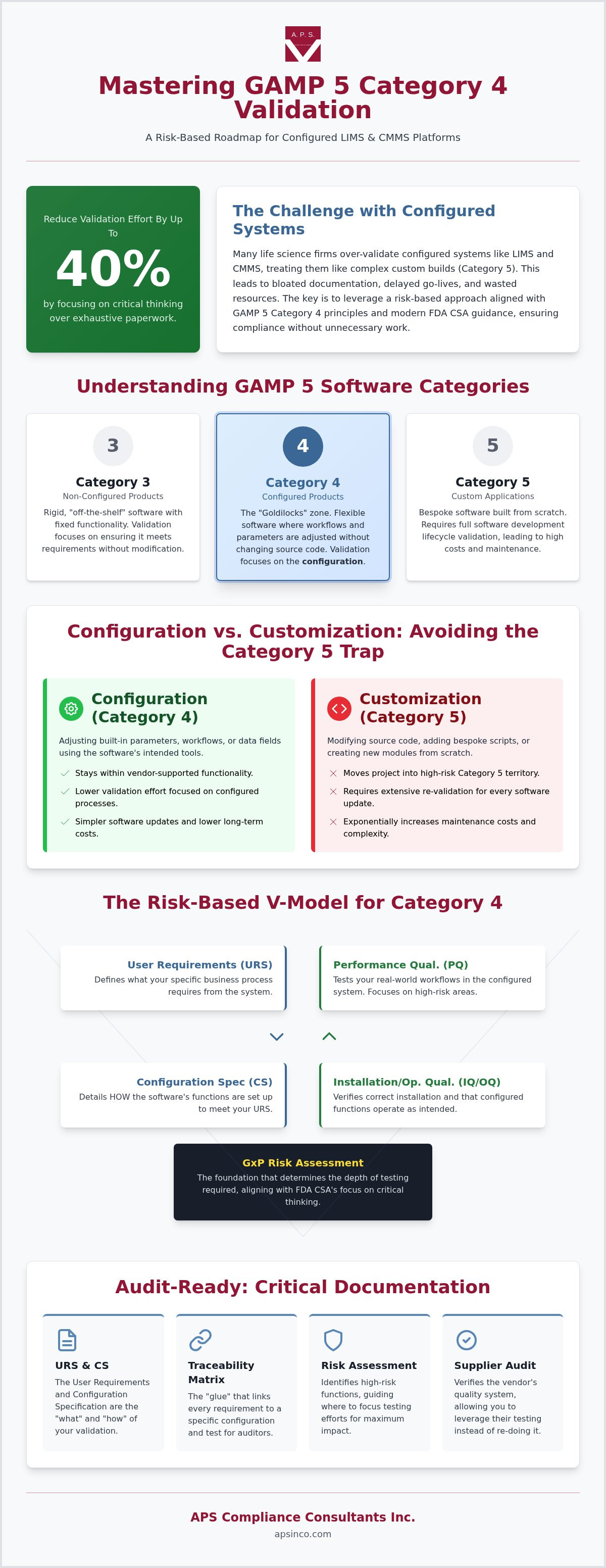
According to ISPE GAMP 5 Second Edition, Category 4 refers to "Configured Products." These systems allow you to adjust parameters, workflows, and data fields to match your specific business needs without ever touching the underlying source code. It's the middle ground. It's the most common tier for modern enterprise software because it balances standard reliability with operational flexibility. Unlike Category 3 systems that offer rigid functionality, GAMP 5 category 4 validation focuses on the configuration layer. This "Goldilocks" approach provides more adaptability than fixed tools but avoids the extreme risks and high maintenance burdens of Category 5 custom-coded solutions.
Common Examples of Category 4 Systems in Pharma
Most digital transformations in the life sciences rely on these platforms. They're designed to be flexible yet stable. Common examples include:
PharmaRockIT LIMS: Tailoring sample lifecycles and laboratory workflows to meet specific quality control requirements.
Alleye CMMS: Configuring maintenance schedules and calibration intervals for complex manufacturing equipment.
Electronic Workbooks (ELN/LES): Adapting digital templates to replace manual paper records while maintaining data integrity.
The Importance of Supplier Assessment
Success in GAMP 5 category 4 validation depends heavily on your software vendor. You shouldn't re-test the base code. Instead, you leverage the supplier's own development and testing lifecycle. This requires a rigorous supplier audit to verify their quality management system. Ask your vendor: How do they manage version control? What are their automated testing standards? Do they provide a pre-validated package to reduce your internal effort? We help our partners navigate these audits to ensure the vendor meets FDA and Health Canada expectations, allowing you to focus on your core business processes.
The Category 4 Validation Lifecycle: A Risk-Based Roadmap
The V-Model remains the backbone of GAMP 5 category 4 validation, but it requires a modern, risk-based adaptation to be truly effective. Instead of testing every out-of-the-box feature, we focus on how the system is configured to meet your specific business processes. This approach aligns with the finalized FDA guidance on Computer Software Assurance (CSA), which prioritizes critical thinking and high-value testing over burdensome documentation. By performing a rigorous GxP risk assessment early, you can determine the precise depth of testing required for each function. For a broader look at these regulatory shifts, see our strategic guide to GAMP 5 and GxP compliance.
Critical Documentation for Category 4 Compliance
A successful validation package starts with a precise User Requirements Specification (URS) that outlines exactly what your process requires. In Category 4 projects, we distinguish between the Functional Specification (FS), which describes what the software can do, and the Configuration Specification (CS), which details how those functions are set up for your site. The Traceability Matrix (TM) acts as the "glue" that holds Category 4 validation together for auditors, ensuring every requirement is linked to a specific configuration and verified through testing.
Performance Qualification (PQ) in Category 4
Performance Qualification shouldn't repeat vendor testing. It should focus on your real-world business workflows within the configured environment. We ensure your system meets ALCOA+ principles, confirming that data remains attributable, legible, and contemporaneous. By concentrating on high-risk areas identified during your GxP risk assessment, you can achieve a leaner, audit-ready state faster. If you're looking to streamline your next project, you can discuss your validation strategy with our consultants to find the most efficient path forward.
Configuration vs. Customization: Avoiding the Category 5 Trap
The distinction between configuration and customization is often the difference between a project's success and its stagnation. In GAMP 5 category 4 validation, configuration involves adjusting built-in parameters, such as workflows or data fields, to align with your business rules. Customization, however, requires modifying the source code or adding bespoke scripts. Once you cross that line, you've entered Category 5 territory. This shift exponentially increases your long-term maintenance costs and necessitates extensive re-validation every time the software is updated. Modular platforms like PharmaRockIT LIMS prioritize no-code configuration to keep you within the safer, more efficient Category 4 framework. Choosing the right platform is critical; you can find more on this in our LIMS software selection guide.
Why 'Lean' Configuration is Better for Audit Readiness
Eliminating unnecessary complexity is vital for maintaining a clean audit trail. Legacy systems often suffer from bloated configurations that are difficult to trace and even harder to defend during an inspection. Modern systems use parameter-based setups and AI-supported specification blocks to minimize manual entry errors. This lean approach ensures that your validation package remains concise and easy for auditors to navigate. It replaces complex, manual scripts with standardized, repeatable settings that prove systemic integrity through clear, automated tracking.
Managing System Updates in a Category 4 SaaS Environment
Operating in a validated SaaS environment changes how you handle vendor updates. Instead of massive, months-long regression testing cycles, you can leverage the vendor's base validation and focus on targeted impact assessments. This ensures that your specific configuration remains compliant without the traditional overhead of on-premise software. By maintaining a clear separation between core code and your business-specific parameters, you protect your validated state during every release cycle. If you're ready to modernize your approach, contact our experts to discuss your configuration needs.
Accelerating Category 4 Validation with APS Compliance
APS Compliance Consultants Inc. acts as your dedicated GMP digitalization partner, moving beyond the role of a traditional software vendor. We specialize in streamlining GAMP 5 category 4 validation by utilizing proven, pre-validated templates that reduce your overall validation effort by up to 40%. This efficiency allows your team to focus on core laboratory operations while we handle the regulatory heavy lifting. For firms in the Greater Montreal Area, our bilingual expertise and local presence ensure seamless communication and reliable support throughout the project lifecycle.
We understand that large-scale software deployments can strain budgets. Our modular implementation approach lets you validate one system or module at a time, effectively spreading out your CAPEX. To meet strict Health Canada and FDA requirements, we utilize AWS Canada Central hosting with infrastructure in Montreal and Calgary. This ensures your data residency remains firmly within Canadian borders, satisfying regional privacy laws while maintaining the highest global quality standards.
The PharmaRockIT Ecosystem: Built for GAMP 5 Category 4
The PharmaRockIT platform is engineered specifically for the life sciences. PharmaRockIT LIMS and Alleye CMMS provide robust functionality that lab staff can configure directly without requiring deep IT intervention. To further simplify your environment, PharmaRockIT LINK digitizes benchtop instrument data. This maintain the simplicity of Category 4 while eliminating the risks of manual transcription and ensuring your data is audit-ready at the source.
Ready for Audit? Partner with GAMP 5 Experts
Navigating the second edition of GAMP 5 requires more than just software; it requires a GAMP 5 validation expert. We provide the critical thinking and technical oversight necessary to ensure your systems stand up to the most rigorous inspections. Your next step toward a leaner compliance model is a Compliance Gap Analysis. This targeted review identifies exactly where your configured systems stand and how we can accelerate your path to a fully validated state.
Mastering the Future of Configured Systems
Navigating the shift toward risk-based assurance requires a clear understanding of where your software sits within the GAMP framework. By prioritizing lean configuration over complex customization, you protect your system's integrity and ensure long-term audit readiness. We've explored how a focused GAMP 5 category 4 validation strategy allows you to leverage vendor testing while maintaining full control over your unique business workflows. This approach isn't just about meeting regulatory expectations; it's about building a scalable foundation for your digital transformation.
As 21 CFR Part 11 and Health Canada experts, APS Compliance Consultants Inc. provides the technical oversight and bilingual Montreal-based support you need to succeed. We can help you accelerate your compliance projects by up to 40% through our proven methodologies and pre-validated templates. Don't let documentation-heavy cycles delay your software go-live or drain your resources. Accelerate your GAMP 5 Category 4 validation project with APS today. We're ready to partner with you to turn regulatory complexity into a strategic advantage.
Frequently Asked Questions
What is the difference between GAMP 5 Category 3 and Category 4?
Category 3 systems are standard products used without modification, while Category 4 systems allow you to adjust parameters and workflows. In GAMP 5 category 4 validation, you must document these specific configurations to prove they meet your business needs. While Category 3 is simpler to validate, it lacks the flexibility required for complex environments like a modern QC lab using PharmaRockIT LIMS or Alleye CMMS.
Does GAMP 5 Category 4 require a Functional Specification (FS)?
Yes, a Functional Specification is essential to define what the software can do, but Category 4 systems often rely on the vendor's FS. Your team's effort should focus on the Configuration Specification, which explains how those functions are set up for your specific site. This approach ensures that your validation package clearly distinguishes between the software's native capabilities and the specific business rules you've implemented for compliance.
How do I handle vendor software updates for a Category 4 system?
Handling updates involves performing a thorough impact assessment to see how vendor changes interact with your site's settings. By using a GAMP 5 category 4 validation framework for SaaS, you can leverage the vendor's core testing and focus only on your specific configurations. This risk-based approach reduces your validation workload to approximately 10-15%, whereas traditional on-premise updates often demand 30-35% of the total project effort.
Is a SaaS LIMS always considered GAMP 5 Category 4?
Most SaaS LIMS platforms are Category 4 because they require configuration to manage specific sample lifecycles and testing workflows. However, if you use a system exactly as it arrives without any adjustments, it remains Category 3. If you introduce custom code or bespoke scripts, it becomes Category 5. The category is defined by your actions, not just the software's delivery model or cloud architecture.
Can a Category 4 system become Category 5 after implementation?
A system escalates to Category 5 the moment you move beyond standard configuration and start writing custom code or scripts. This transition makes the system much harder to maintain and re-validate during future updates. We advocate for a modular, no-code configuration strategy to keep your platforms in Category 4. This keeps your validation package lean and significantly reduces the total cost of ownership over the software's life.


Comments