

Pharma CMMS Implementation: Validated 2026 Roadmap
What if the manual paper logs you maintain for security are actually the greatest liability in your next regulatory audit? Most maintenance teams recognize that cumbersome manual transcription invites human error, yet the fear of software updates breaking a validated system often keeps innovation at a standstill. Developing a robust cmms implementation plan for pharma requires aligning maintenance schedules with 21 CFR Part 11 and ALCOA+ principles without skyrocketing your validation budget. It's a high-stakes balance between operational efficiency and non-negotiable compliance.
This guide provides a definitive roadmap designed for the 2026 regulatory landscape. You'll discover how to transition to a paperless, audit-ready ecosystem that reduces the risk of Out of Specification (OOS) events while accelerating your deployment timeline from months to weeks. We'll explore how leveraging a lean, pre-validated solution like PharmaRockIT CMMS allows you to focus on systemic integrity rather than constant software maintenance. From GAMP 5 expertise to Canadian-hosted data sovereignty, this framework ensures your maintenance digitalization is a seamless extension of your quality culture.
Table of Contents
Why Pharmaceutical CMMS Implementation Requires a Regulatory-First Approach
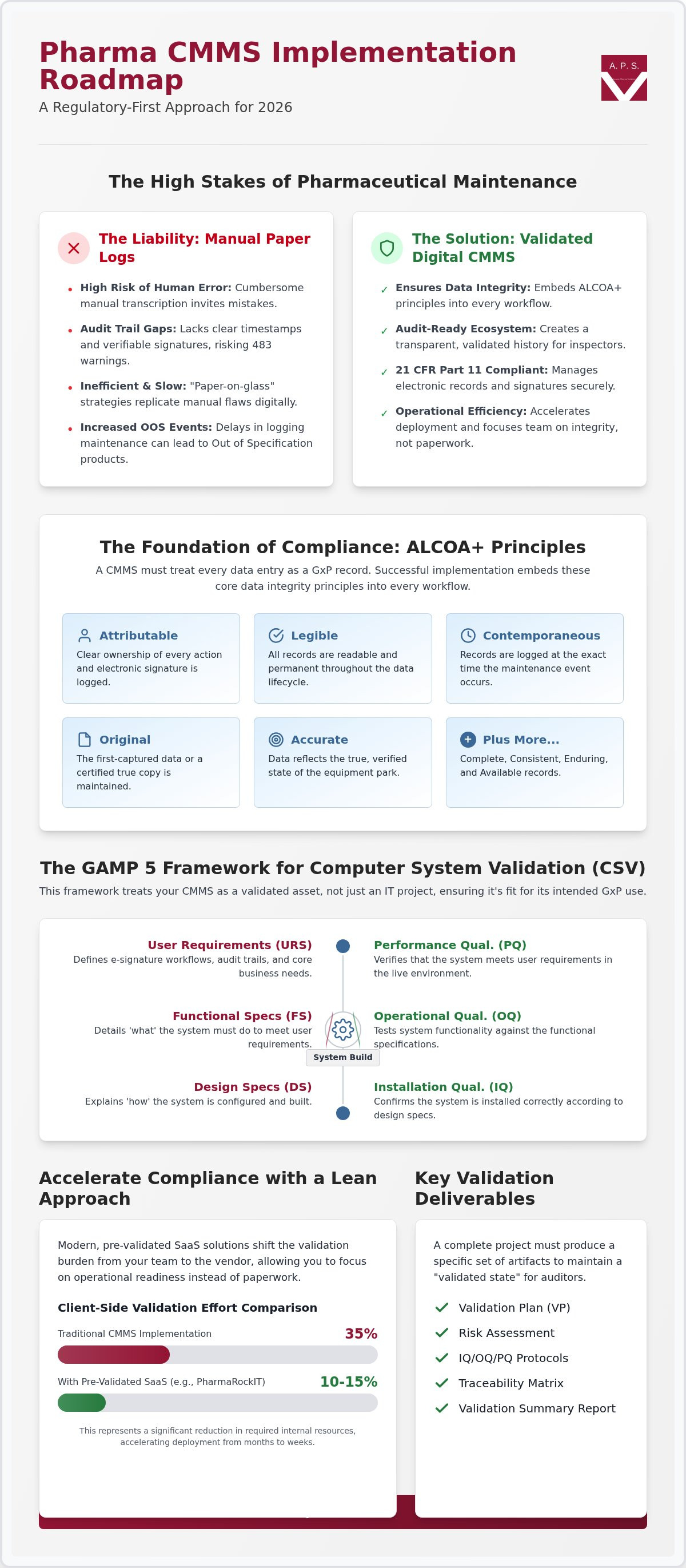
A Computerized Maintenance Management System (CMMS) in a GxP environment is much more than a digital calendar for work orders. It's a critical record-keeping system that validates the state of your production equipment. If a machine isn't maintained, the product it makes isn't compliant. An effective cmms implementation plan for pharma must treat every data entry as a potential piece of evidence for an auditor. Relying on "paper-on-glass" strategies, where you simply digitize inefficient manual processes, often replicates the same data integrity risks you're trying to escape.
Successful implementation embeds ALCOA+ principles into every workflow. Without these, you risk 483 warnings and citations that can halt production. Your framework should prioritize these core pillars:
Attributable: Clear ownership of every electronic signature.
Contemporaneous: Records logged exactly at the time of the maintenance event.
Accurate: Data that reflects the true, verified state of the equipment park.
The Intersection of Maintenance and Data Integrity
Your equipment calibration and preventative maintenance (PM) data aren't isolated metrics; they directly impact batch release decisions. If a sensor drifts out of tolerance and your maintenance log doesn't reflect a timely correction, the entire batch becomes suspect. Common audit pitfalls often stem from manual logs that lack clear audit trails or timestamps. A regulatory-first approach ensures that maintenance events are linked directly to equipment history, creating a transparent narrative for inspectors and reducing the risk of Out of Specification (OOS) events.
Understanding Regulatory Expectations (FDA and Health Canada)
Modern compliance hinges on meeting 21 CFR Part 11 requirements for electronic signatures and records. This isn't just about security; it's about proving who did what and when. For local entities, Canadian data residency provides an extra layer of sovereignty and security. This ensures your cmms implementation plan for pharma aligns with both global standards and regional data protection laws, providing peace of mind during remote audits.
The GAMP 5 Framework: Aligning CMMS with Computer System Validation (CSV)
Unlike a general IT project, a cmms implementation plan for pharma treats software as a validated asset. Applying GAMP 5 principles allows you to categorize your system correctly, usually as Category 4 (Configured) rather than Category 1 (Infrastructure). This distinction is vital; it shifts the focus toward validating your specific business rules and workflows. By mapping your User Requirements Specifications (URS) to Performance Qualification (PQ) through the V-Model, you ensure every critical feature is verified against 21 CFR Part 211 standards.
Risk-based testing is your most powerful tool for efficiency. Instead of exhaustive testing of every standard feature, focus your validation efforts on high-risk GxP functions like audit trail triggers and maintenance lockout logic. Modern SaaS models, like the pre-validated PharmaRockIT CMMS, can reduce client-side validation effort from 35% down to 10-15%. This shift empowers your team to focus on operational readiness rather than paperwork. If you're feeling overwhelmed by the technicalities, you can consult with our team to streamline your approach.
Defining User Requirements (URS) for Maintenance
The URS serves as the authoritative foundation for the entire validation project. It must define critical requirements such as electronic signature workflows, equipment reservation logic, and automated audit trails. Without a precise URS, your PQ will lack the necessary benchmarks to prove the system is fit for its intended use.
The Validation Deliverables Checklist
To maintain a "validated state," your project must produce a specific set of artifacts. These include the Validation Plan, Risk Assessment, IQ/OQ protocols, and a Traceability Matrix. Partnering with GAMP 5 validation experts ensures these documents meet the highest scrutiny during inspections.
A Step-by-Step Pharma CMMS Implementation Roadmap
A successful cmms implementation plan for pharma isn't a race; it's a disciplined sequence of regulatory milestones. The process begins with Phase 1: Planning and Governance. Here, you establish the "Cockpit" by defining user roles and plant-based access controls to ensure strict data security. Moving into Phase 2, you tackle Master Data Preparation. This critical stage often consumes 30-35% of the total project effort as you catalog your equipment park and define precise calibration intervals. Precision here prevents downstream validation failures.
Phase 3 focuses on Configuration and Integration. This involves connecting the CMMS to existing ERPs like SAP or Dynamics and using tools like LINK for automated data acquisition from benchtop instruments. Finally, Phase 4 covers Validation and Training. You'll execute IQ/OQ/PQ protocols to ensure the system is fully "Audit-Ready" before going live. If you're looking to accelerate your implementation timeline, our consultants can guide you through each phase with a focus on GxP integrity.
Master Data: The Silent Implementation Killer
Clean data is the bedrock of compliance. Migrating legacy equipment records without transcription errors is a major hurdle that can derail even the best projects. Adhering to the latest ISPE GAMP® 5 2nd Edition standards during this phase ensures that your data migration is both compliant and efficient. Utilizing AI-supported tools can further accelerate specification entry while maintaining the accuracy required for high-stakes pharmaceutical environments.
Phased Rollout vs. Big Bang
A modular approach is almost always superior to a "big bang" launch in a laboratory or production setting. It allows for a progressive paperless transformation, giving staff time to adapt to new digital workflows. This strategy simplifies change management and ensures that training for laboratory and maintenance staff is focused and effective. By rolling out core modules first, you build momentum and reduce the risk of operational friction during the transition.
Future-Proofing Maintenance with PharmaRockIT CMMS
Adopting a "Zero-Footprint" SaaS model is the most effective way to ensure long-term agility in a regulated environment. Unlike heavy legacy systems, PharmaRockIT CMMS provides a cloud-native architecture that simplifies remote audits and disaster recovery. This approach ensures your cmms implementation plan for pharma isn't bogged down by infrastructure maintenance. Instead, server-side updates maintain the system's validated state without disrupting your daily operations. This continuous compliance model is a significant shift from traditional enterprise software that often breaks under the weight of manual patches.
Operational practicality is at the heart of our design. We've built a system that lab staff can maintain easily without constant intervention from IT specialists. Connectivity is another pillar of this future-proof strategy. By integrating LINK, you can automate data acquisition from RS232-based instruments, effectively eliminating the manual transcription risks identified earlier. This automation ensures data residency remains secure within our Canadian-hosted environment, providing full sovereignty over your GxP records.
The Modular Advantage
Modern digitalization thrives on connectivity rather than isolation. PharmaRockIT CMMS integrates seamlessly with our LIMS and PHarmaRockIT Electronic Workbook (ELN/LES) to create a unified digital laboratory landscape. This cross-module synergy ensures that equipment status is always visible to the analysts who need it most. For those still evaluating their broader tech stack, reviewing our LIMS software selection guide can help you understand the compounding benefits of a modular ecosystem.
Getting Started with Your Digital Transformation
The most successful transitions begin with a focused pilot site. Identifying a single laboratory or production line for your initial rollout allows you to refine your cmms implementation plan for pharma before scaling across the enterprise. This phased approach minimizes disruption while proving the ROI of a paperless, audit-ready maintenance ecosystem. Ready to secure your regulatory future? Schedule a consultation with APS to accelerate your CMMS implementation.
Securing Your Path to Audit-Ready Maintenance
Transitioning from manual logs to a paperless environment is a vital step toward systemic integrity. We've explored how a regulatory-first approach, grounded in GAMP 5 principles, transforms maintenance from a liability into a compliant asset. By focusing on master data precision and modular integration, you eliminate the risk of OOS events and audit findings.
Developing a robust cmms implementation plan for pharma ensures that your facility remains audit-ready in the modern regulatory landscape. Connect with our GAMP 5 experts to build your validated CMMS roadmap today. Our methodology helps you accelerate validation by up to 40% using proven templates while ensuring your system is 21 CFR Part 11 and EU Annex 11 compliant by design. With Canadian-hosted SaaS for data sovereignty, you can focus on core operations with total peace of mind. Your journey toward a leaner, more efficient maintenance ecosystem starts with a single, strategic step.
Frequently Asked Questions
What is a CMMS in the pharmaceutical industry?
A Computerized Maintenance Management System (CMMS) in pharma is a critical record-keeping tool used to manage the maintenance and calibration lifecycle of GxP equipment. It replaces manual paper logs with electronic, tamper-proof records to ensure production machinery remains in a qualified state. By centralizing equipment history and scheduling, it helps Quality Control teams maintain systemic integrity and prevent the risk of Out of Specification events during manufacturing.
How long does a pharma CMMS implementation typically take?
Traditional enterprise systems often require months to deploy, yet lean solutions like PharmaRockIT CMMS allow sites to go live in a month or less. The duration depends heavily on master data preparation, which typically represents 30-35% of the total project effort. A successful cmms implementation plan for pharma uses pre-validated templates and AI-supported tools to accelerate data migration while ensuring every equipment record meets strict regulatory standards.
Does CMMS software need to be validated for GxP compliance?
Yes, any software that manages GxP-regulated equipment must undergo Computer System Validation (CSV) to comply with GAMP 5 standards. This process proves the system consistently performs as intended and maintains data integrity. Leveraging a SaaS model is highly efficient here. It can reduce your validation effort from 35% down to 10-15% because the vendor provides the foundational validation documents, including Risk Assessments and IQ/OQ protocols, for your review.
What is the difference between a general CMMS and a pharma-specific CMMS?
General systems focus on uptime and basic work orders, but pharma-specific solutions prioritize regulatory compliance and ALCOA+ principles. Systems like PharmaRockIT CMMS include native features for electronic signatures and attributable audit trails. They're designed specifically for GxP environments, handling equipment qualification and calibration intervals with the precision required by the FDA. Standard industrial software often lacks these specialized controls, leading to significant gaps during a data integrity audit.
How does a CMMS support 21 CFR Part 11 compliance?
The system supports compliance by enforcing electronic signatures, role-based access, and timestamped audit trails that are both comprehensive and attributable. It ensures that every maintenance action is linked to a specific user through centralized authentication. This level of control is a cornerstone of a solid cmms implementation plan for pharma. It replaces instrument printouts with secure electronic records that meet the stringent "True Copy" and data integrity requirements of global regulators.
Can a cloud-based CMMS be used in a GMP-regulated environment?
Yes, cloud-native systems are increasingly preferred because they offer better disaster recovery and automatic updates that don't break the validated system. For Canadian companies, using a "zero-footprint" SaaS hosted in the AWS Canada Central Region ensures data sovereignty. These platforms provide the same level of security as on-premises systems, with 256-bit encryption and 2FA, while eliminating the heavy infrastructure maintenance and manual patching that often plague legacy systems.


Comments