

21 CFR Part 11 Compliant ELN Software: The 2026 Strategic Guide to Selection and Validation
- 9 minutes ago
- 8 min read
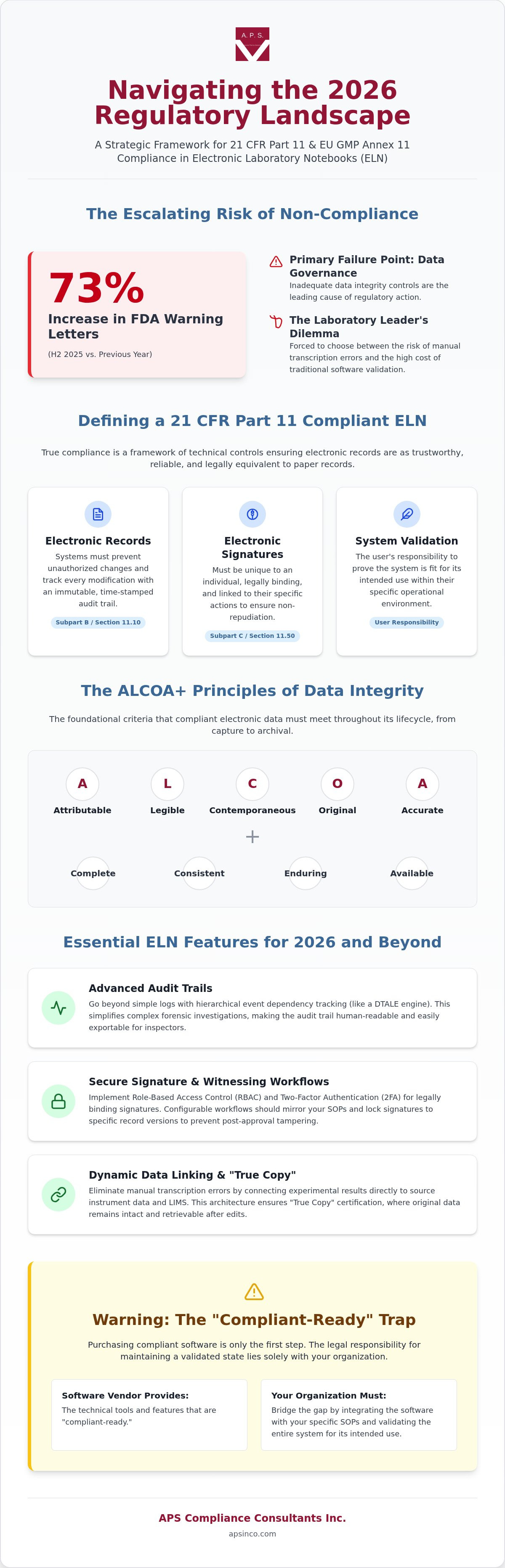
In the second half of 2025, FDA warning letters increased by 73% compared to the previous year, with data governance cited as a primary failure. It's a sobering reality for laboratory leaders who feel trapped between the burden of manual transcription errors and the staggering cost of traditional validation. You shouldn't have to choose between innovation and compliance. Finding the right 21 CFR Part 11 compliant ELN software is no longer just about buying a digital notebook; it's about establishing a validated ecosystem that protects your scientific integrity.
We'll help you navigate these complexities with a strategic framework designed for the 2026 regulatory landscape. You'll learn how to leverage the FDA's Computer Software Assurance (CSA) model to slash validation timelines while ensuring your records are perpetually audit-ready. This guide explores the critical intersection of GAMP 5 principles and the upcoming EU GMP Annex 11 revisions. We're moving beyond simple software selection to show you how a supported partner approach, utilizing tools like the PharmaRockIT Electronic Workbook, creates a seamless bridge between your lab notes and sample management.
Table of Contents
What Defines 21 CFR Part 11 Compliant ELN Software?
True 21 CFR Part 11 compliant ELN software isn't just a digital version of a paper notebook. It's a specialized framework of technical controls designed to ensure that electronic records are as trustworthy, reliable, and equivalent to paper records. For a Title 21 CFR Part 11 Overview, we examine three fundamental pillars: electronic records, electronic signatures, and system validation. These standards must often be harmonized with EU GMP Annex 11 to ensure global compliance. Simple digital notebooks often fail audits because they lack the immutable, attributable audit trails required to prove who did what and when. In a closed system, where access is controlled by the users responsible for the content, these safeguards are vital for maintaining systemic integrity.
The Core Requirements of Subpart B and C
The regulation demands rigorous controls for record generation, modification, and maintenance under Section 11.10. It's not enough to save a file; the system must prevent unauthorized changes and track every single modification with a timestamp. Section 11.50 focuses on signature manifestations, ensuring electronic signatures are unique to an individual and legally binding. 21 CFR Part 11 is the FDA standard for ensuring electronic records are equivalent to paper. These technical safeguards prevent non-repudiation, meaning a user can't later deny the validity of their digital signature or the actions they performed within the system.
ALCOA+ Principles in Modern Lab Documentation
Compliance hinges on the ALCOA+ acronym, which forms the backbone of modern data integrity. Data must be Attributable, Legible, Contemporaneous, Original, and Accurate. Modern systems like the PharmaRockIT EWB extend this with the "+" factor. This ensures data is also Complete, Consistent, Enduring, and Available. By utilizing 21 CFR Part 11 compliant ELN software that enforces these standards, laboratories move beyond a simple "compliant-ready" state. They establish a robust data lifecycle where record integrity is protected from the moment of capture through long-term archiving, allowing your team to focus on science rather than paperwork.
Critical Features of a Compliant Electronic Laboratory Notebook
Selecting the right 21 CFR Part 11 compliant ELN software requires looking deep into the system's architecture. It's not just about a clean interface. It's about how the software handles metadata and record longevity. Every entry, modification, or deletion must be timestamped and attributed to a specific user without exception. This architecture supports "True Copy" certification, ensuring original data remains retrievable even after multiple edits. Advanced platforms use dynamic data linking to connect experimental results directly to source instrument data, effectively eliminating the risks associated with manual transcription.
Audit Trails and the DTALE Engine
Compliance in 2026 demands more than simple activity logs. You need hierarchical event dependency tracking to pass rigorous inspections. The PharmaRockIT EWB utilizes a proprietary DTALE engine (Dynamic Temporal Audit Linking Engine) to simplify complex forensic investigations. It links related actions across the platform, making the audit trail both human-readable and easily exportable. This level of transparency aligns perfectly with the FDA Guidance on Part 11, which emphasizes the reliability of electronic records as a core regulatory priority.
Electronic Signatures and Witnessing Workflows
Role-Based Access Control (RBAC) is the gatekeeper of your digital lab. It ensures only qualified personnel can sign, witness, or approve records. To achieve non-repudiation, the system must implement two-factor authentication (2FA) for all legally binding signatures. These workflows should be highly configurable to mirror your organization's internal SOPs. By locking signatures to specific record versions, the software prevents any post-approval tampering. If you're unsure how to align these technical controls with your operational needs, contact our experts to discuss a strategic implementation plan.
The Validation Gap: Why Software Alone Isn't Enough
Many laboratory leaders fall into the "compliant-ready" trap, believing that purchasing 21 CFR Part 11 compliant ELN software automatically guarantees regulatory adherence. In reality, software vendors only provide the technical tools; the legal responsibility for maintaining a validated state lies solely with the user. You must bridge the gap between software features and your internal SOPs to ensure total data integrity. This is where professional computer system validation services become indispensable. They provide the documented evidence through IQ/OQ/PQ protocols that the system performs as intended within your specific operational environment.
GAMP 5 and Risk-Based CSV
A modern implementation utilizes the V-Model approach to ensure every user requirement is verified through structured testing. By following GAMP 5 Category 4 or 5 standards, you can apply a risk-based methodology to your validation lifecycle. GAMP 5 risk assessments reduce validation effort by focusing on critical-to-quality functions. This focused approach allows you to dedicate resources where they matter most for patient safety and data integrity. Leveraging a pre-validated SaaS model like PharmaRockIT EWB further accelerates this process by eliminating the need to validate underlying IT infrastructure, which is managed by the vendor under a rigorous quality agreement.
Health Canada and Global Audit Readiness
Operating in a global market means your 21 CFR Part 11 compliant ELN software must also satisfy Health Canada and EU GMP Annex 11 requirements simultaneously. For multi-site organizations, success depends on a robust Validation Master Plan that harmonizes these diverse standards into a single, cohesive strategy. While the 21 CFR Part 11 Regulation provides the legal framework for electronic records, global audit readiness requires a holistic view of your entire data ecosystem. If you're ready to secure your laboratory's digital future, contact our validation specialists to start your strategic assessment today.
PharmaRockIT EWB: The Supported GMP Digitalization Solution
PharmaRockIT EWB functions as a modular Electronic Workbook and Laboratory Execution System (LES) that integrates seamlessly within the wider PharmaRockIT ecosystem. This connectivity allows for a unified approach when paired with LIMS software or CMMS, ensuring data flows without friction across your entire operation. As a zero-footprint SaaS, it removes the burden of local IT infrastructure management, allowing for rapid deployment in weeks rather than months. For organizations concerned with data residency, your records are hosted securely in AWS Montreal and Calgary regions to maintain 100% Canadian data sovereignty.
Connecting the Lab with PharmaRockIT LINK
Achieving a fully paperless workflow requires more than just digital notes; it requires direct connectivity to the source of truth. PharmaRockIT LINK eliminates transcription errors by facilitating secure acquisition from benchtop instruments directly into your 21 CFR Part 11 compliant ELN software. This integration ensures a continuous, digital chain of custody from initial sample login to the final CofA emission. By automating these data transfers, you remove the human error inherent in manual entry, significantly strengthening your data integrity posture while accelerating your release cycles.
Local Expertise and Bilingual Support
Implementing a high-stakes digital platform requires a partner who understands both the technology and the complex regulatory landscape. APS Compliance Consultants Inc. provides expert bilingual support for North American and European operations, acting as a dedicated extension of your internal quality team. We deliver a truly turnkey solution by combining software deployment with comprehensive equipment qualification IQ OQ PQ. This "supported partner" approach ensures that your 21 CFR Part 11 compliant ELN software is not only installed but is fully validated and ready to withstand the most rigorous global audits.
Secure Your Laboratory’s Digital Future
Achieving a state of total data integrity requires more than just high-end features; it demands a partnership rooted in regulatory expertise. We’ve explored how the transition to a risk-based assurance model allows you to maintain a perpetually audit-ready environment without the traditional validation burden. By utilizing our GAMP 5 compliant validation templates and the proprietary DTALE Audit Engine, you can eliminate the "compliant-ready" trap and secure your scientific records for the long term. Our bilingual Canadian support team is here to ensure your transition to a paperless workflow is both seamless and legally defensible.
The path to selecting the right 21 CFR Part 11 compliant ELN software shouldn't be a solitary journey. We’re ready to help you bridge the gap between technical controls and operational excellence. Request a PharmaRockIT EWB Demo and Compliance Consultation today to see how we can empower your team. Let's transform your laboratory into a model of modern efficiency and unwavering compliance.
Frequently Asked Questions
Is all ELN software 21 CFR Part 11 compliant out of the box?
No, software is rarely compliant out of the box. Most vendors provide a "compliant-ready" platform, but you're responsible for achieving a validated state through Computer System Validation (CSV). This involves proving that technical controls like audit trails and electronic signatures work within your specific environment. You must align the software with your internal SOPs to meet the legal standards of 21 CFR Part 11 and EU GMP Annex 11.
What is the difference between an ELN and an LES (Laboratory Execution System)?
An ELN provides a flexible space for capturing unstructured scientific notes, while an LES enforces rigid, step-by-step workflows to ensure procedural consistency. PharmaRockIT EWB bridges this gap by offering a modular Electronic Workbook that supports both functions. Implementing 21 CFR Part 11 compliant ELN software with LES features allows you to standardize laboratory execution while maintaining the detailed documentation required for complex research and development.
Can a SaaS ELN meet Canadian data residency requirements?
Yes, SaaS solutions can meet these requirements if the vendor uses local data centers. Our PharmaRockIT EWB is hosted entirely within Canada, utilizing AWS regions in Montreal and Calgary for maximum security. This approach ensures that your sensitive data remains under Canadian jurisdiction, satisfying data sovereignty requirements. You get the efficiency of a cloud-native platform without compromising on the residency standards demanded by your quality and legal departments.
How long does it typically take to validate an ELN for GMP use?
While traditional validation cycles often last six months, a risk-based GAMP 5 approach can significantly shorten that window. By leveraging our proven validation templates, we can reduce the total project timeline by up to 40%. Most organizations reach a fully validated state for their 21 CFR Part 11 compliant ELN software within 8 to 12 weeks. This efficiency allows you to transition to digital operations faster while maintaining rigorous compliance.
Do I still need paper backups if my ELN is 21 CFR Part 11 compliant?
You don't need paper backups once your system is validated and your SOPs are updated to reflect a digital-first workflow. The regulation specifically allows electronic records to serve as the legally binding equivalent of paper. Your focus should shift to maintaining the integrity of the digital record through robust backup and disaster recovery protocols. This ensures your data remains accurate, contemporaneous, and available for audit without the burden of physical storage.


Comments