

GMP Audit Trail Review: 2026 Compliance Guide
- 11 minutes ago
- 8 min read
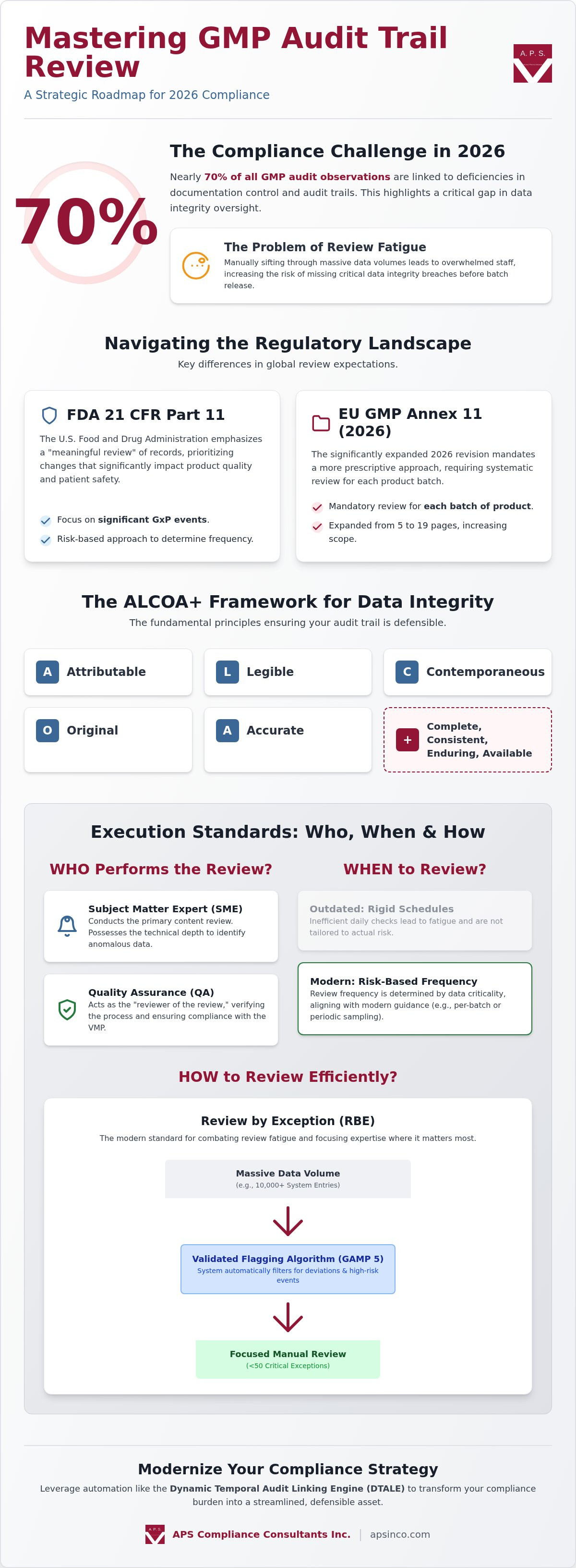
Nearly 70% of GMP audit observations in 2026 are linked to deficiencies in documentation control and audit trails. This staggering figure highlights the urgent need for a precise understanding of gmp audit trail review requirements to ensure systemic integrity. It's no longer enough to simply capture data; you must prove you are actively and regularly reviewing it.
We understand the weight of this responsibility. Reviewing massive data volumes leads to significant fatigue, and it's easy to feel overwhelmed by the complexity of distinguishing between basic system logs and critical GxP events. You need a strategy that provides security without stalling laboratory operations.
This guide helps you master regulatory expectations by providing a clear roadmap for compliance. We'll show you how to implement a risk-based approach that satisfies both FDA expectations and the expanded 2026 EU GMP Annex 11 revisions.
By aligning with GAMP 5 Second Edition and ALCOA+ principles, you'll learn to automate reviews using a Dynamic Temporal Audit Linking Engine. This ensures you focus expertise where it matters most, transforming your compliance burden into a streamlined, defensible asset.
Table of Contents
Regulatory Foundations: Defining GMP Audit Trail Review Requirements
Audit trail review (ATR) is the forensic process of evaluating the history of GxP-critical data. It ensures that every modification, deletion, or overwrite is fully traceable and justified. While many ask, "What is an Audit Trail?" in a general sense, meeting gmp audit trail review requirements demands a focus on systemic integrity through the ALCOA+ framework and GAMP 5 risk-based principles. This ensures data is Attributable, Legible, Contemporaneous, Original, and Accurate.
You must distinguish between simple system logs and GxP audit trails. System logs track IT-level events like successful logins or printer errors. In contrast, GMP audit trails record changes to sample weights, processing parameters, and final results. Relying on system logs alone won't satisfy inspectors because they don't provide the context needed to verify data integrity.
FDA vs. EU Annex 11: Key Differences in Review Expectations
Regulatory expectations vary by jurisdiction. The FDA emphasizes a "meaningful review" of records, focusing on significant changes that impact product quality. Conversely, the 2026 revision of EU GMP Annex 11, which expanded from 5 to 19 pages, mandates that audit trails be reviewed for each batch of product. For firms in North America, Health Canada GUI-0001 aligns with these global standards, requiring a defensive, risk-based approach to ensure gmp audit trail review requirements are met across the entire data lifecycle.
The Consequences of Inadequate Audit Trail Oversight
Gaps in oversight carry heavy penalties. In 2026, approximately 70% of GMP audit observations are linked to documentation control and audit trail deficiencies. Common FDA 483 citations often highlight a failure to review electronic records before batch release. This often stems from review fatigue. When your staff is buried under massive data volumes, the risk of missing a critical data integrity breach skyrockets. Modernizing this process isn't just about compliance; it's about operational survival.
Execution Standards: Who, When, and How to Review Audit Trails
Identifying the right personnel is the first step in meeting gmp audit trail review requirements. While QA provides oversight, the primary content review must be conducted by the Subject Matter Expert (SME) or process owner. These individuals possess the technical depth to recognize anomalous data patterns that a generalist might overlook. Every entry must reflect the ALCOA+ principles discussed earlier, particularly the "reason for change" requirement. A simple "correction" isn't enough; you need a justified rationale for every modification to maintain a defensible record.
Frequency shouldn't be a one-size-fits-all approach. Modern labs are transitioning from rigid daily checks to risk-based schedules, such as batch-release or periodic reviews. According to FDA guidance on data integrity, the frequency should be determined by the criticality of the data and the complexity of the system. Critical data elements, like final sample results, require a 100% review, whereas low-risk system metadata may only require periodic sampling.
The Role of Quality Assurance (QA) in the ATR Process
QA acts as the "reviewer of the review." Their job is to verify that the process owners are performing their duties according to the Validation Master Plan. This oversight includes self-inspections and standardizing ATR documentation to ensure your lab is always audit-ready. If you're struggling to define these roles, our team can help you establish a robust governance framework.
Review by Exception (RBE): The Modern Standard
Review by Exception (RBE) is the most effective way to combat review fatigue. Instead of scanning thousands of "normal" entries, the system flags only deviations or high-risk events for manual inspection. To use RBE, you must validate the flagging algorithms under GAMP 5 guidelines. This ensures the automated system is fit for its intended use and provides the same level of assurance as a manual review.
Implementing a Risk-Based Audit Trail Review Strategy
A one-size-fits-all approach to gmp audit trail review requirements is neither efficient nor effective. You must prioritize efforts based on the risk to product quality and patient safety. Start with a comprehensive system inventory and GxP criticality assessment. This allows you to distinguish between high-impact systems, like your LIMS or chromatography software, and lower-risk auxiliary systems. By focusing on the most critical data first, you ensure that your compliance efforts are both thorough and sustainable.
Once your inventory is set, follow these essential steps to build a defensible strategy:
Define Critical Data: Determine which entries, such as sample results and processing parameters, require immediate attention versus administrative metadata.
Establish Frequencies: Set review intervals based on system complexity and 21 CFR Part 11 requirements.
Standardize Procedures: Develop and validate ATR SOPs and checklists to ensure consistency across the laboratory.
Empower Personnel: Train your SMEs and QA staff on "meaningful review" techniques to move beyond simple clerical checks.
Data Integrity Risk Assessment (DIRA) for Audit Trails
A robust DIRA evaluates the probability of undetected data manipulation and its potential impact on the consumer. By aligning with GAMP 5 principles and PIC/S good practices, you can mathematically justify reduced review frequencies for low-risk systems. This focused approach ensures your team isn't wasting time on data that doesn't impact the final product's safety or efficacy. It's about working smarter, not harder, to maintain ALCOA+ standards.
Validation of the ATR Process
The review process itself must be validated to confirm its reliability. This involves ensuring that audit trails cannot be disabled or altered by unauthorized users. You must also verify electronic signature enforcement and perform "True Copy" certifications for any data transfers. If you need assistance building a risk-based framework that satisfies regulators, contact our consultants for a customized gap analysis.
Modernizing Compliance: Leveraging PharmaRockIT and DTALE for Efficient Reviews
Manual reviews aren't sustainable in high-volume laboratory environments. To meet modern gmp audit trail review requirements, forward-thinking firms are shifting toward digital ecosystems like PharmaRockIT. This modular platform is built specifically for computer system validation services, replacing cumbersome paper-based media with fully electronic, attributable records. By centralizing governance through the PharmaRockIT Cockpit, you can streamline ATR across multiple global sites while maintaining a strictly validated state that satisfies both FDA and Annex 11 auditors.
Simplifying Complex Investigations with DTALE
Advanced investigations require more than just a chronological list of changes; they require context. Our proprietary Dynamic Temporal Audit Linking Engine (DTALE) tracks hierarchical event dependencies, revealing how a single parameter modification ripples through the entire sample lifecycle. By visualizing these complex data relationships, you can quickly identify systemic patterns of non-compliance or human error. This deep visibility is a game-changer for lab efficiency. It has been documented to reduce the time spent on Out of Specification (OOS) investigations by up to 40%.
SaaS vs. On-Premises: Impact on Audit Trail Maintenance
Choosing the right infrastructure significantly impacts your long-term compliance burden and total cost of ownership. Cloud-native solutions like PharmaRockIT reduce the ongoing validation effort from a typical 35% down to just 15%, liberating your staff from repetitive IT tasks. For domestic firms, we ensure data sovereignty through Canadian-hosted infrastructure, providing peace of mind regarding data residency. Partnering with GAMP 5 validation experts ensures that your SaaS audit trails remain in a perpetual state of readiness. This approach strictly adheres to ALCOA+ principles while empowering your laboratory to scale with confidence.
Future-Proofing Your Data Integrity Strategy
Mastering gmp audit trail review requirements is no longer just a regulatory hurdle; it's a competitive necessity in an increasingly digital landscape. By shifting from exhaustive manual checks to a risk-based, automated approach, you empower your laboratory to maintain the highest standards of data integrity while reclaiming valuable operational time. Aligning with GAMP 5 principles and the latest 2026 Annex 11 revisions ensures your firm remains audit-ready and resilient.
At APS Compliance Consultants Inc., we're dedicated to simplifying these high-stakes burdens. Our bilingual North American and European support team brings GAMP 5 certified validation methodologies directly to your workflow. Whether you're utilizing our proprietary Dynamic Temporal Audit Linking Engine for complex investigations or seeking a centralized governance model, we provide the seasoned expertise you need to succeed. Don't let review fatigue compromise your systemic integrity. Contact APS Compliance Consultants Inc. for a Data Integrity Gap Assessment or PharmaRockIT Demo today. We're ready to partner with you to turn regulatory complexity into a streamlined, defensible asset.
Frequently Asked Questions
Who is responsible for performing the audit trail review in a GMP lab?
The Subject Matter Expert (SME) or process owner is primarily responsible for performing the review. They possess the technical knowledge to evaluate the data's scientific validity and context. While IT manages the system infrastructure, they don't understand the nuance of the results. This ensures that gmp audit trail review requirements are met with technical precision. QA then provides the final oversight to confirm the review was completed according to established SOPs.
How often must audit trails be reviewed according to the FDA?
The FDA requires the review frequency to be commensurate with the risk and criticality of the data. For critical data impacting batch release, the review must occur before the batch is distributed. For other systems, a periodic schedule based on a documented risk assessment is acceptable. This risk-based approach prevents review fatigue while ensuring that significant changes to GxP records are captured and evaluated in a timely manner.
What is the difference between an audit trail and a system log?
An audit trail records GxP-critical actions like data creation, modification, or deletion, including the "who, when, and why" of the change. In contrast, a system log tracks technical events such as login attempts, hardware errors, or network connections. Inspectors expect you to focus your gmp audit trail review requirements on the audit trail, as it directly impacts data integrity, whereas system logs are primarily used for IT troubleshooting.
Can QA perform the audit trail review instead of the process owner?
QA shouldn't be the primary reviewer of technical data content. They often lack the specific laboratory or manufacturing expertise required to spot subtle data manipulations or scientific inconsistencies. The process owner performs the content review to verify accuracy and ALCOA+ compliance. QA’s role is to act as a secondary check, verifying that the review process followed the Validation Master Plan and that all deviations were properly investigated.
Is review by exception (RBE) acceptable to GMP inspectors?
Yes, inspectors accept Review by Exception (RBE) if the underlying system is properly validated. You must demonstrate that the software accurately flags all deviations, deletions, and modifications for manual oversight. This approach is supported by GAMP 5 and the 2026 EU GMP Annex 11 revisions. It allows your team to focus on high-risk events rather than scanning thousands of compliant entries, significantly improving the efficiency of your data integrity program.


Comments