

CMMS Validation for FDA Compliance: 2026 Strategic Guide
- 6 minutes ago
- 8 min read
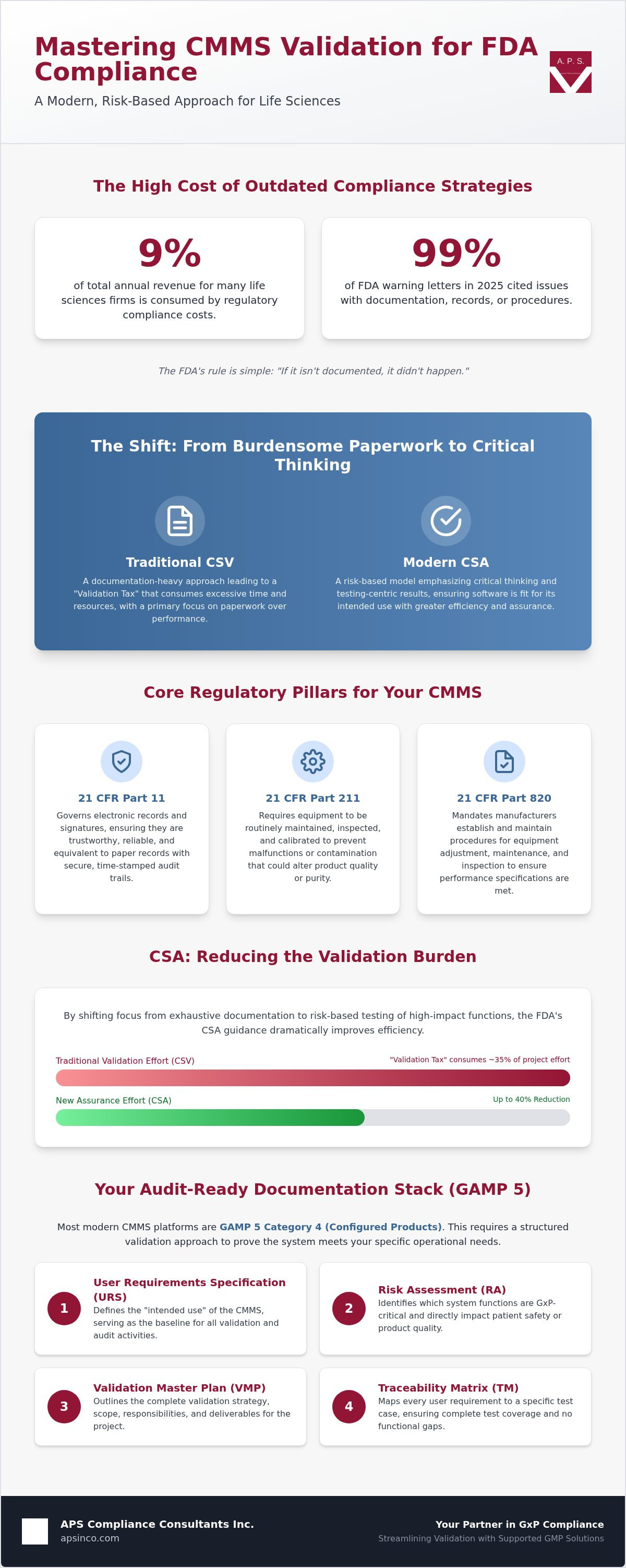
Did you know that for many life sciences firms, the cost of regulatory compliance now consumes up to 9% of total annual revenue? It's a staggering figure that highlights why the traditional, documentation-heavy approach to maintenance systems is no longer sustainable. You're likely feeling the mounting pressure of 21 CFR Part 11 complexity and the burden of manual, paper-heavy processes while trying to achieve CMMS validation for FDA compliance. We understand the fear of audit findings caused by maintenance record gaps, especially since 99% of FDA warning letters in 2025 cited issues with documentation or procedures.
This guide will show you how to master the transition from rigid CSV to the FDA’s modern, risk-based Computer Software Assurance (CSA) model. By focusing on critical thinking rather than excessive paperwork, you can reduce validation effort by up to 40%. We’ll preview the latest 2026 regulatory shifts, including the updated EU GMP Annex 11, and explain how cloud-native tools like PharmaRockIT CMMS ensure your maintenance records remain audit-ready, accurate, and fully optimized for digital deployment.
Table of Contents
Why CMMS Validation is a Regulatory Priority for FDA Compliance
CMMS validation for FDA compliance represents more than a technical checkbox; it's the documented assurance that your maintenance software performs exactly as intended in its specific operational environment. Within the life sciences, the integrity of your equipment is the foundation of product quality. If a sterilizer or a tablet press isn't maintained according to validated schedules, the risk to batch consistency and patient safety becomes unacceptable. With 99% of FDA warning letters in 2025 citing issues with documentation, records, or procedures, the stakes for your maintenance data have never been higher. The FDA operates under a strict "if it isn't documented, it didn't happen" rule, meaning missing maintenance logs are treated as a failure in CGMP.
Regulatory bodies expect a high level of systemic integrity. Key regulations governing this space include:
21 CFR Part 211: Requires that equipment be maintained and calibrated at appropriate intervals to prevent contamination or malfunctions.
21 CFR Part 820: Mandates that manufacturers establish and maintain procedures for equipment adjustment, maintenance, and inspection.
21 CFR Part 11: Sets the standards for electronic records and signatures used within the CMMS to ensure they're trustworthy and equivalent to paper records.
The Risk of Non-Compliance: Beyond Audit Findings
A failed audit is only the tip of the iceberg. The real danger lies in how equipment failure directly impacts product efficacy. Unplanned downtime or poorly calibrated machinery leads to batch deviations, costly recalls, and potential patient harm. Manual, paper-heavy systems exacerbate these risks by creating data silos and increasing transcription errors. Transitioning to a validated digital environment ensures that 21 CFR Part 11 requirements are met through secure, time-stamped audit trails and electronic signatures. This level of systemic integrity empowers your team to move away from reactive firefighting and toward a state of controlled, proactive maintenance that simplifies CMMS validation for FDA compliance while satisfying both regulators and stakeholders.
The GAMP 5 Framework for Maintenance System Validation
GAMP 5 provides the structured roadmap necessary for a robust validation strategy. Most modern maintenance platforms are classified as Category 4 (Configured Products). This means while the software is a standard commercial product, your team must configure it to meet specific site workflows. A dedicated Validation Master Plan (VMP) defines the scope and ensures every step of the IQ/OQ/PQ hierarchy aligns with your operational goals. During this process, adhering to ALCOA+ principles is mandatory. Every maintenance log and audit trail must be attributable, legible, and contemporaneous to withstand the scrutiny of an inspection.
The Essential Documentation Stack
Successful CMMS validation for FDA compliance relies on a core set of documents that prove systemic integrity. The User Requirements Specification (URS) is your baseline; it defines the "intended use" that the FDA will audit against. Next, a Risk Assessment (RA) identifies which maintenance functions are GxP-critical. Finally, the Traceability Matrix (TM) maps every requirement to a specific test case, ensuring no functional gap remains unverified.
Establishing Audit-Ready Calibration and Maintenance Workflows
Effective validation covers the entire equipment lifecycle, from initial procurement to final retirement. By integrating equipment qualification iq oq pq directly into your CMMS, you create a centralized source of truth that simplifies future CMMS validation for FDA compliance activities. This integration eliminates the risk of manual transcription errors and ensures that calibration schedules are automatically triggered and recorded. While vendors provide the foundation, remember that site-specific Performance Qualification (PQ) is essential to verify the system in your unique environment. If you're looking to modernize your current approach, our team can help you develop a customized validation roadmap that balances speed with absolute regulatory security.
Accelerating Timelines with Computer Software Assurance (CSA)
The traditional "Validation Tax" has long burdened life sciences maintenance departments, often consuming up to 35% of a project's total effort. This is changing rapidly. The FDA’s February 2026 guidance on Computer Software Assurance (CSA) marks a definitive shift from documentation-centric Computerized System Validation (CSV) toward a risk-based, testing-focused approach. By prioritizing critical thinking over burdensome paperwork, organizations can now reduce their validation drag to as little as 15% of the total project lifecycle.
For non-product software like a CMMS, the focus moves away from proving every button works to ensuring the system supports overall quality and safety. You don't need exhaustive scripts for every minor configuration. Instead, CSA encourages unscripted testing for low-risk functions, allowing your team to focus their energy where it matters most. This streamlined methodology is a cornerstone of modern CMMS validation for FDA compliance, empowering you to deploy digital tools faster without compromising on regulatory integrity.
CSV vs. CSA: Which Methodology to Choose?
Traditional CSV relies on rigid, pre-approved scripts with "pass/fail" results for every step, which is often overkill for maintenance workflows. In contrast, CSA utilizes unscripted testing where the tester’s expertise and real-time observation provide the evidence needed. High-risk maintenance functions, such as those impacting sterile processing or critical calibration limits, may still require traditional CSV’s scripted rigor. However, for most CMMS workflows, unscripted testing provides sufficient assurance while accelerating deployment timelines. The primary goal of CSA is to focus resources on critical-to-quality functions that directly impact patient safety and product integrity.
Ready to slash your compliance overhead and modernize your systems? Contact our consultants to transition your facility to a CSA model.
The APS Advantage: Supported GMP Solutions and Validated SaaS
Choosing standalone software often leaves your quality team alone with the immense burden of regulatory proof. APS Compliance Consultants Inc. acts as a digitalization partner, providing supported GMP solutions through PharmaRockIT CMMS and Alleye CMMS. These cloud-native platforms utilize a Zero-Footprint architecture that completely eliminates the need for local server qualification. By leveraging our robust vendor-base validation, you can focus your resources purely on site-specific Performance Qualification (PQ). Our local Canadian team provides bilingual compliance expertise in both English and French, ensuring your CMMS validation for FDA compliance is handled by experts who understand your specific regional requirements.
PharmaRockIT CMMS: Calibration and Maintenance Lifecycle
PharmaRockIT CMMS centralizes the entire equipment lifecycle within a single, secure ecosystem. The Cockpit module offers multi-site organizations a unified view for centralized governance, while our proprietary Dynamic Temporal Audit Linking Engine (DTALE) tracks complex event dependencies during investigations. This level of systemic integrity is vital for maintaining ALCOA+ standards at every stage of operation. We advocate for a modular implementation, which supports a phased approach to computer system validation services. This strategy empowers you to digitize your most critical maintenance workflows first, effectively reducing the initial validation effort from 35% to 15%.
Strategic Next Steps for Your Maintenance Digitalization
Your path to a paperless facility starts with a comprehensive Data Integrity Gap Assessment. This critical step identifies vulnerabilities in your current manual logs before you commit to new software. Once these gaps are mapped, partnering with gamp 5 validation experts will ensure a streamlined rollout. It's time to move away from reactive compliance and toward a state of controlled, proactive maintenance excellence that satisfies both internal stakeholders and global regulators while simplifying your long-term CMMS validation for FDA compliance.
Future-Proofing Your Maintenance Compliance Strategy
The shift toward Computer Software Assurance (CSA) is more than a regulatory update; it's a strategic opportunity to reclaim lost productivity while ensuring your facility remains at the cutting edge of GxP standards. By moving away from documentation-heavy legacy models, you can prioritize critical-to-quality functions that safeguard your products and patients. Implementing a robust strategy for CMMS validation for FDA compliance ensures your maintenance records are always audit-ready, providing the systemic integrity required for 21 CFR Part 11.
APS Compliance Consultants Inc. provides the specialized expertise needed to navigate this transition seamlessly. We help you accelerate validation projects by up to 40% using our proven templates and the PharmaRockIT ecosystem, a solution trusted by industry leaders like Neopharm. With our deep GAMP 5 knowledge and bilingual support in the Greater Montreal Area, we serve as your dedicated partner. It's time to replace manual silos with a validated, cloud-native architecture that grows with your organization. We're ready to help you achieve a state of controlled, proactive excellence.
Streamline your maintenance compliance with APS today
Frequently Asked Questions
Is CMMS software pre-validated by the vendor?
No software is truly pre-validated by a vendor alone. While APS provides a robust validation base for PharmaRockIT CMMS, the FDA requires site-specific Performance Qualification (PQ). This step confirms that the software performs as intended within your unique operational environment. You must document this evidence on-site to ensure full regulatory adherence and verify that your specific maintenance workflows meet all CGMP standards.
What is the difference between CSV and CSA for maintenance software?
Computerized System Validation (CSV) is a traditional, documentation-heavy approach that requires rigid scripts for every feature. Conversely, Computer Software Assurance (CSA) is a modern, risk-based methodology that focuses on testing critical-to-quality functions. For CMMS validation for FDA compliance, CSA allows your team to use unscripted testing for low-risk features. This shift reduces total validation effort by up to 40% while still maintaining absolute systemic integrity.
How does 21 CFR Part 11 affect electronic maintenance signatures?
This regulation mandates that electronic signatures are secure, attributable, and equivalent to traditional paper signatures. Your system must maintain a time-stamped audit trail that captures every modification. By following ALCOA+ principles, PharmaRockIT CMMS ensures that all maintenance records remain trustworthy. Our proprietary DTALE engine tracks event dependencies, providing the high degree of professional authority needed to satisfy inspectors during complex data integrity investigations.
Does a cloud-based CMMS meet FDA data residency requirements?
Yes, cloud-based systems meet FDA requirements as long as the data remains secure and accessible for inspections. The FDA prioritizes data integrity over physical server locations. Our cloud-native Alleye CMMS uses a Zero-Footprint architecture to manage your records safely. This approach eliminates the burden of local infrastructure qualification while ensuring that your maintenance data is always backed up, encrypted, and ready for a regulatory audit.
How often do I need to re-validate my CMMS software?
Re-validation isn't a fixed calendar event but is triggered by major system changes or software updates. You should conduct periodic reviews to ensure the system remains in a validated state. When updates occur, a risk-based assessment determines which GxP-critical functions require new testing. This targeted approach to CMMS validation for FDA compliance prevents unnecessary downtime while ensuring your maintenance operations stay fully aligned with the latest 2026 regulatory standards.


Comments