

LIMS Validation Services: A Strategic Guide to GxP Compliance in 2026
- 11 minutes ago
- 8 min read
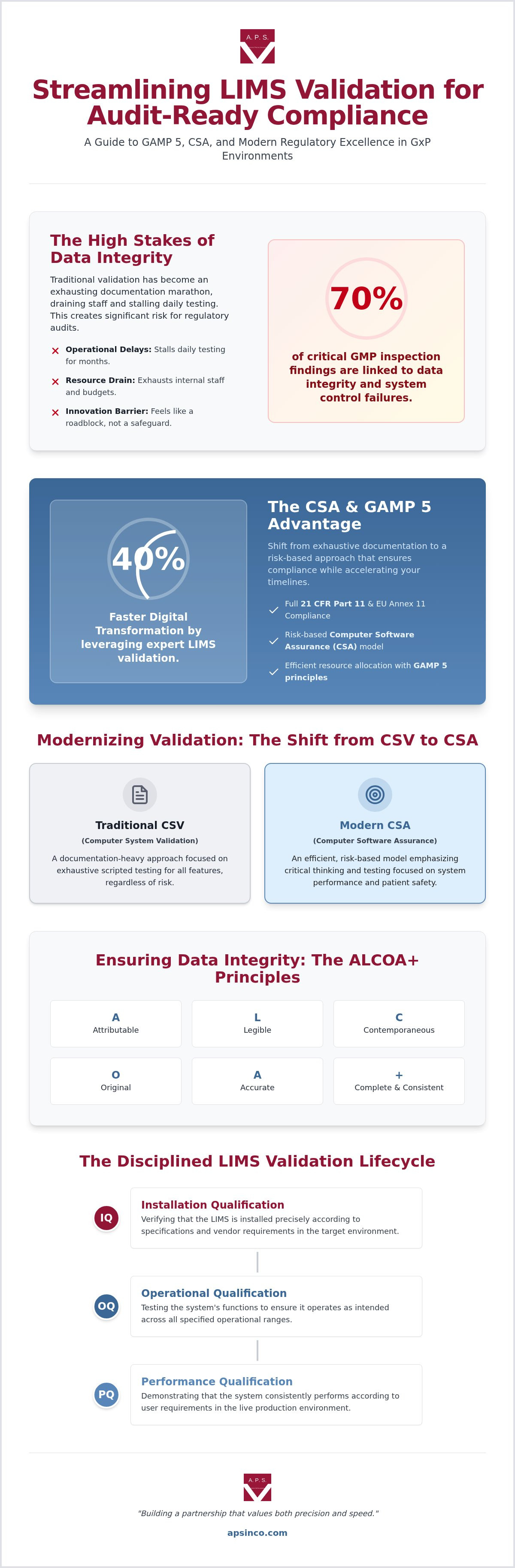
Nearly 70% of critical GMP inspection findings in early 2026 are linked to data integrity gaps and computerized system control failures. If you're currently managing LIMS validation services internally, you know the prospect of an upcoming FDA or Health Canada audit brings a familiar sense of dread. It's common to feel that traditional validation has become an exhausting documentation marathon that drains your staff and stalls daily testing for months. This high-stakes burden often feels like a barrier to innovation rather than a necessary safeguard for quality.
Expert compliance support shouldn't be a source of operational friction. By leveraging a risk-based Computer Software Assurance (CSA) approach and GAMP 5 principles, you can ensure full 21 CFR Part 11 compliance while accelerating your digital transformation by up to 40%. This guide explores how to achieve an audit-ready state using ALCOA+ principles and modular ecosystems like PharmaRockIT. We'll show you how to streamline your IQ/OQ/PQ processes, minimize disruptions to your bench work, and build a clear traceability matrix that stands up to the most rigorous regulatory scrutiny.
Table of Contents
Defining LIMS Validation Services in Regulated Environments
LIMS validation services provide the documented evidence that a laboratory system consistently performs according to its intended use, serving as the essential safeguard for data integrity and audit readiness in regulated environments. In a GxP setting, this process is the foundational bedrock of operational integrity. It's the primary mechanism used to ensure your system is audit-ready and that every byte of data generated meets ALCOA+ principles. Without this rigorous oversight, even the most advanced software can't guarantee the reliability of its results.
This validation goes far beyond basic software testing. It encompasses complex workflows, instrument connectivity, and the automated generation of data reports. For laboratories operating under FDA 21 CFR Part 11, EU Annex 11, or Health Canada requirements, validation ensures that electronic records are as trustworthy as their paper predecessors. In Canada, this also necessitates a keen eye on data residency requirements to ensure compliance with national standards. It's a holistic approach that examines how data moves from the bench to the final report.
Why Professional Validation Services are Essential
Navigating the dense regulatory landscape without specialized expertise often results in costly 483 observations or Health Canada audit findings. Professional consultants act as your strategic guides, providing the critical Traceability Matrix that links every user requirement directly to functional testing results. This level of systemic integrity is what separates a compliant lab from one at risk of failing an inspection during a surprise visit.
We understand the pressure of balancing daily testing with documentation needs. APS Compliance Consultants help labs accelerate these timelines by 40% through standardized computer system validation services. By utilizing proven templates and a risk-based GAMP 5 approach, we empower your team to focus on core science while we handle the technical burden of compliance. It's about building a partnership that values both precision and speed.
The GAMP 5 Framework for LIMS Validation
GAMP 5 Second Edition remains the definitive global standard for a risk-based approach to computerized system validation. It allows laboratories to scale their validation efforts based on the complexity and intended use of the software. A primary component of this framework is software categorization. Category 4 systems, such as configured LIMS like PharmaRockIT, utilize standard software functionality with user-defined parameters. These require significantly less intensive testing than Category 5 systems, which involve bespoke, custom-coded functions. By accurately identifying these categories, professional LIMS validation services ensure your resources are allocated where they offer the most protection.
Effective validation isn't about testing every possible button; it's about testing what counts. A robust risk assessment focuses validation efforts on functions that directly impact patient safety and product quality. This targeted methodology ensures your data consistently adheres to ALCOA+ principles. Your records must be Attributable, Legible, Contemporaneous, Original, and Accurate, as well as complete and consistent. When you prioritize these high-stakes areas, you create a defensible compliance posture that stands up to the most detailed regulatory audits.
CSV vs. CSA: The Modern Validation Debate
The industry is rapidly shifting from traditional Computer System Validation (CSV) toward the more efficient Computer Software Assurance (CSA) model. While CSV often results in a documentation marathon, CSA emphasizes critical thinking and risk-based testing. This modern approach reduces the burden of scripted testing for low-risk features, allowing your team to focus on actual system performance. Partnering with GAMP 5 validation experts ensures you're utilizing the latest FDA guidance from February 2026 to streamline your deployment. If you're ready to modernize your approach, consulting with our team can help you identify the most efficient path to compliance.
Executing the LIMS Validation Lifecycle: IQ, OQ, and PQ
Success in LIMS validation services relies on a disciplined execution of the validation lifecycle. This structured approach moves your system from a raw software installation to a fully compliant, production-ready asset. The process begins with Installation Qualification (IQ), where we verify that the LIMS is installed precisely according to vendor specifications and your specific IT infrastructure requirements. Once the foundation is stable, we transition to Operational Qualification (OQ). During this phase, we test functional requirements in a controlled, non-production environment to ensure every configured feature operates as intended. Finally, Performance Qualification (PQ) confirms the system handles real-world lab workflows and peak data loads without compromising integrity. A comprehensive Final Validation Report then summarizes these results, providing the formal authorization needed for a confident 'Go-Live'.
The Importance of User Requirement Specifications (URS)
Validation projects often fail because the URS is poorly defined or too vague. It's the foundation of the entire project; if you don't know what you're testing against, you can't prove compliance. APS helps laboratories develop 'High-Level URS' frameworks that align technical requirements with overarching business goals. This ensures every test script has a direct purpose and every function serves your specific operational needs, preventing the common pitfall of over-validating unnecessary features.
Instrument Qualification and Connectivity
A critical yet overlooked aspect of validation is the 'LINK' between your benchtop instruments and the LIMS. Automating this data transfer is the most effective way to eliminate transcription errors and manual entry risks. Achieving total lab compliance often requires a parallel focus on equipment qualification IQ OQ PQ to ensure your hardware is as reliable as your software. If you're ready to bridge the gap between your instruments and your data, contact our experts today to start your transformation.
Reducing Validation Effort with Modular SaaS LIMS Solutions
Efficiency in the lab is often hampered by the sheer weight of infrastructure setup. Traditional on-premises systems demand 20-25% of the total project effort just for installation and server configuration. In contrast, validated SaaS solutions, often called "Zero-Footprint" LIMS, reduce this initial burden to just 5-10%. By moving to a modular architecture, laboratories can adopt a "phased validation" strategy. This approach spreads out the investment and reduces the immediate risk associated with a massive, single-phase rollout. It allows your team to validate and deploy critical modules first, gaining immediate value while the rest of the system follows.
As a core part of modern LIMS validation services, PharmaRockIT arrives with a pre-validated status. This significantly minimizes the Performance Qualification (PQ) burden on your internal staff, as the underlying platform has already undergone rigorous testing. This shift empowers lab personnel to maintain the system directly rather than relying solely on IT departments, ensuring that the software evolves alongside your scientific processes. When the platform handles the heavy lifting of infrastructure validation, your scientists can focus on high-value data analysis and core research objectives.
PharmaRockIT: A Compliant Digitalization Ecosystem
PharmaRockIT is more than a tool; it's a cloud-native ecosystem designed for regulatory sovereignty. It features Canadian-hosted data residency, providing peace of mind for entities that must keep data within national borders. The integrated DTALE engine provides hierarchical audit trails, which simplify complex investigations by linking data points across different modules. This level of systemic integrity ensures that every action is traceable and defensible. For those still weighing their options, it's beneficial to consult a LIMS software selection guide to understand how modularity specifically benefits your unique workflows. Utilizing professional LIMS validation services in tandem with this modular approach ensures your lab stays agile and compliant in an increasingly digital landscape.
Modernizing Your Laboratory Compliance Strategy for 2026
The future of laboratory compliance isn't found in thicker binders or endless manual checks. It's built on a foundation of critical thinking and agile methodologies. By transitioning to a risk-based CSA model, you can replace the traditional documentation marathon with a streamlined process that prioritizes patient safety and product quality. Embracing modular, cloud-native ecosystems like PharmaRockIT allows your team to focus on science while maintaining regulatory sovereignty through secure data residency.
Expert LIMS validation services bridge the gap between complex GxP requirements and operational efficiency. With deep expertise in GAMP 5 and 21 CFR Part 11, we help you navigate the 2026 regulatory landscape with confidence. Our proven templates and methodologies allow you to accelerate projects by up to 40%, ensuring you stay ahead of inspection trends. It's time to transform compliance from a bottleneck into a competitive advantage for your laboratory. We're here to ensure your transition is seamless, secure, and fully audit-ready.
Accelerate your lab's compliance with APS validation services today.
Frequently Asked Questions
What is the difference between LIMS validation and LIMS verification?
Validation is the holistic process of proving a system meets its intended use and regulatory requirements, while verification focuses on whether the software meets its technical design specifications. In a GxP environment, verification is often a component of the broader validation effort. We ensure that your LIMS doesn't just work technically but actually supports your specific laboratory workflows and compliance goals.
How long does a typical LIMS validation project take with APS?
Timelines for LIMS validation services vary based on system complexity and your specific laboratory requirements. While traditional on-premises projects can span six to nine months, our risk-based GAMP 5 approach often accelerates these timelines by up to 40%. By utilizing pre-validated templates and modular ecosystems like PharmaRockIT, we streamline the process to ensure your lab reaches a compliant, audit-ready state much faster.
Is 21 CFR Part 11 compliance included in LIMS validation services?
Yes, 21 CFR Part 11 compliance is a foundational element of our validation strategy. We specifically test and document electronic records, audit trails, and electronic signature functionalities to ensure they meet the highest regulatory standards. Our methodology ensures that your digital data is as reliable and trustworthy as paper records, satisfying the strict requirements of both the FDA and Health Canada during inspections.
Can APS validate an existing legacy LIMS that was never properly qualified?
We can perform retrospective validation on legacy systems to bring them into full compliance with current GxP standards. This process involves a thorough gap analysis to identify missing documentation or functional risks followed by targeted testing to remediate those findings. Our experts help you establish a defensible traceability matrix for your existing software, ensuring that your historical data and current operations remain secure during regulatory audits.
What documentation deliverables should I expect from a validation service?
You should expect a comprehensive validation package that includes the User Requirement Specifications (URS), a risk assessment, and detailed IQ, OQ, and PQ protocols. We also provide a completed Traceability Matrix and a Final Validation Summary Report. These documents serve as your primary evidence of compliance, demonstrating to inspectors that your system has been rigorously tested and is authorized for its intended use in a regulated environment.


Comments