

21 CFR Part 11 Gap Assessment: A Practical Guide for 2026
Could your systems have electronic signatures and access controls in place, yet still leave you unable to demonstrate that regulated records are trustworthy? A 21 CFR Part 11 gap assessment makes the difference visible by connecting applicable requirements to evidence you can test, document, and defend.
If you’re unsure which systems belong in scope, how to judge control effectiveness, or how to plan remediation without disrupting regulated operations, a structured assessment can bring clarity. Part 11 applicability depends on the electronic records and signatures required by underlying predicate rules, so start with intended use and record flows, not a blanket review of every system.
This guide explains how to define a defensible scope, evaluate controls such as access management, audit trails, electronic signatures, and computer system validation, then rank gaps by potential impact. You’ll also learn how to document evidence and risk rationale, assign remediation actions, and plan follow-up to maintain the validated state. APS connects assessment findings with computer system validation and data integrity work through a tailored, risk-based approach for GxP-regulated environments.
Table of Contents
What a 21 CFR Part 11 gap assessment examines, and why scope matters
A 21 CFR Part 11 gap assessment is a documented comparison of applicable controls with objective system evidence and the system’s intended use. It identifies where procedures, configured functions, or actual practices may not support the electronic records and signatures used in a regulated process. It is a diagnostic activity, not a substitute for computer system validation: the assessment identifies and prioritizes gaps, while validation documents evidence that the system performs its intended functions.
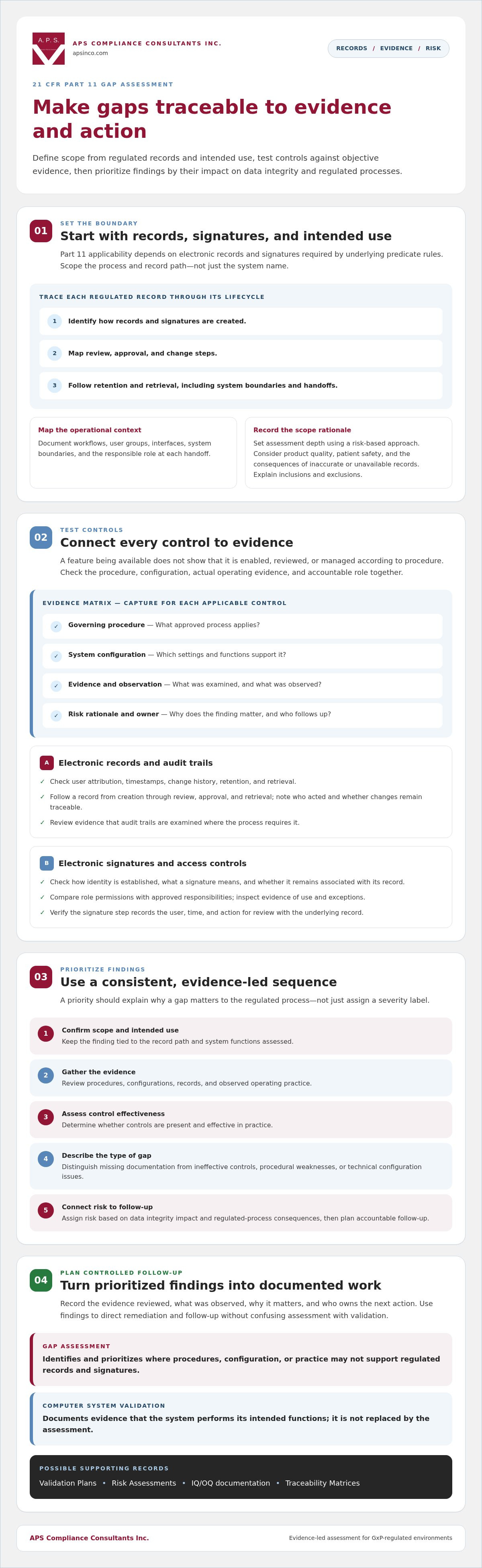
Scope starts with applicability. Identify records and signatures required under relevant predicate rules, then trace how they are created, reviewed, approved, changed, retained, and retrieved. A system name alone is not enough to determine scope; the process and use of its electronic records matter. For regulatory context, see the 21 CFR Part 11 requirements. The 21 CFR Part 11 Wikipedia article can provide supplementary historical context, but assess applicability against current authoritative guidance.
Set the boundaries around records, signatures, and system use
Document the regulated process and intended use before testing controls. Map relevant electronic records, signature steps, workflows, user groups, interfaces, and system boundaries. For example, if a laboratory result moves from an instrument into a data system and then into a quality workflow, map each transfer and identify where review or approval occurs. Record the source, destination, and responsible role at each handoff. This map helps distinguish the regulated record path from unrelated system functions.
Keep assessment scope proportionate to system risk
Set assessment depth through a risk-based approach. Consider the data’s role in product quality or patient safety, the consequences of an inaccurate or unavailable record, and how the system supports the regulated process. Document why functions are included or excluded so the rationale can be reviewed and repeated. If jurisdictional or interpretive questions arise, record them for review against current authoritative guidance rather than assuming one interpretation applies everywhere.
Which Part 11 control areas should the assessment examine?
A 21 CFR Part 11 gap assessment should test controls against evidence, not just compare a feature list with regulatory language. For each applicable area, record the governing procedure, relevant configuration, evidence examined, observed result, and responsible role. A system may have an audit-trail function, for example, but that alone doesn’t show it’s enabled, reviewed, or managed according to an approved procedure.
Use the FDA Guidance on 21 CFR Part 11 Scope and Application to inform interpretation. Keep regulatory expectations distinct from internal procedures and operational evidence.
Evaluate electronic records and audit trails
Check whether records can be attributed to users and whether timestamps, change history, retention, and retrieval support the regulated workflow. Review relevant procedures and evidence that audit trails are examined where required by the process. For a useful sample, follow a record from its creation through review, approval, and retrieval, noting who performed each action and whether changes remain traceable. ALCOA+ can frame questions about data integrity, such as whether information is attributable, legible, and available, but it doesn’t replace applicable regulations or a documented assessment.
Evaluate electronic signatures and access controls
Examine how identity is established, what a signature means in the workflow, and whether it remains associated with its record. Compare role permissions with approved responsibilities, then inspect evidence of actual use and exceptions. Check whether the signature step records the user, time, and action in a way that can be reviewed with the underlying record. Don’t infer effectiveness from a configured option alone; check that procedures, system settings, and operating practice align.
Capture findings in a consistent evidence matrix. For each control area, state what you reviewed, what you observed, why it matters, and who owns follow-up.
Control area
Evidence, observation, risk rationale, and owner
Records and retention
Record samples and procedures; note exceptions, data impact, and process owner.
Audit trails
Configuration and review records; document gaps, integrity implications, and quality owner.
Signatures and access
Settings, role assignments, and workflow evidence; record exceptions, consequences, and system owner.
APS can help your team connect assessment evidence with data integrity and computer system validation work. Discuss your assessment needs with APS.
How to prioritize Part 11 gaps without treating every finding equally
Prioritization should show why a finding matters to the regulated process, not just assign it a severity label. Apply a consistent sequence so reviewers can trace each priority from scope and evidence to a controlled follow-up. Check the applicable text in the Official 21 CFR Part 11 Regulation and document the basis for your interpretation.
Confirm the assessment scope and intended use.
Gather procedures, configurations, records, and observed operating evidence.
Assess whether controls are present and effective in practice.
Document each gap and distinguish missing documentation from ineffective controls, procedural weaknesses, or technical configuration issues.
Assign risk based on data integrity impact and regulated-process consequences, then plan follow-up.
For example: “This finding is high priority because the sampled workflow permits changes to regulated results without documented review, which could affect the integrity of data used for a quality decision.” Adapt the rationale to observed evidence; don’t copy a severity label without explaining its basis.
Document defensible findings and risk rationale
For each gap, record the control question, evidence reviewed, observation, and impact rationale. Cite specific records, configurations, or procedures, and note evidence limitations or exceptions. A missing procedure may call for a different response than a configured control that fails in operation. This distinction helps reviewers understand the finding and lets the accountable team select corrective action that addresses the cause.
Turn ranked findings into controlled remediation
Translate each priority into an accountable owner, defined action, target date, and objective closure evidence. Where remediation changes system functionality or regulated workflows, link the work to change control, testing, training, and computer system validation as applicable. APS can help connect assessment findings with risk assessments and validation documentation. Plan risk-based remediation with APS.
From assessment findings to audit readiness: how APS can support next steps
A 21 CFR Part 11 gap assessment is most useful when its conclusions inform decisions across quality, laboratory, process, and technical teams. APS works with these stakeholders to translate findings into actions that fit the system’s intended use and operational context, then establish how progress and evidence will be reviewed. This keeps remediation connected to the work people perform, rather than treating it as a separate documentation exercise.
Plan for controlled implementation and ongoing oversight. Route approved actions through your quality processes, with appropriate review of system changes and their effects on regulated workflows. For systems requiring direct technical fixes or architectural updates, engineering specialists like The Code Factory provide production readiness reviews and code remediation before formal re-testing. APS’s computer system validation services provide support for maintaining controls through the system lifecycle.
Connect remediation to the wider validation lifecycle
Before closing a finding, define what will demonstrate that the corrective action works in practice. Depending on the action, that may include reviewed test results, updated procedures, training records, or documented approval. Tie each item to the relevant finding so reviewers can follow the decision and its outcome. Continue oversight as changes occur, rather than treating closure as the end of compliance responsibility.
Build the assessment around operational ownership
Assign roles according to who makes decisions and performs the work. Quality can oversee compliance decisions, system owners coordinate system changes, laboratory and process users assess workflow impact, and technical teams support implementation. APS brings GAMP5 expertise to this collaborative process; its GAMP 5 validation guidance provides context for aligning validation effort with risk.
To discuss how APS can support your assessment and follow-up, Discuss your Part 11 assessment with APS.
Make compliance progress part of the system lifecycle
Use lessons from a 21 CFR Part 11 gap assessment to shape future system decisions. Recurring issues can point to requirements that need clearer definition before a new workflow or technology is introduced, such as how records are attributed or how users carry out approvals. Bringing these lessons into planning helps teams consider compliance and data integrity early, alongside operational needs.
That forward view can make future projects more deliberate. Quality, laboratory, and technical stakeholders can agree on what trustworthy records and workable controls should look like before design and configuration decisions are made.
APS can work with your team to turn assessment insights into practical next steps. Discuss your Part 11 assessment with APS to move forward with greater clarity in your compliance planning.
Frequently Asked Questions
Is a 21 CFR Part 11 gap assessment legally required?
No. 21 CFR Part 11 doesn’t prescribe a gap assessment as a named deliverable. It’s an organizational assessment method, not a separate FDA filing. For governance, define who approves its conclusions, how unresolved issues are escalated, and how the rationale is retained with quality records. This helps management explain decisions and demonstrate a consistent compliance process during internal or external review.
Does every computerized system need a 21 CFR Part 11 gap assessment?
No. For shared or modular platforms, assess regulated functions and their dependencies rather than treating every feature as one indivisible unit. A reporting function used for a quality decision may need different scrutiny from unrelated administrative functions. Keep an inventory that identifies configuration boundaries, interfaces, and accountable owners so teams can reconsider those boundaries if workflows are redesigned.
How often should an organization repeat a Part 11 gap assessment?
There’s no single interval specified for all organizations. Set a documented review cadence within your quality system and explain its basis, considering the system’s role, data criticality, and past control performance. Software supporting release decisions may warrant a different cadence from a low-impact application. Quality should approve the schedule and ensure overdue reviews are visible and escalated.
Can a Part 11 gap assessment replace computer system validation?
No. An assessment isn’t evidence that system functions operate correctly under defined conditions. Identifying a calculation as critical, for example, doesn’t show that its output is accurate across specified inputs; that conclusion requires suitable validation evidence. Link assessment conclusions to the validation record, while retaining test execution, deviation, and approval records as evidence of system performance.
How should a company assess a cloud-hosted system for Part 11 gaps?
Assess the supplier relationship as well as the application. Define which activities your organization controls and which the provider performs, then consider service commitments, data location, backup and recovery arrangements, and how provider changes are communicated. Vendor documentation and broader cyber security due diligence can inform the review, but your organization still needs evidence that the configured service and connected workflows fit regulated use. Record assumptions and supplier dependencies for future review.



Comments