

Medical Device Software Validation Services: A Practical Buying Guide
What if the greatest validation risk is not an incomplete test, but evidence disconnected from the software’s intended use? Choosing medical device software validation services means looking beyond a polished template. Your validation approach should reflect how the system is used, its potential impact on product quality or patient safety, and the decisions your team needs to support with evidence. First distinguish software used in production or a quality system from software that is itself part of a medical device: their validation contexts differ.
When evaluating support, you need clear answers about project records, risk-based testing, and who coordinates quality, software, and regulatory work. This guide offers practical criteria for assessing a validation partner and its deliverables. You’ll learn what to look for in planning, traceable evidence, review responsibilities, and lifecycle support. APS brings GAMP 5 expertise and GMP operations experience to collaborative computer system validation projects.
Table of Contents
Medical device software validation services: what should they deliver?
Computer system validation is documented evidence that software consistently performs its intended function. Medical device software validation services should organize that evidence around intended use and risk, rather than supply a generic document set. Validation consulting defines and coordinates this work. It is distinct from developing software, testing a device as a product, or conducting a broad compliance assessment. For background on how these related concepts differ, see Validation and Verification in Medical Devices.
Scope depends on the software’s role and the quality requirements that apply to its context. Consider its GxP impact, the critical data it creates or processes, and possible effects on product quality or patient safety. These factors help determine what to test, document, review, and maintain.
How does intended use shape validation scope?
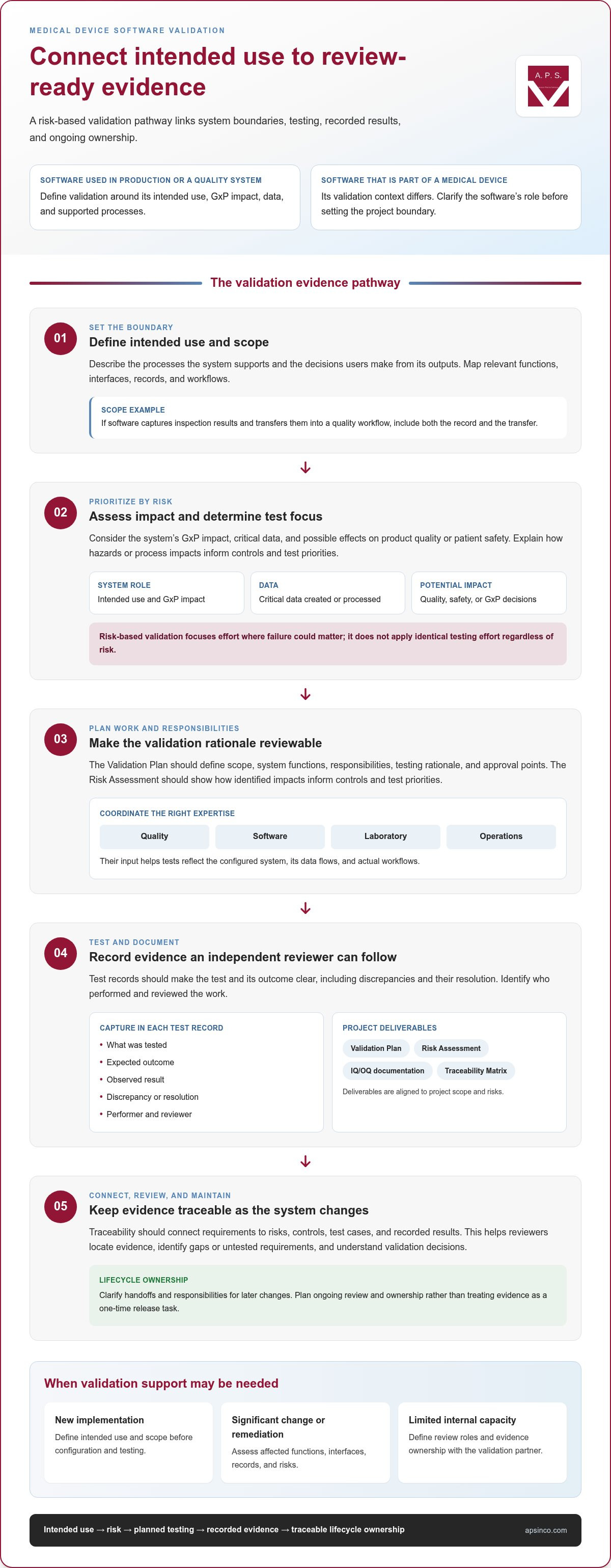
Start by describing the processes the system supports and the decisions users make from its outputs. Then map the boundaries across relevant functions, interfaces, records, and workflows. For example, if software captures inspection results and transfers them into a quality workflow, include both the record and the transfer in the scope. APS can organize project deliverables such as a Validation Plan, Risk Assessment, IQ/OQ documentation, and Traceability Matrix around that defined scope.
When does a medical device software project need validation support?
Support can help with a new implementation, a significant system change, remediation of validation gaps, or a project where internal teams have limited capacity to coordinate quality, software, and regulatory work. Assess the system’s role, intended use, and relevant quality requirements before setting the validation boundary. Plan for ongoing changes too, rather than treating evidence as a one-time release task.
New implementation: define intended use and scope before configuration and testing.
Change or remediation: assess affected functions, interfaces, records, and risks.
Limited capacity: define review roles and evidence ownership with a validation partner.
How to assess a consultant's risk-based validation method
A sound risk-based approach connects intended use, critical data, and process risks to the testing performed. Ask how the consultant identifies functions that could affect product quality, patient safety, or a GxP decision, and how the assessment affects test depth. Risk-based validation focuses effort where failure could matter; indiscriminate testing applies the same effort everywhere, regardless of risk. GAMP 5 can structure the work, but project-specific judgment is still needed. For U.S. software validation principles, consult the FDA General Principles of Software Validation.
Effective delivery depends on collaboration as well as method. Quality oversees the quality-system context and approvals. Software, laboratory, and operations stakeholders explain system behavior, data flows, and actual workflows. Their input helps ensure documented tests reflect the configured system and how people use it.
What should a validation plan and risk assessment explain?
Check that the plan defines scope, system functions, responsibilities, testing rationale, and approval points. The risk assessment should explain how hazards or process impacts inform controls and test priorities. Traceability should connect requirements to risks, controls, test cases, and recorded results. This makes gaps and untested requirements easier to identify during review and gives stakeholders a shared basis for decisions.
How should teams evaluate test evidence and documentation?
Test records should state what was tested, the expected outcome, the observed result, and any discrepancy or resolution. Evidence should identify who performed and reviewed the work and be clear enough for an independent reviewer to follow. In APS computer system validation projects, deliverables can include Validation Plans, Risk Assessments, IQ/OQ documentation, and Traceability Matrices, aligned to project scope and risks.
Use these criteria to discuss your validation requirements with APS, including how quality and operational teams will review evidence and retain ownership as the system changes.
Compare validation deliverables, lifecycle support, and operational fit
Compare medical device software validation services by how well their outputs support project decisions, review, and ongoing ownership. Focus on five practical areas:
Scope definition: Are project boundaries and assumptions clear to reviewers?
Risk assessment: Can your team see why particular controls or tests receive attention?
Test evidence: Are outcomes and deviations recorded so reviewers can assess them?
Traceability: Can evidence be followed from requirements through tests and results?
Support: Are handoffs and responsibilities for later changes understood?
Which validation deliverables support review and traceability?
A Validation Plan defines how project work is organized and reviewed. A Risk Assessment records the rationale for validation priorities. IQ/OQ documentation captures installation and operational checks, while a Traceability Matrix helps reviewers locate supporting records. Together, these deliverables give quality and technical teams a structured record for oversight and audit preparation. Check that reviewers can use the documents to understand decisions, not simply that the documents are present.
Assess evidence claims in context. APS’s GAMP 5 Validation Package includes more than 150 automated test scripts; the project’s test selection should still reflect its scope and risks. Separately, PharmaRockIT has fully documented V-Model validation, including executed IQ and OQ with objective evidence. That evidence applies specifically to the platform. For medical device software lifecycle context, see the IEC 62304 Medical Device Software Standard.
How can validation support fit existing teams and systems?
Agree on communication, document review, approvals, and coordination with quality, technical, and operations staff. Define who assesses future changes and maintains project records after initial delivery. Teams developing their GAMP 5 method can use the GAMP 5 validation experts guide to inform methodology discussions and align project practices.
Discuss your validation project and deliverables with APS to consider how evidence review and lifecycle responsibilities can fit your operations.
Select medical device software validation services that fit your project
Choose medical device software validation services that match your system’s intended use, boundaries, and risks. Use these four steps to turn a broad need into a project your quality and technical teams can review:
Define intended use. Describe what the software does and which decisions or processes it supports.
Map system boundaries. Identify relevant functions, interfaces, users, records, and connected workflows.
Identify risks. Consider impacts on critical data, product quality, patient safety, and process outcomes.
Align deliverables. Match the plan, risk assessment, testing, and traceability evidence to the defined scope.
What information should you prepare before engaging a consultant?
Gather existing requirements, system documentation, quality procedures, and validation records. Summarize the software’s purpose, affected processes, interfaces, critical records, and current validation status, including known gaps or planned changes. Identify quality, technical, and operational reviewers, then clarify who makes decisions and approves records. This preparation helps define a practical scope without assuming every system needs the same evidence.
What does a practical APS engagement look like?
APS’s GAMP 5 computer system validation consulting starts with collaborative scoping, followed by a risk-based plan and project-specific deliverables for review. Quality, software, and operations stakeholders contribute system knowledge and review evidence. Defined responsibilities support coordinated decisions throughout the work. APS also provides bilingual support from the Greater Montreal Area for organizations seeking local Canadian collaboration.
For a project discussion, discuss a validation project with APS. Share your system context and existing records so the team can frame the work around intended use, risk, and operational needs.
Set your validation project up for its next stage
A well-run validation project can inform future technology decisions. Record what your team learns about evidence review, system risks, and approval criteria, then use those lessons to make later project planning more consistent. This gives your organization a clearer basis for approaching new software initiatives.
Medical device software validation services should support the current project and your organization’s ability to make informed decisions as its technology portfolio develops. APS provides computer system validation consulting tailored to project requirements, with practical documentation and technical expertise to support your team.
To discuss your priorities and the support your team needs, contact APS about your medical device software validation project. Share the system’s intended use, current records, and key risks to start a focused conversation.
Frequently Asked Questions
What does medical device software validation demonstrate?
Validation demonstrates that the organization has evaluated whether software behavior is acceptable under defined operating conditions and controls. It does not prove that software is defect-free or can never fail. Instead, the results help responsible stakeholders understand limitations, assess residual risk, and decide whether safeguards or further actions are needed before relying on the system in routine operations.
Does all medical device software require the same validation approach?
No. Systems with similar functions can warrant different approaches because configuration, user workflows, data criticality, interfaces, and consequences of error differ. A standalone application with limited data exchange may have a different validation profile from a configured system that transfers records into downstream quality decisions. Reassess planned effort when intended use, architecture, or reliance on the process changes.
What deliverables should a computer system validation consultant provide?
Agree on acceptance criteria, evidence formats, and responsibility for open actions before testing begins. Request records that let an internal reviewer understand the test context, including the software version, relevant environment, data setup, and user roles involved. Documented assumptions and approval status help your team interpret results and maintain a useful project record after handover.
How do I compare medical device software validation consultants?
Compare how consultants manage decisions and transfer knowledge, not just how they present templates. Ask how they communicate an unexpected result, explain an excluded test, or resolve disagreement about evidence. A clear working approach makes decision ownership visible and equips your staff to maintain the rationale after the engagement. This helps you select medical device software validation services that fit your team’s ongoing responsibilities.


Comments