

Biotech Compliance Consulting Services: A Practical Guide to Choosing the Right Partner
A thick validation binder can still leave a biotech operation exposed. Effective biotech compliance consulting services connect computer system validation, equipment qualification, data integrity, and the workflows your teams rely on every day. The goal is evidence that supports reliable GxP operations, not documentation for its own sake.
That connection matters when systems, equipment, and procedures don’t align, or when it’s unclear how regulatory requirements translate into practical controls. You need a risk-based approach tied to intended use, critical processes, and data integrity, with validation deliverables your internal teams can apply and maintain. This guide explains how to assess a consulting partner’s technical scope, evidence, collaboration, and support for ongoing audit readiness. APS brings validation and GxP operations experience to this work, developing practical deliverables such as Validation Plans, Risk Assessments, IQ/OQ documentation, and Traceability Matrices in collaboration with your team.
Table of Contents
What biotech compliance consulting services should address
Biotech compliance consulting aligns regulated processes, systems, equipment, and evidence with intended use through a risk-based approach, supporting reliable, audit-ready GxP operations. Effective biotech compliance consulting services connect these elements rather than treating validation, data integrity, and laboratory operations as separate workstreams.
A software change, for example, can affect how an instrument captures results, how records are reviewed, and whether a process remains in a validated state. Quality decisions should account for potential impact on product quality and patient safety. Scope and evidence should be proportionate to intended use and process criticality, not determined by documentation volume alone.
Which compliance challenges call for specialist support?
Specialist support can help when you introduce or change a computerized system, respond to inspection findings, identify data integrity gaps, or scale laboratory operations. Each issue may involve connected controls: a system change can affect equipment interfaces, user access, records, procedures, and existing validation evidence. A data integrity assessment can identify where those controls need attention. For broader industry context, Clarivate's regulatory compliance services for biotech provides company information.
How biotech compliance work supports audit readiness
Advice is only one part of the work. Practical implementation may include assessments, risk documentation, validation protocols, testing evidence, and remediation plans that assign responsibilities to the right internal teams. APS provides deliverables such as Validation Plans, Risk Assessments, IQ/OQ documentation, and Traceability Matrices, developed in collaboration with client teams.
Audit readiness also depends on maintaining evidence as systems, equipment, and processes change. Controlled procedures, traceable records, clear ownership, and lifecycle reviews help teams show how a system remains fit for intended use. Documentation is useful when it reflects work performed and supports ongoing controls, not when it simply adds volume to a project file.
How to evaluate biotech compliance consulting services
Evaluate biotech compliance consulting services against the work your site needs, not broad claims of experience or geographic reach. Start with five criteria: intended use, process and system criticality, agreed scope, defined deliverables, and responsibilities for your internal team. This framework helps focus a project discussion, but it is not a universal regulatory checklist.
Then examine the proposed risk-based approach. The partner should explain how identified risks shape testing depth, evidence, and review, and why lower-risk functions may need different controls from functions that affect critical data or product quality. Relevant GAMP 5 methods and experience with Health Canada and FDA compliance matter most when they are applied to the specific systems, equipment, and processes in scope.
What validation deliverables should a project define?
APS provides Validation Plans, Risk Assessments, IQ/OQ documentation, and Traceability Matrices. Together, these records set out the project approach, document risks, capture installation and operational testing, and link requirements to test results and approval evidence. Define the purpose of each deliverable and the decision it supports. This helps prevent a document set that is extensive but disconnected from execution.
How should teams assess data integrity expertise?
A data integrity assessment should examine actual practices, controls, and records, then document identified gaps and their significance. For example, review how records are created, checked, corrected, and retained, and how access controls and audit trails support their reliability. ALCOA+ provides useful principles: records should be attributable, legible, contemporaneous, original, and accurate. A consultant should translate those principles into controls that fit your workflows and data.
APS works with internal teams to define scope and responsibilities alongside technical evidence. If you’re setting priorities for validation or data integrity work, discuss your compliance project with APS.
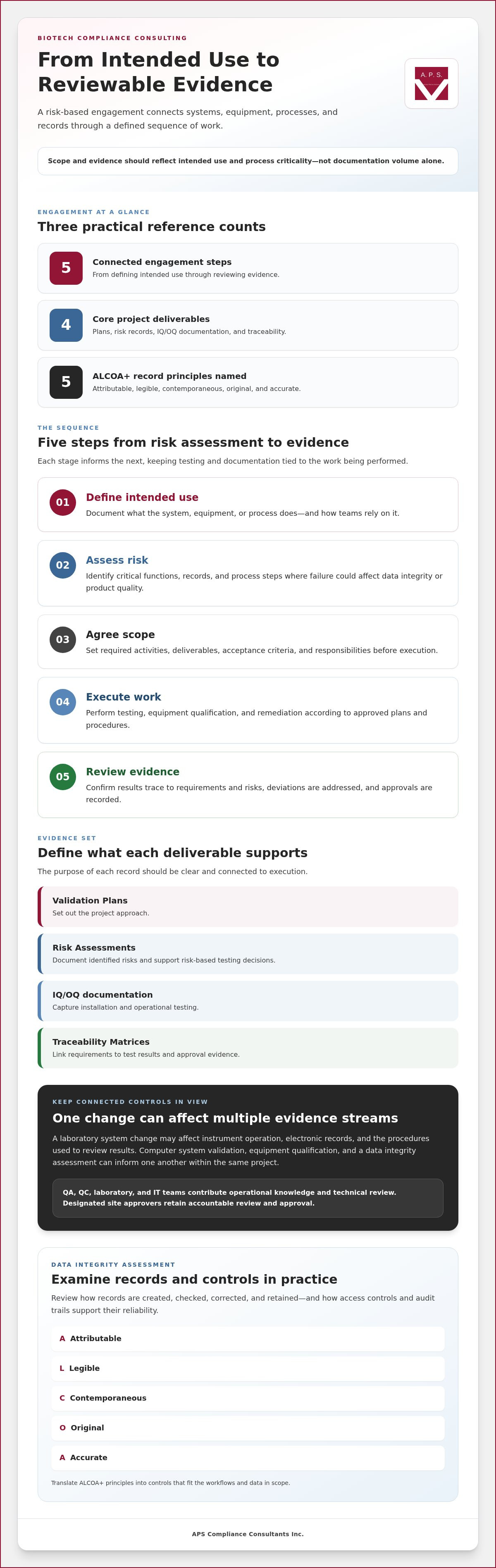
How a biotech compliance engagement moves from risk assessment to evidence
A defined sequence turns compliance objectives into reviewable evidence. For biotech compliance consulting services, organize the work into five connected steps:
Define intended use: Document what the system, equipment, or process does and how teams rely on it.
Assess risk: Identify critical functions, records, and process steps where failure could affect data integrity or product quality.
Agree scope: Set required activities, deliverables, acceptance criteria, and responsibilities before execution.
Execute work: Perform testing, equipment qualification, and remediation according to approved plans and procedures.
Review evidence: Confirm results are traceable to requirements and risks, deviations are addressed, and approvals are recorded.
These activities often intersect. A laboratory system change, for example, may affect instrument operation, electronic records, and the procedures used to review results. Computer system validation, equipment qualification, and a data integrity assessment can therefore inform one another within the same project. QA, QC, laboratory, and IT teams contribute operational knowledge and technical review. Designated site approvers retain accountable review and approval.
Where GAMP 5 and risk-based validation fit
GAMP 5 provides a framework for applying a risk-based approach; it does not replace your site procedures or approval process. Intended use and process criticality guide the requirements, testing, and documentation needed to show that controls address relevant risks. The aim is proportionate evidence, not reduced evidence where quality or data integrity is at stake.
Computer system validation is documented evidence that a computerized system consistently performs its intended function. That evidence must remain relevant as the system and its use evolve.
How to maintain compliance after project closeout
Plan for lifecycle controls, including change assessment, periodic review, audit trail reviews, training, and controlled records. Your teams retain operational ownership of procedures and ongoing system oversight. Consultants can support defined validation, remediation, and evidence activities. This keeps readiness active rather than confined to a project file.
To define a practical validation or remediation scope, discuss your compliance project with APS.
Why biotech teams partner with APS for integrated compliance support
APS brings computer system validation, data integrity consulting, equipment qualification, and GMP digitalization together to address connected operational risks. A change to laboratory software, for example, may also affect instrument records and the procedures used to review results. Coordinating these workstreams helps teams establish relevant evidence and controls across the process rather than addressing each issue in isolation.
The PharmaRockIT platform has fully documented V-Model validation, including executed IQ and OQ with objective evidence. APS’s GAMP 5 Validation Package includes more than 150 automated test scripts. These resources support defined validation work; they do not remove the need to assess intended use, site procedures, and project-specific risks.
What APS brings to biotech compliance projects
APS supports pharmaceutical, biotechnology, and medical device organizations with a bilingual team based in the Greater Montreal Area. Its modular PharmaRockIT platform supports phased implementation across laboratory and maintenance workflows, helping organizations plan operational change in stages. APS prioritizes deployment of its solutions in the AWS Canada Central Region to support Canadian data sovereignty objectives.
Define a practical next step with APS
Bring a clear picture of your current systems, known compliance gaps, intended use, and critical workflows to the initial project discussion. These details help APS identify where validation, equipment qualification, or data integrity support can contribute, and define how internal teams will participate in review and ongoing operations. The result is a discussion grounded in practical priorities rather than a generic service scope.
Discuss your biotech compliance priorities with APS and define a risk-based path toward sustainable audit readiness.
Build a Practical Path to Audit Readiness
Choosing biotech compliance consulting services means looking beyond documentation volume. Define intended use, criticality, project scope, deliverables, and internal responsibilities. Then confirm that the risk-based approach connects validation, equipment, data integrity, and operational workflows. Audit readiness depends on maintaining those controls throughout the system lifecycle.
APS supports this work with practical evidence, including Validation Plans, Risk Assessments, IQ/OQ documentation, and Traceability Matrices. The PharmaRockIT platform has fully documented V-Model validation, including executed IQ and OQ with objective evidence. APS’s GAMP 5 Validation Package includes more than 150 automated test scripts. These resources help teams organize validation activities while keeping evidence tied to intended use and identified risks.
Bring your current systems, known gaps, and critical workflows into the discussion. Discuss your biotech compliance priorities with APS to define a practical scope for your organization. With clear responsibilities and lifecycle controls, your team can strengthen compliance and maintain audit readiness.
Frequently Asked Questions
What do biotech compliance consulting services include?
Biotech compliance consulting services can include risk assessments, computer system validation, equipment qualification, data integrity assessment, and remediation support. The scope should reflect intended use and the criticality of the processes, systems, equipment, and records involved. Project evidence may include Validation Plans, IQ/OQ documentation, and Traceability Matrices, with internal teams involved in review, approval, and ongoing operational ownership.
How do I choose a biotech compliance consulting partner?
Choose a partner that connects its proposed work to your intended use, critical processes, risks, deliverables, and team responsibilities. Ask how identified risks determine testing and evidence, and look for relevant GAMP 5 methods and regulated-industry experience rather than relying on broad claims alone. A practical scope should clarify who executes, reviews, approves, and maintains controls after project activities are complete.
What is the difference between computer system validation and data integrity consulting?
Computer system validation establishes documented evidence that a computerized system consistently performs its intended function. Data integrity consulting focuses on whether data practices, records, and controls preserve reliable information throughout its lifecycle. The work can overlap: validation may test access, record handling, or audit trail functions, while a data integrity assessment examines whether those controls address risks in actual laboratory workflows.
When should a biotech company use GAMP 5 validation support?
Use GAMP 5 validation support when implementing or changing a computerized system, addressing validation gaps, or defining a risk-based approach for a regulated process. GAMP 5 informs how intended use and process criticality shape requirements, testing, and documentation. It supports structured decision-making but does not replace site procedures, quality oversight, or the organization’s responsibility for approving and maintaining its validated state.
Can compliance consulting support a phased digital transformation?
Yes. Consulting can help plan digital change in phases by defining intended use, assessing risks, and setting validation activities for each stage. Modular solutions can support a gradual transition across laboratory and maintenance workflows, while computer system validation, equipment qualification, and data integrity controls remain connected to each phase. Your teams retain operational ownership, with consultants supporting defined implementation and validation work.


Comments