

Audit Ready Data Management: The GxP Guide to Continuous Compliance
Did you know that data integrity deficiencies appeared in roughly 15 percent of all FDA Warning Letters issued to drug manufacturers in 2025? It's a sobering reality for quality managers who are often left managing scattered data across paper binders and disconnected spreadsheets. You likely feel the weight of validation backlogs and the constant pressure of maintaining a state of compliance while manual transcription risks loom over every benchtop instrument. This guide shows you how to establish audit ready data management across your GxP operations by implementing structured frameworks and automated capture systems.
We'll explore how ALCOA+ principles and automated workflows eliminate pre-audit panic and ensure your facility remains inspection-ready at all times. You'll learn to align with FDA 21 CFR Part 11 and EU GMP Annex 11 requirements while accelerating your compliance timelines by up to 40 percent. By shifting from reactive paperwork to continuous data governance, your team can focus on core operations rather than regulatory fear. We're here to help you bridge the gap between the laboratory and the boardroom with precision and reliability.
Table of Contents
What Is Audit Ready Data Management in GxP Environments?
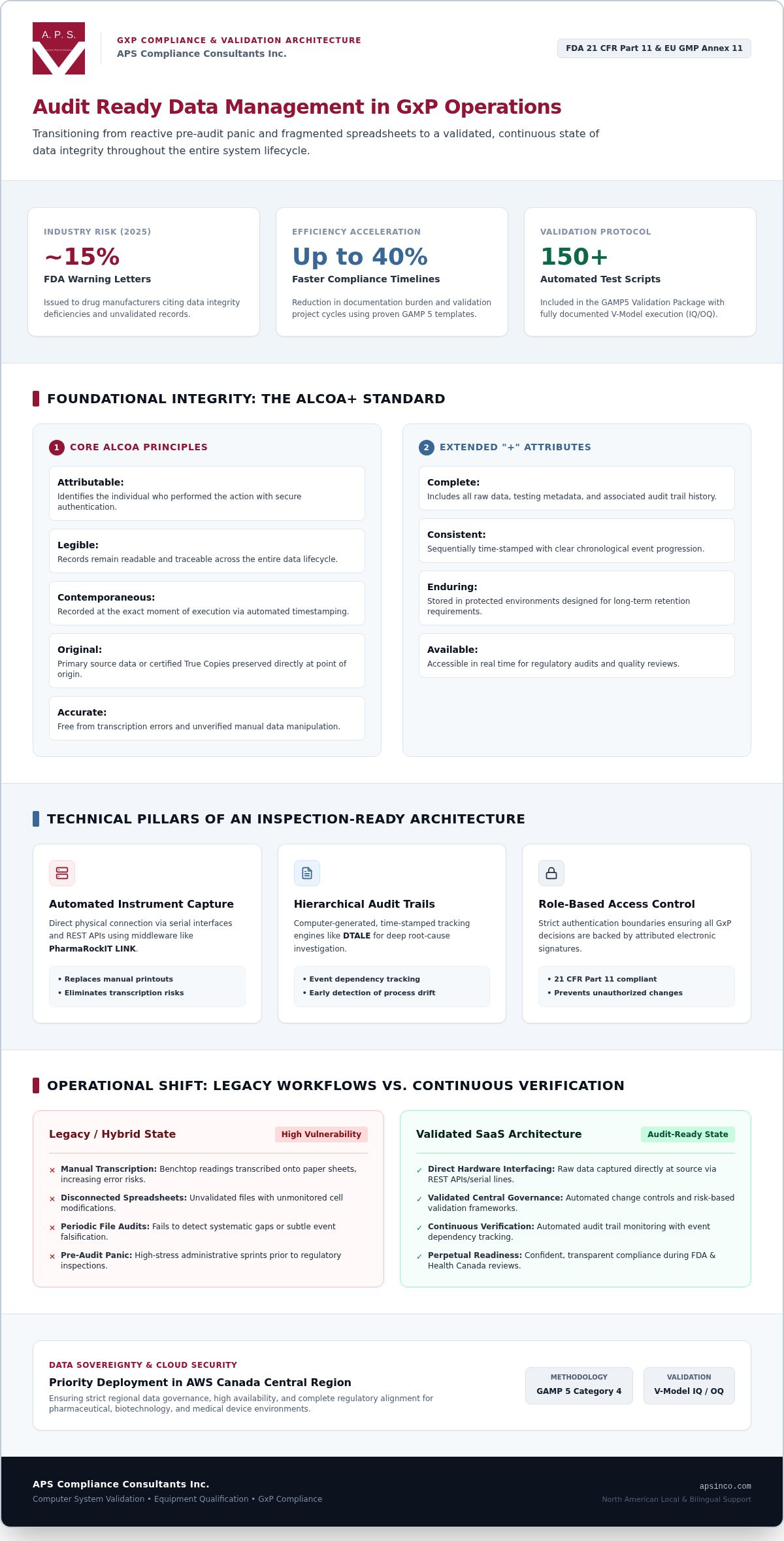
Audit ready data management isn't a pre-inspection sprint; it's a continuous state of data integrity maintained throughout the entire information lifecycle within GxP-regulated environments. Regulatory agencies like the FDA and Health Canada don't just look at final reports; they evaluate the governance systems that ensure data reliability. When these systems fail, the risk of product recalls, the removal of products from the market because of quality, safety, or compliance concerns, increases significantly. This level of oversight is central to Good Practice (GxP) standards, where data reliability links directly to patient safety and operational trust.
ALCOA+ Principles as the Foundation of Data Integrity
ALCOA+ serves as the foundational framework for maintaining high-integrity records. You must ensure data is Attributable, Legible, Contemporaneous, Original, and Accurate. The plus attributes extend this to include data that's complete, consistent, enduring, and available. There's a critical distinction between static paper documents and dynamic electronic laboratory records. While paper is prone to loss and lacks transparency, electronic records provide a secure, time-stamped history that validates every GxP decision made within your facility. This transition ensures your data remains a trustworthy asset during any inspection.
The Hidden Vulnerabilities of Hybrid and Spreadsheet Workflows
Many organizations harbor hidden risks within hybrid workflows and unvalidated spreadsheets. These isolated silos are high-risk zones for manual transcription errors and unauthorized changes that compromise systemic integrity. Regulatory inspectors increasingly scrutinize QC laboratories where data remains disconnected from central systems. Periodic file audits often fail to catch systematic gaps because they don't provide the hierarchical event tracking needed to detect process drift or falsification. Achieving a truly audit-ready state requires moving beyond these fragmented, manual methods toward integrated and validated data capture.
Technical Pillars of an Inspection-Ready Data Architecture
Modern audit ready data management relies on a technical architecture that enforces compliance at the point of origin. You must implement systems that move beyond administrative checklists to provide inherent data security through centralized role-based access control and secure authentication. These technical controls ensure that every GxP decision is supported by immutable records that satisfy 21 CFR Part 11 requirements. As detailed in FDA guidance on data integrity, these systems should prevent unauthorized changes while ensuring that all data remains attributable and accurate.
Automated Instrument Connectivity and Direct Data Capture
Standalone benchtop instruments often create significant data silos in the QC laboratory. You can bridge these gaps by interfacing physical hardware via serial connections or REST APIs. Middleware like PharmaRockIT LINK replaces manual instrument printouts, which are frequently prone to transcription risks. By capturing raw instrument data directly, you guarantee the preservation of the original record and eliminate the need for hybrid paper binders. This direct capture method streamlines your operations and provides a higher return on investment for your existing equipment. If you're looking to automate your benchtop data capture, reach out to our technical team.
Enforcing Attributable Timestamping and Systematic Audit Trail Reviews
Audit trails are the primary tool for detecting unauthorized changes or process drift. You must maintain secure, computer-generated, time-stamped audit trails that provide a clear history of all data interactions. Routine, documented audit trail reviews are essential for early detection of systematic integrity gaps. Advanced engines like DTALE empower quality managers by providing hierarchical event dependency tracking. This technology allows for deeper root-cause investigations, ensuring that your audit ready data management strategy remains effective without the traditional pre-inspection panic.
Step-by-Step Implementation: From Gap Assessment to Continuous Verification
Achieving a state of continuous compliance requires a methodical roadmap. You shouldn't treat validation as a one-time event. Instead, focus on a structured implementation that addresses the highest risks first. A successful audit ready data management strategy begins with a thorough evaluation of how data moves through your facility, ensuring that every critical quality attribute is protected.
Conducting a Data Integrity Assessment and Risk Prioritization
Map out every touchpoint where data is generated, modified, or stored. You must identify manual intervention points where risks of transcription errors are highest. By applying a risk-based approach, you can categorize systems based on their process criticality and impact on patient safety. Look for gaps where existing software lacks essential controls like electronic signature enforcement. We recommend referencing the MHRA GxP Data Integrity guidance to ensure your governance system meets international expectations for data sovereignty and lifecycle management.
Applying Computer Software Assurance and GAMP 5 Principles
Shift your focus from administrative paperwork to high-value testing and critical thinking through Computer Software Assurance. This methodology prioritizes testing based on risk rather than a one-size-fits-all documentation approach. Your validation deliverables, including IQ, OQ, and traceability matrices, must provide objective evidence that the system performs its intended function. By employing specialized computer system validation services, you ensure your framework is built on proven templates. Engaging GAMP 5 validation experts can accelerate project timelines by 40 percent. This efficiency allows your team to maintain audit ready data management while we manage the granular details of qualification. If you're ready to streamline your validation process, contact our compliance consultants today.
Scalable Digitalization: Transitioning to Validated SaaS Workflows
Achieving audit ready data management is significantly easier when transitioning from legacy on-premises systems to zero-footprint SaaS architectures. These modern platforms provide a validated environment that eliminates the high maintenance costs and security risks associated with aging local servers. By adopting a modular approach, you can implement digital tools in phases across your QC, QA, and maintenance departments. This strategy spreads out capital expenditure while ensuring each department adapts to new workflows at a manageable pace. Pre-validated platforms are designed to reduce your internal documentation burden by up to 40 percent, allowing your team to focus on production rather than paperwork.
Modular Digital Ecosystems Versus Monolithic Deployments
Modular tools offer flexibility that monolithic deployments simply can't match. You can maintain clear role separation by deploying specific modules like LIMS software for sample lifecycle governance alongside Electronic Workbooks (EWB) for benchtop activities. Because each module undergoes independent qualification, you significantly lower the operational risks during the transition. This phased adoption ensures that your audit ready data management framework remains stable even as you upgrade different parts of your laboratory infrastructure. It's an efficient way to modernize without disrupting daily output.
Establishing Validated Governance with the PharmaRockIT Platform
The PharmaRockIT platform provides a centralized hub for managing your entire digital ecosystem. Through the PharmaRockIT Cockpit, you gain access to centralized user management, Single Sign-On (SSO), and Two-Factor Authentication (2FA) to secure your critical data. We prioritize data sovereignty by hosting all solutions in the AWS Canada Central Region, ensuring your information remains within the required jurisdiction. This combination of security and accessibility empowers your quality managers to monitor compliance in real-time. When you're ready to modernize your systems, partner with APS Compliance Consultants to build a validated data governance structure that lasts.
Achieving Sustainable Data Integrity
Transitioning to audit ready data management is a fundamental shift from reactive pre-inspection panic to a disciplined, automated governance model. By integrating ALCOA+ principles into your daily workflows and replacing manual transcription with direct instrument capture, you eliminate the systematic gaps that often trigger regulatory findings. This approach ensures that your data remains a trustworthy asset, allowing your team to focus on innovation and production rather than documentation backlogs. It's about building a foundation where compliance is a natural result of your operations.
Our PharmaRockIT ecosystem features pre-executed V-Model validation packages to streamline your digital transformation. We empower your organization to accelerate project timelines by up to 40% using proven GAMP 5 templates, ensuring full compliance with FDA and Health Canada standards. With local Canadian bilingual support backed by decades of CSV expertise, we provide the technical precision and collaborative partnership your facility requires to succeed. Accelerate your compliance with APS Compliance Consultants and secure your operational future. You can move forward with the confidence that your high-stakes burdens are in capable hands.
Frequently Asked Questions
What is the primary difference between data backup and audit-ready data archiving?
Data backup is a temporary disaster recovery measure designed to overwrite files periodically for system restoration. In contrast, audit-ready data archiving creates permanent, immutable records protected against alteration or deletion. For compliant audit ready data management, an archive must preserve the metadata, original context, and full electronic audit trail throughout the mandatory regulatory retention period.
How do ALCOA+ standards apply to computerized analytical instruments?
ALCOA+ standards require that analytical instrument data be captured automatically at the moment of generation. This process ensures records are attributable to a specific operator and contemporaneously timestamped. Systems like PharmaRockIT LINK enforce these attributes by transmitting raw data directly from benchtop units to a secure database, eliminating manual transcription risks and securing original records.
What constitutes a regulatory-compliant electronic signature under 21 CFR Part 11?
A compliant electronic signature must contain two distinct identification components, typically a unique username and a password or biometric verification. The system must link the signature manifest to the specific electronic record. It also needs to display the printed name of the signer, the date and time of execution, and the specific meaning of the signing action.
Can cloud-hosted SaaS solutions meet strict GMP data sovereignty requirements?
Yes, cloud-hosted SaaS solutions can meet strict data sovereignty requirements by using localized infrastructure. For example, deploying software within the AWS Canada Central Region guarantees that data remains within specified national borders. This infrastructure setup allows life science organizations to benefit from automated cloud validation while maintaining strict compliance with local data governance laws.
How often should Quality Assurance teams perform audit trail reviews?
Quality Assurance teams must perform audit trail reviews based on an established risk-based approach. For critical process steps, such as batch release or final product testing, you should review the audit trails before approving the results. For lower-risk operational data, periodic reviews conducted during scheduled system performance evaluations are sufficient to detect anomalies or process drift.


Comments