

Pharma Lab Compliance Audit: Strategic Guide to Inspection Readiness
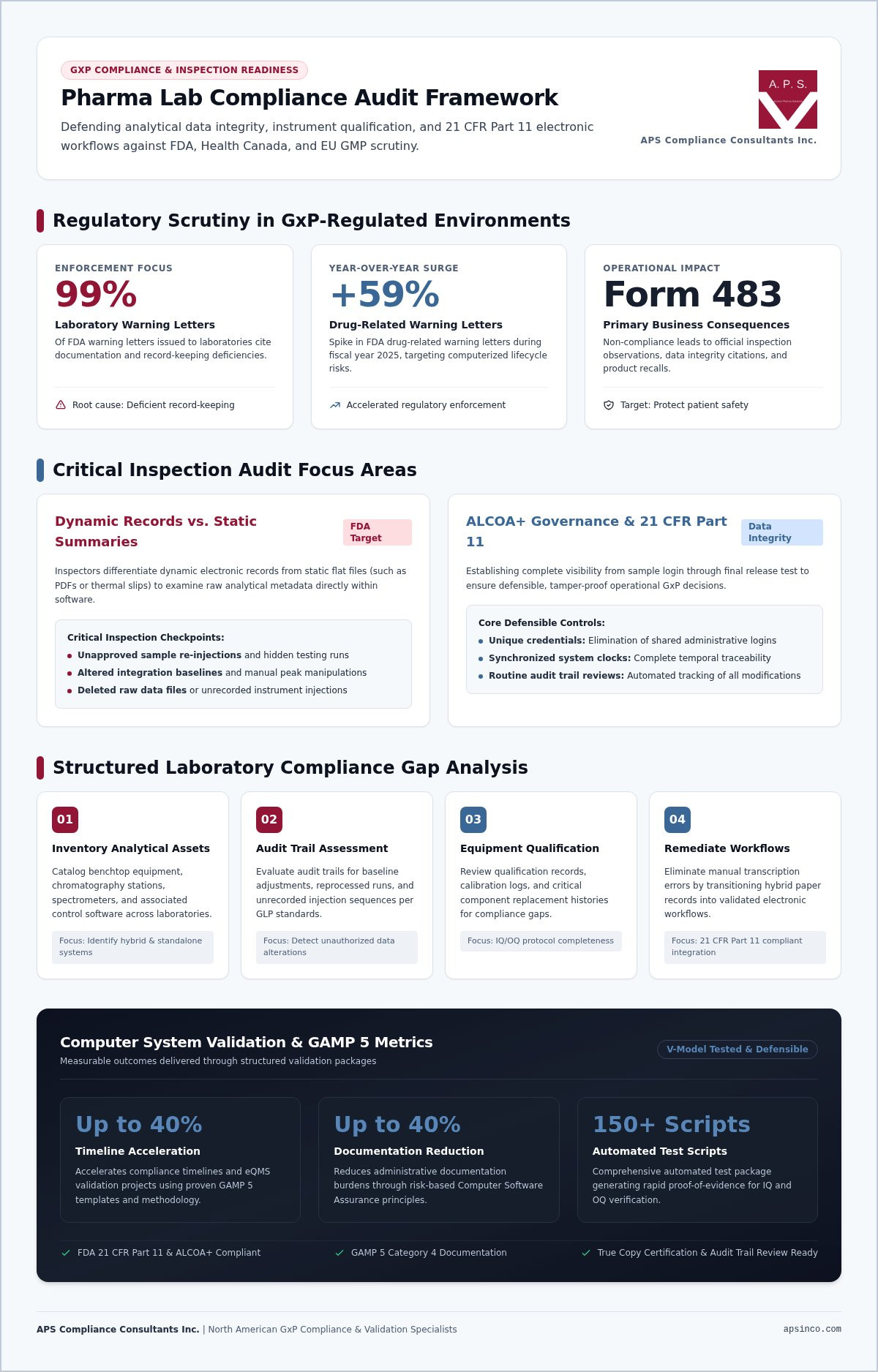
When 99% of FDA warning letters issued to laboratories cite documentation and record-keeping deficiencies, preparing for a pharma lab compliance audit cannot remain a reactive paper drill. If your quality team feels overwhelmed by fragmented instrument records and hybrid workflows that falter during routine audit trail reviews, you aren't alone. Balancing fast-paced testing schedules with the constant fear of Form 483 observations and data governance citations places immense pressure on internal resources.
True audit readiness doesn't come from scrambling through binders right before an inspection; it happens when you embed data integrity directly into your laboratory operations. In this guide, you'll discover how to master regulatory inspection readiness across laboratory data integrity, analytical instrument qualification, and validated electronic workflows. We'll walk you through practical risk-based strategies, systematic ALCOA+ controls, and defensible computer system validation packages designed to satisfy strict regulatory scrutiny.
Table of Contents
Regulatory Expectations for a Pharma Lab Compliance Audit in 2026
A pharma lab compliance audit conducted by the FDA, Health Canada, or European regulators goes far beyond reviewing physical logbooks. With FDA drug-related warning letters jumping 59% in fiscal year 2025, investigators examine the entire computerized system lifecycle. Regulators concentrate heavily on analytical data authenticity to prevent contaminated releases and expensive product recalls. Conducting proactive internal reviews protects operations, ensuring your team identifies systemic vulnerabilities before an agency investigator issues formal Form 483 observations.
FDA and Health Canada Scrutiny in GxP-Regulated Environments
Inspectors routinely interrogate raw analytical sequences, run parameters, and electronic signature attribution. Within GxP-regulated environments, regulatory enforcement regularly cites unapproved sample re-injections, altered integration baselines, and deleted raw data files. Aligning your internal testing routines with established Good Laboratory Practice (GLP) principles guarantees that original analytical records remain complete and attributable. Defending your data requires proving that electronic records reflect actual benchtop activities without unauthorized modifications or selective reporting.
The Core Shift Toward Risk-Based Inspection Frameworks
Agencies now rely on a structured, risk-based approach to schedule audits and determine their technical depth. Rather than evaluating every instrument identically, inspectors target critical analytical equipment and workflows that directly influence critical process control and patient safety. Every release test influences an operational GxP decision, making laboratory data reliability non-negotiable. Establishing routine audit trail reviews, strict security privileges, and documented data controls demonstrates active system governance, transforming routine compliance from a frantic pre-inspection scramble into a steady, defensible operating state.
High-Risk Audit Focus Areas: Data Integrity and System Validation
Software adoption alone doesn't guarantee compliance. During a rigorous pharma lab compliance audit, inspectors differentiate dynamic electronic records from static flat-file summaries or printed thermal slips. A static PDF cannot display reprocessing histories, hidden injections, or baseline modifications. Per official FDA Inspection Guidance, laboratory investigators evaluate raw metadata directly within analytical software. They verify that routine audit trail reviews are systematically conducted and tied to individual accountability through unique user credentials and strict role-based permission tiers.
Enforcing ALCOA+ Principles Across the Sample Lifecycle
Maintaining data governance requires total visibility from sample login through final release. A defensible data integrity assessment traces every analytical injection, standard preparation, and calculation back to an authenticated analyst. Common vulnerabilities in benchtop instruments include shared generic administrative logins, unsynchronized system clocks, and manual transcription loops. Connecting benchtop systems directly to validated digital workflows eliminates transcription errors and fulfills core ALCOA+ criteria.
Computer System Validation and GAMP 5 Category Alignment
Laboratories frequently struggle with software compliance when commercial packages lack structured testing. Validating configurable laboratory software demands disciplined execution aligned with proven computer system validation services and GAMP 5 principles. When aligning systems to 21 CFR Part 11 requirements, quality teams must establish defensible verification across electronic signatures, secure data storage, and automated audit tracking. If internal teams lack bandwidth for complex testing, partnering with specialized validation experts through an inspection readiness consultation helps establish fully compliant electronic records without operational delays.
Executing a Laboratory Compliance Gap Analysis: Step-by-Step
Self-inspections fall short when they rely on generic checklists. Preparing for an unannounced pharma lab compliance audit requires a methodical, technically rigorous evaluation of benchtop reality. To ensure inspection readiness across operations, quality teams should execute a four-step remediation workflow:
Step 1: Inventory all analytical assets. Catalog every chromatograph, spectrophotometer, balance, and firmware revision generating test results.
Step 2: Scrutinize calibration and qualification packages. Audit maintenance records, vendor calibration certificates, and change logs against established operational baselines.
Step 3: Conduct sample-to-report tracking audits. Trace real samples from initial logging through final release, reviewing instrument audit trails, raw integrations, and manual balance printouts as emphasized in the PDA Data Integrity Report.
Step 4: Remediate vulnerabilities through formal CAPA. Prioritize non-conformances using risk ranking, resolving critical computerized system gaps before regulatory notification.
Analytical Instrument Qualification (IQ/OQ/PQ) and Maintenance Records
Analytical instruments require continuous fitness for use. Verify current calibration states with structured equipment qualification iq oq pq protocols that clearly link user requirements to test evidence. Inspectors look specifically for unrecorded repairs; any critical component replacement, such as a detector lamp or pump seal, must trigger documented impact assessments and necessary requalification testing.
Software Configuration, Audit Trails, and System User Governance
Inspect computerized system clock configurations to verify automatic network time synchronization. Regulators flag manual date alterations immediately as deliberate manipulation. System administrative privileges must remain strictly segregated from routine analytical testing staff. Ensure that automated data backup routines include verified restoration testing. If your internal team needs specialized support to identify and fix these hidden compliance vulnerabilities, contact our validation specialists to conduct an audit gap analysis.
Modernizing Laboratory Compliance with Validated Digital Ecosystems
Transforming routine operations into an active state of audit readiness requires replacing vulnerable hybrid routines with validated digital ecosystems. When analytical benches rely on manual transcriptions and physical paper binders, human error is inevitable during a pharma lab compliance audit. Modernizing these environments doesn't demand multi-year internal software projects. Quality teams can deploy pre-validated SaaS platforms that reduce internal validation workloads by up to 40%, securing seamless compliance while maintaining operational agility.
Direct Instrument Interfacing and Paperless Execution
Legacy analytical balances, pH meters, and titrators often lack native network interfaces, forcing analysts to paste thermal paper printouts into paper logbooks. Connecting benchtop instruments through specialized hardware middleware captures raw RS-232 serial data streams directly into electronic systems. Pairing this connectivity with an electronic workbook like PharmaRockIT EWB guides analysts through validated testing sequences step by step. Automated data ingestion eliminates manual transcription loops entirely, ensuring records are contemporaneous and accurate from the moment of generation.
Continuous Inspection Readiness with Supported GMP Platforms
Maintaining long-term compliance requires software architectures that satisfy global data integrity mandates without overburdening internal IT teams. Deploying modular systems hosted in dedicated regional cloud infrastructure, such as the AWS Canada Central Region, ensures strict data sovereignty and security. Applying pre-configured validation packages with over 150 automated test scripts allows labs to accelerate project timelines significantly. By collaborating with specialized gamp 5 validation experts, quality managers establish fully defensible V-model documentation, including executed IQ and OQ evidence that withstands the most demanding regulatory inspections.
Build a Defensible Laboratory Foundation for Your Next Audit
Passing an unannounced pharma lab compliance audit doesn't have to trigger panic across your quality department. When you replace fragile hybrid systems with connected electronic workflows, compliance becomes a natural operational standard rather than a reactive scramble. Methodical equipment qualification, routine audit trail reviews, and enforceable data governance ensure your testing remains fully defensible under intense scrutiny.
APS Compliance Consultants collaborates directly with your team to eliminate compliance gaps while handling the technical heavy lifting. With pre-configured GAMP 5 validation packages containing over 150 automated test scripts, we reduce documentation timelines by up to 40% while maintaining full alignment with FDA 21 CFR Part 11, Health Canada, and EU Annex 11 standards. Partner with APS to accelerate your audit readiness, empowering your lab to operate with absolute confidence.
Frequently Asked Questions
What triggers a regulatory compliance audit in a pharmaceutical quality control laboratory?
Regulatory agencies initiate a laboratory audit based on routine risk-based inspection cycles, prior non-conformances, or quality signals like market complaints and product recalls. Targeted inspections also follow major facility changes, license expansions, or sudden spikes in out-of-trend test results. In an unannounced pharma lab compliance audit, investigators specifically scrutinize analytical workflows where data modifications could conceal contaminated product releases.
How do auditors evaluate electronic signatures under FDA 21 CFR Part 11?
Auditors verify that electronic signatures link uniquely to single individuals, clearly display user intent, and bind irrevocably to electronic records. During reviews, inspectors confirm that high-risk approvals require dual authentication and secure password protocols. They also scrutinize user lists to catch shared accounts, unauthorized permission escalations, or omitted timestamps, ensuring signatures carry the legal weight of traditional handwritten signatures without exception.
Can legacy benchtop instruments meet modern data integrity expectations without full replacement?
Yes, older benchtop instruments can meet compliance standards without full hardware replacement. Connecting instruments via RS-232 serial ports to specialized middleware like PharmaRockIT LINK routes raw test measurements straight into validated electronic platforms. This direct integration eliminates error-prone paper thermal printouts, enforces secure user authentication, and automatically logs metadata, establishing defensible ALCOA+ compliance while preserving your existing analytical equipment capital.
What is the difference between a routine self-inspection and a formal gap assessment?
Routine self-inspections verify whether daily operations follow established SOPs, while a formal gap assessment benchmarks entire systems against current regulatory standards. During a gap analysis for a pharma lab compliance audit, specialists dissect instrument qualification status, audit trail functionality, and software validation packages. This thorough evaluation uncovers technical vulnerabilities, such as unvalidated firmware or poor administrative segregation, that generic internal self-audits routinely overlook.
How does GAMP 5 guidance influence laboratory computerized system validation?
GAMP 5 establishes a risk-based validation framework that scales testing according to software complexity and patient safety impact. Instead of generating endless boilerplate paperwork, it guides teams to focus on critical data pathways and system intended use. By categorizing software and applying pre-configured automated test scripts, labs streamline computerized system validation while producing defensible documentation that satisfies FDA and Health Canada inspectors.


Comments