

IQ OQ PQ Validation Services: A Strategic Guide to Equipment Qualification in 2026
How many critical projects have stalled because your validation protocols felt more like an administrative anchor than a quality safeguard? In GxP-regulated environments, the documentation burden often feels insurmountable, particularly when you are managing the complexity of modern SaaS-based systems. Many quality managers fear that a single oversight in data integrity could lead to audit observations or even product recalls. By shifting toward a risk-based approach, you can transform these requirements into an operational advantage. Our specialized IQ OQ PQ validation services help you bridge the gap between rigorous regulatory expectations and the need for speed, ensuring your equipment performs reliably from day one.
You will learn how to master the technical requirements of equipment qualification while aligning with the 2026 FDA Computer Software Assurance guidance and updated EU GMP Annex 11 standards. We will show you how to reduce manual documentation by up to 40% using proven methodologies and automated test scripts. This guide provides the strategic roadmap you need to maintain data integrity, achieve audit readiness, and empower your team to focus on core operations without compromising on quality or compliance.
Table of Contents
Understanding Equipment Qualification in GxP-Regulated Environments
Equipment qualification is the documented process of confirming that equipment is suitable for its intended use. In GxP-regulated environments, this isn't just a best practice; it's a statutory requirement. Regulations like FDA 21 CFR 211.63 mandates that equipment used in manufacturing, processing, or holding drug products be of appropriate design and size. Health Canada standards echo these requirements to protect systemic integrity across the supply chain. Failing to maintain these standards often results in product recalls, which are the removal of products from the market because of quality, safety, or compliance concerns. We help you avoid these risks by implementing a lifecycle approach that maintains compliance from initial procurement to final decommissioning.
The Role of the Validation Master Plan (VMP)
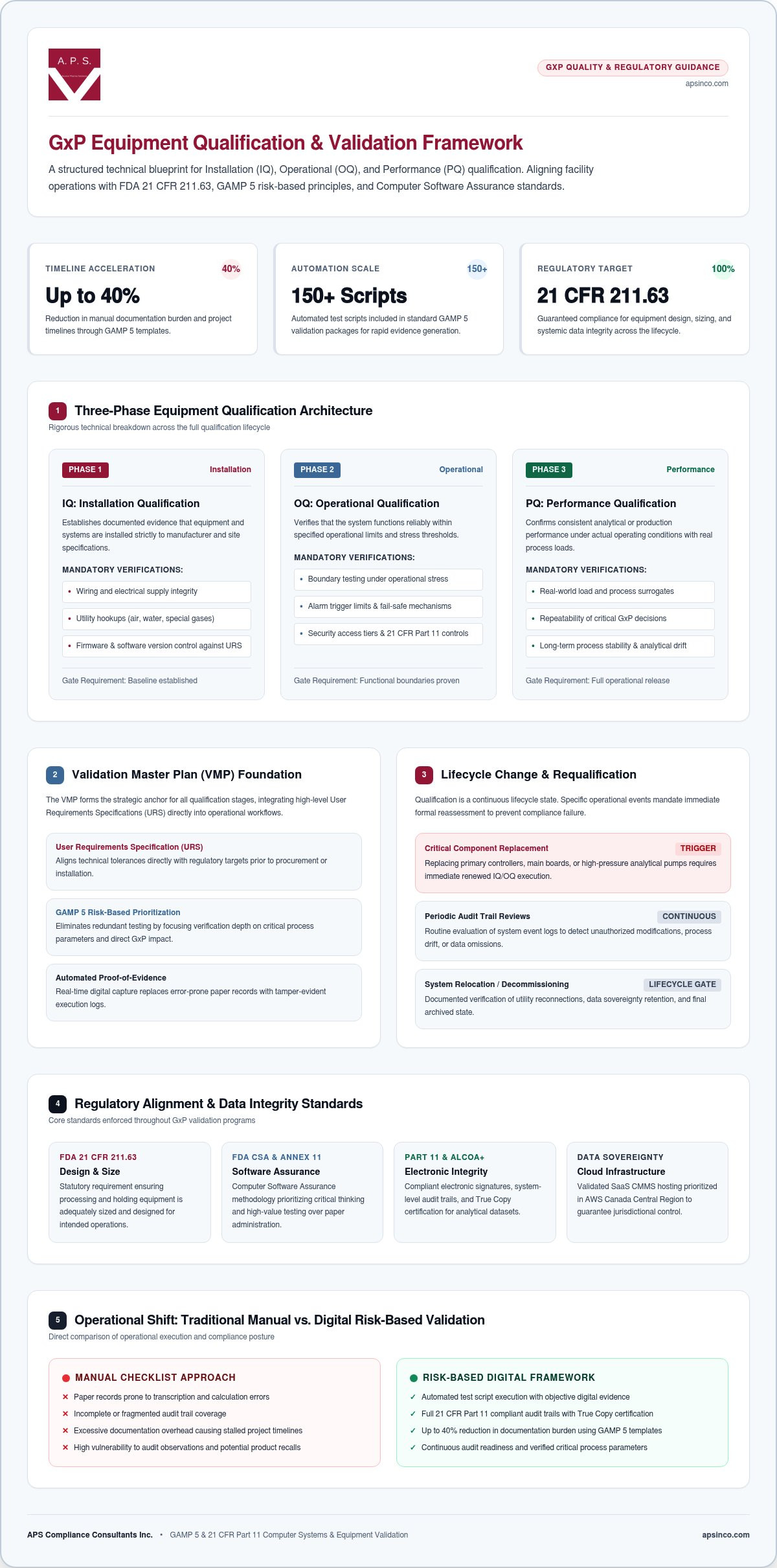
The VMP serves as the strategic foundation for all pharmaceutical equipment qualification and validation stages. It outlines the scope, responsibilities, and specific methodologies required for your site. Our approach integrates a high-level User Requirements Specification (URS) framework into the VMP. This ensures that every technical specification aligns with your operational goals. By establishing these parameters early, we create a clear path for successful IQ OQ PQ validation services and long-term operational integrity. A well-structured VMP reduces project ambiguity and ensures that all stakeholders are aligned on compliance objectives.
Why Manual Validation Fails Modern Audits
Relying on paper-based systems creates significant compliance gaps. Manual records are prone to transcription errors; they often lack the secure audit trails required by modern regulators. These deficiencies can lead to severe audit observations during inspections. We've seen that shifting toward GMP digitalization is the most effective way to enhance data integrity. Automated systems capture execution data in real time, providing objective evidence that manual methods simply can't match. Using expert IQ OQ PQ validation services ensures your lab stays ahead of evolving regulatory expectations while improving overall efficiency. This transition empowers your quality team to focus on critical data analysis rather than manual document tracking.
Technical Requirements for IQ, OQ, and PQ Phases
Effective equipment qualification demands a rigorous technical breakdown across three distinct phases. Installation Qualification (IQ) serves as the first gate, providing documented evidence that the equipment and its components are installed according to manufacturer specifications and site standards. This phase is critical for establishing a baseline for all subsequent IQ OQ PQ validation services. Following successful installation, the focus shifts to Operational Qualification (OQ). This phase proves the system operates within its specified functional limits, ensuring that every alarm and security control functions as intended.
Installation and Operational Qualification Essentials
During IQ, our teams verify the physical integrity of the setup. Mandatory checks include:
Wiring and electrical supply verification
Utility connections, such as compressed air, water, or specialized gases
Firmware and software versioning against the original design specifications
OQ test cases then push the system to its operational boundaries. We focus on alarm triggers, security access levels, and boundary testing to confirm the equipment maintains control under stress. This technical depth aligns with the FDA guidance on Process Validation: General Principles and Practices, which emphasizes that facilities and equipment must be qualified before commercial distribution.
Performance Qualification for Analytical Instruments
In QC laboratories, analytical instrument qualification requires a specific focus on Performance Qualification (PQ). Unlike OQ, PQ verifies consistent performance under real-world loads using actual process materials or standardized surrogates. It confirms the reliability of data generated for GxP decisions, ensuring that your results are accurate and repeatable. If you're struggling with complex protocol design, you can speak with our compliance experts to streamline your documentation.
Qualification isn't static. Any critical component replacement, such as a main control board or a high-pressure pump, may require renewed qualification. Identifying these critical components early prevents unexpected downtime and ensures your operational integrity remains intact throughout the equipment lifecycle. Using expert IQ OQ PQ validation services ensures that these changes are documented without stalling your production timelines.
Implementing a Risk-Based Approach to Accelerate Compliance
A risk-based approach isn't just a regulatory preference; it's a necessity for operational efficiency. Instead of treating every component with equal weight, you should prioritize controls based on intended use and potential impact on patient safety. This methodology aligns directly with the ICH Q9(R1) Quality Risk Management guidance. By focusing on critical functions, our IQ OQ PQ validation services help you allocate resources where they matter most. Our GAMP 5 validation experts use proven templates to reduce the documentation burden by up to 40%. This acceleration doesn't sacrifice quality. It enhances it by focusing engineering hours on high-risk areas rather than administrative tasks.
Data Integrity and the ALCOA+ Framework
Data integrity is the backbone of any validated system. We apply ALCOA+ principles to every protocol, ensuring records are attributable, legible, contemporaneous, original, and accurate. Audit trail reviews play a vital role in this framework. They allow you to detect process drift or data falsification before they result in a product recall. These periodic examinations confirm that your automated records remain a "True Copy" of the original activity. Consistent reviews provide the objective evidence needed to satisfy the most rigorous GxP inspections.
Computer Software Assurance (CSA) vs. Traditional CSV
The transition from traditional computer system validation toward Computer Software Assurance marks a significant change in regulatory expectations. CSA emphasizes critical thinking and high-value testing over excessive, check-the-box documentation. While traditional CSV often leads to project delays, CSA focuses on testing the specific functions that impact product quality. This approach allows you to streamline your pipeline by using unscripted testing for lower-risk functions. It's a faster way to achieve compliance without compromising on safety. If you're ready to modernize your lab, contact our team today to start your risk-based transformation using our specialized IQ OQ PQ validation services.
Strategic Validation Services: Achieving 40% Faster Timelines
Speed in compliance shouldn't mean cutting corners. We provide IQ OQ PQ validation services that accelerate timelines by up to 40% through a disciplined, automated approach. For many labs, the fear of project delays stems from the complexity of validating new systems. Our strategy uses over 150 automated test scripts to provide rapid proof-of-evidence. This efficiency allows your team to focus on core operations while we handle the heavy lifting of regulatory adherence.
Modular Validation for Progressive Transformation
A modular implementation strategy allows for phased rollouts, which helps manage CAPEX and reduces operational disruption. You don't need to transform your entire facility overnight. By integrating tools like PharmaRockIT LIMS into a connected digital ecosystem, you create a scalable foundation for future growth. Using a validated SaaS CMMS further streamlines maintenance management, ensuring your equipment remains in a qualified state without manual tracking.
Audit Readiness and Gap Analysis
Achieving audit readiness requires a proactive look at your existing processes. We conduct a thorough data integrity assessment to identify compliance gaps before they become liabilities. Our goal is to ensure all your data is 21 CFR Part 11-compliant and attributable. Since we are based in the Greater Montreal Area, we provide bilingual expertise and local support that larger firms often lack. We prioritize deployment in the AWS Canada Central Region, securing data sovereignty for our North American clients. This combination of local agility and technical precision ensures your IQ OQ PQ validation services deliver long-term value and systemic integrity.
Securing Operational Integrity Through Strategic Validation
Mastering equipment qualification in 2026 requires a decisive shift from rigid, paper-heavy tasks toward a risk-based lifecycle approach. By prioritizing critical data and embracing Computer Software Assurance, you ensure that your facility remains compliant without sacrificing speed. Our GAMP 5 certified experts provide the technical depth needed to navigate evolving FDA and Health Canada expectations. We've proven that integrating automated evidence capture and maintaining data sovereignty within the AWS Canada Central Region are no longer optional for modern labs; they're essential for systemic integrity.
APS Compliance Consultants Inc. acts as your collaborative partner to handle the complexities of IQ OQ PQ validation services. We provide bilingual Canadian support to help you accelerate compliance timelines by up to 40%. It's time to transform your validation protocols from a project bottleneck into a competitive advantage. Partner with APS for Accelerated IQ OQ PQ Validation and take the first step toward a more efficient, audit-ready future. Your laboratory's success is within reach.
Frequently Asked Questions
What is the difference between IQ, OQ, and PQ in equipment qualification?
IQ verifies that equipment is installed correctly per manufacturer specifications, including electrical and utility connections. OQ tests the system across its operational boundaries to ensure alarms and security controls function within specified limits. PQ confirms the equipment consistently performs under real-world conditions using actual process materials. Together, these phases form the core of our IQ OQ PQ validation services to ensure long-term operational integrity and compliance.
How does a risk-based approach reduce the validation documentation burden?
A risk-based approach prioritizes testing and documentation efforts on functions that directly impact patient safety and product quality. By identifying low-risk areas that require less formal evidence, you can streamline the qualification process. APS uses proven GAMP 5 templates to reduce the manual documentation burden by up to 40%. This methodology shifts the focus from administrative checklists to critical thinking, ensuring high-value testing for your laboratory processes.
Why is GAMP 5 the preferred standard for computer system validation services?
GAMP 5 is the preferred framework because it provides a scalable, risk-based methodology for computer system validation. It categorizes software to determine the appropriate level of testing, which prevents over-testing of low-risk systems. By following the V-Model and focusing on the system lifecycle, GAMP 5 ensures that your digitalization projects are both compliant and operationally efficient. This structured approach is fundamental to our IQ OQ PQ validation services.
Can a SaaS CMMS be fully validated for FDA 21 CFR Part 11 compliance?
Yes, a SaaS CMMS like Alleye can be fully validated to meet FDA 21 CFR Part 11 and EU GMP Annex 11 requirements. These systems use secure audit trails, compliant electronic signatures, and attributable records to maintain data integrity. APS prioritizes data sovereignty by hosting these solutions in the AWS Canada Central Region. Validated SaaS models reduce your internal validation effort from 35% down to approximately 15% of the project.
What are the risks of using unvalidated equipment in GxP-regulated environments?
Using unvalidated equipment in GxP-regulated environments invites severe risks, including audit observations and potential product recalls. Without documented evidence of suitability, the data generated by these instruments is considered untrustworthy by regulators. This lack of control compromises patient safety and can lead to expensive remediation projects. Proper qualification is the only way to maintain the systemic integrity required for pharmaceutical and biotech manufacturing operations.


Comments