

SaaS CMMS for Life Sciences: A Practical Guide for 2026
What if maintenance records are digital, but equipment status, calibration history, and validation evidence still take hours to reconcile before an audit? For teams evaluating a SaaS CMMS for life sciences, the decision is not simply whether to replace paper and spreadsheets. It is whether equipment workflows, validation evidence, and data governance work together.
Look beyond software features to practical questions about access, data sovereignty, supplier evidence, and your organization’s responsibility for computer system validation. Vendor testing can support your validation activities, but it does not replace your assessment of the system’s intended use and risks.
This guide explains how to assess, validate, and implement a SaaS CMMS in a GxP-regulated environment. It covers what to evaluate in maintenance, calibration, and equipment qualification workflows; how to take a risk-based approach to CMMS validation; and what to confirm about hosting, access controls, and operational responsibilities. The aim is traceable equipment records and audit readiness without avoidable validation burden.
Table of Contents
What a SaaS CMMS for life sciences must control
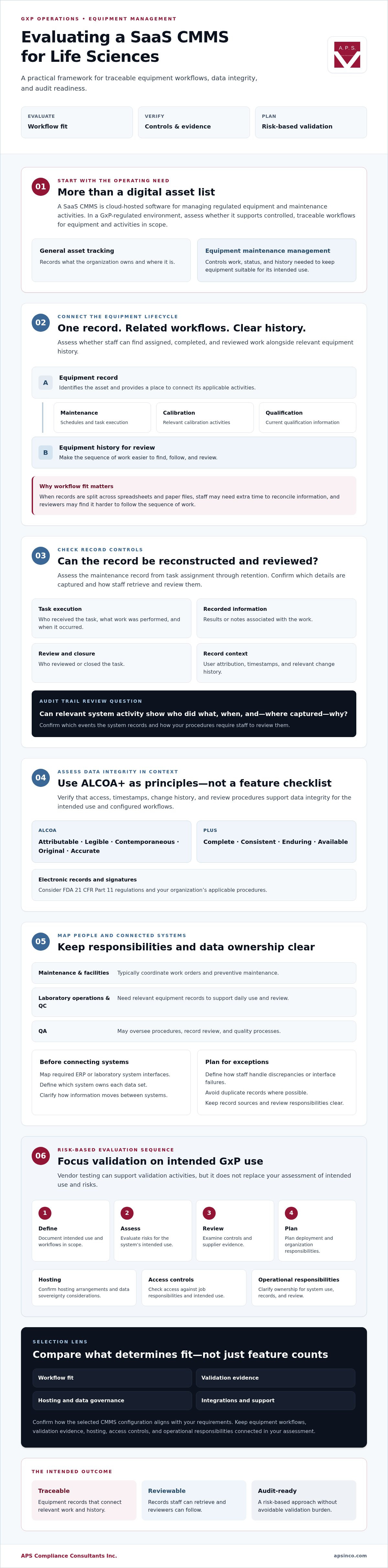
A SaaS CMMS is cloud-hosted software for managing regulated equipment and maintenance activities. A Computerized Maintenance Management System (CMMS) generally organizes maintenance work and equipment records. In a GxP-regulated environment, its value depends on whether it supports controlled, traceable workflows for the equipment and activities in scope.
Equipment maintenance management controls the work, status, and history needed to keep equipment suitable for its intended use. General asset tracking records what an organization owns and where it is. The distinction matters: a location or inventory record alone does not show whether required maintenance or calibration is current, or whether equipment qualification status has been reviewed.
Which life-sciences teams use a CMMS?
Maintenance and facilities teams typically coordinate work orders and preventive maintenance. Laboratory operations and QC teams need relevant equipment records to support daily use and review. QA may oversee procedures, record review, and quality processes. Define each group’s responsibilities so the CMMS supports collaboration without blurring laboratory equipment controls with broader facility work, such as building repairs.
Which equipment workflows belong in scope?
Start with an equipment record that identifies the asset and links it to applicable maintenance schedules, calibration activities, and qualification status. The record should make assigned, completed, and reviewed work easy to find alongside the equipment’s history. This helps staff check status and prepare for review without piecing together information from disconnected files.
For example, a laboratory instrument’s record may link a completed preventive maintenance task to a calibration event and current qualification information. If those details are spread across spreadsheets and paper files, staff may need extra time to reconcile them, and reviewers may find it harder to follow the sequence of work. Fragmented records are not necessarily unreliable, but they can make traceability, review, and audit readiness harder to demonstrate. Assess a SaaS CMMS for life sciences against these equipment lifecycle workflows, not just its asset list.
How SaaS CMMS supports maintenance records and data integrity
A controlled maintenance record should document the work from assignment through retention: who received the task, what work was performed, when it occurred, what results or notes were recorded, and who reviewed or closed it. When assessing a SaaS CMMS for life sciences, check whether configured workflows preserve these details in records staff can retrieve and review.
Role-based access should reflect job responsibilities. User attribution and timestamps help establish who performed an action and when, while change history can show relevant record updates. An audit trail supports reconstruction of relevant system activity by showing who did what, when, and, where captured, why. Confirm which events the system records and how your procedures require staff to review them.
What data integrity controls should teams assess?
Use ALCOA+ as a set of data integrity principles, not as a checklist of software features. Assess whether records are attributable, legible, contemporaneous, original, and accurate, as well as complete, consistent, enduring, and available. Then verify that user access, timestamps, change history, and review procedures support these principles for the intended use and configured workflows. For electronic records and signatures, consult the FDA 21 CFR Part 11 regulations and your organization’s applicable procedures.
How does a CMMS connect to other regulated systems?
Map required interfaces with ERP or laboratory systems before configuration. For each exchange, define which system owns the data, how information moves, and how staff handle discrepancies or interface failures. Avoid duplicate records where possible, while keeping the source of each record and review responsibilities clear. For related electronic-record considerations, consult applicable regulations and your organization’s procedures.
Test and maintain controls as part of your organization’s computer system validation rather than assuming they are adequate from a vendor’s feature list. If you need to align CMMS workflows with data integrity expectations, discuss your requirements with APS.
How to evaluate SaaS CMMS validation, hosting, and implementation
Assess the system against its intended GxP use, not a generic feature checklist. This sequence helps keep computer system validation focused on operational and data risks:
1. Define intended use: Specify the equipment types, users, workflows, records, and decisions the CMMS will support.
2. Map risks: Identify functions and records that could affect quality or a GxP decision, then apply a risk-based approach.
3. Review controls: Compare access, workflow configuration, audit trails, record retention, and relevant interfaces with your requirements.
4. Assess evidence: Identify which supplier documents apply to your configuration and where organization-specific testing is needed.
5. Plan deployment: Assign responsibilities and plan data migration, user readiness, and assessment of changes after release.
Vendor documentation can inform validation, but it does not replace organization-specific computer system validation. APS provides Validation Plans, Risk Assessments, IQ/OQ documentation, and Traceability Matrices. For PharmaRockIT, the platform has documented V-Model validation, including executed IQ and OQ with objective evidence. Check each document against your intended use, configuration, user requirements, and procedures. For further planning, see the CMMS validation guide. The International Society for Pharmaceutical Engineering (ISPE) is also a reference point for GAMP guidance.
Compare hosting and governance
Multi-tenant SaaS, single-tenant, and client-controlled infrastructure differ in how environments are hosted and operational responsibilities are divided. Confirm which model is available for the CMMS under consideration, then document who manages access, changes, backups, recovery, and incident communication. Ask where production and recovery data reside and which jurisdiction applies. For Canadian regulated entities, APS identifies AWS Canada Central for production hosting and AWS Canada West for disaster recovery. Verify that this arrangement applies to the selected model when assessing data sovereignty.
As you compare hosting, validation evidence, and responsibilities, contact APS to discuss your CMMS validation requirements.
Choosing a life-sciences SaaS CMMS with APS and PharmaRockIT
Choose a platform based on your workflows and governance needs. Use these criteria to structure vendor discussions about a SaaS CMMS for life sciences:
Workflow fit: Can it manage equipment lifecycle, preventive maintenance, calibration, and qualification workflows?
Validation evidence: Which executed testing and supporting documents apply to your intended use and configuration?
Access controls: Can roles and permissions align with your responsibilities and procedures?
Hosting: Where is the selected environment hosted, and how are hosting responsibilities divided?
Integrations: Which ERP or laboratory connections are required, and who owns the exchanged data?
Support: What support arrangements apply to your deployment model, and how are issues and changes handled?
PharmaRockIT CMMS is designed around equipment lifecycle, preventive maintenance, calibration, and qualification workflows. APS combines the software with computer system validation expertise and documented deliverables, including Validation Plans, Risk Assessments, IQ/OQ documentation, and Traceability Matrices. The platform has documented V-Model validation, including executed IQ and OQ with objective evidence. Your organization must still determine which evidence applies to its intended use and configuration, then complete its own validation activities.
Where can PharmaRockIT CMMS fit?
A modular implementation may allow teams to phase workflows and organizational adoption, with validation planning aligned to each selected phase. Neopharm implemented PharmaRockIT CMMS for equipment lifecycle management and calibration workflows. Treat this as an implementation example, not a guarantee of specific outcomes for another organization.
What should a readiness discussion cover?
Before a discussion, gather your equipment categories, current workflows, user roles, integration needs, deployment preferences, and validation requirements. Use a GAMP 5 validation guide to inform risk-based planning. Then discuss your SaaS CMMS and validation requirements with APS, including intended use, deployment needs, and the evidence scope to confirm.
Set Your CMMS Up for Sustained Control
A successful SaaS CMMS for life sciences connects equipment workflows with data integrity controls, validation evidence, and clear operational responsibilities. Before implementation, define intended use, assess risks, and confirm that the selected hosting model fits your governance and data sovereignty requirements. Supplier evidence can support your work, but your organization remains responsible for its own computer system validation.
PharmaRockIT has documented V-Model validation, including executed IQ and OQ with objective evidence. APS can provide Validation Plans, Risk Assessments, IQ/OQ documentation, and Traceability Matrices to support your assessment and validation planning. For Canadian regulated entities, production hosting is in AWS Canada Central and disaster recovery is in AWS Canada West. Confirm that these arrangements apply to the deployment model under consideration.
Bring your equipment workflows, user needs, hosting questions, and validation scope into one practical discussion. Discuss your SaaS CMMS requirements with APS to plan for traceable equipment records and audit readiness. A clear scope and defined responsibilities give your team a practical basis for moving forward.
Frequently Asked Questions
What is a SaaS CMMS in life sciences?
A SaaS CMMS is a cloud-hosted maintenance management system for regulated equipment and activities. In life sciences, it can organize equipment records and connect preventive maintenance, calibration, and qualification workflows. Assess it for its intended use, configured workflows, access controls, and record traceability. The organization remains responsible for determining whether and how the system supports its GxP processes.
Does a SaaS CMMS need computer system validation?
If your organization uses a CMMS to support GxP activities, assess the system for its intended use and document evidence that it performs as intended. The scope of computer system validation should reflect the system’s functions, configuration, and risks. Supplier testing may support your work, but it does not replace your organization’s assessment, procedures, and validation evidence for its own use.
What validation documents should a SaaS CMMS vendor provide?
Ask for applicable validation plans, risk assessments, executed installation and operational qualification evidence, and traceability documentation. Check whether each item applies to the product version and configuration you plan to use, and whether it addresses your user requirements and intended workflows. Supplier evidence can inform your validation package. Document any gaps that require organization-specific assessment or testing.
How should a life-sciences company assess SaaS CMMS data residency?
Confirm where production data and backups are stored, which jurisdictions govern them, and how access and recovery responsibilities are divided. These details support your data sovereignty assessment. Verify the arrangements for the specific deployment model rather than assuming every hosting option is the same. For Canadian regulated entities, APS identifies production hosting in AWS Canada Central and disaster recovery in AWS Canada West. Confirm applicability to your selected model.
Can a SaaS CMMS manage calibration and preventive maintenance?
Yes. A CMMS can support preventive maintenance schedules and calibration workflows when those functions are included and configured for the organization’s requirements. Linked equipment records can help staff review assigned tasks, completed work, calibration status, and related history together. Confirm that the chosen system supports your procedures and that the relevant workflows are assessed and validated for their intended GxP use.


Comments