

How to Prepare for an FDA Inspection: A 2026 Compliance Checklist
- 11 minutes ago
- 8 min read
An FDA investigator walks through your front door and asks to see the complete audit trail for a batch released two years ago. If that request triggers panic about document retrieval or data integrity gaps, you're facing a challenge shared by many quality leaders. Learning how to prepare for an FDA inspection shouldn't feel like a desperate scramble; it's about building a culture of continuous readiness. The fear of Form 483 observations and the overwhelming volume of documentation can make regulatory visits feel like an impossible hurdle. We understand that managing staff anxiety and inconsistent legacy systems is a heavy burden to carry alone.
It's time to move toward a state of permanent compliance. In this guide, you'll learn to master the complexities of regulatory scrutiny through a structured approach that prioritizes digital validation and systemic integrity. We'll provide a 2026 compliance checklist focused on streamlining your document retrieval and empowering your team to handle interviews with confidence. We'll explore how modernizing your validation processes ensures your records remain accurate, accessible, and ready for scrutiny at a moment's notice.
Table of Contents
Understanding FDA Inspection Types and the 2026 Regulatory Landscape
Understanding the specific nature of an audit is the first step in learning how to prepare for an FDA inspection. The agency generally categorizes its visits into three primary areas:
Pre-Approval Inspections (PAI): Evaluating a facility's ability to manufacture a specific drug safely before market approval.
Surveillance Inspections: Routine check-ups designed to monitor ongoing compliance and product quality.
For-Cause Inspections: Targeted investigations triggered by specific issues, complaints, or whistleblower reports.
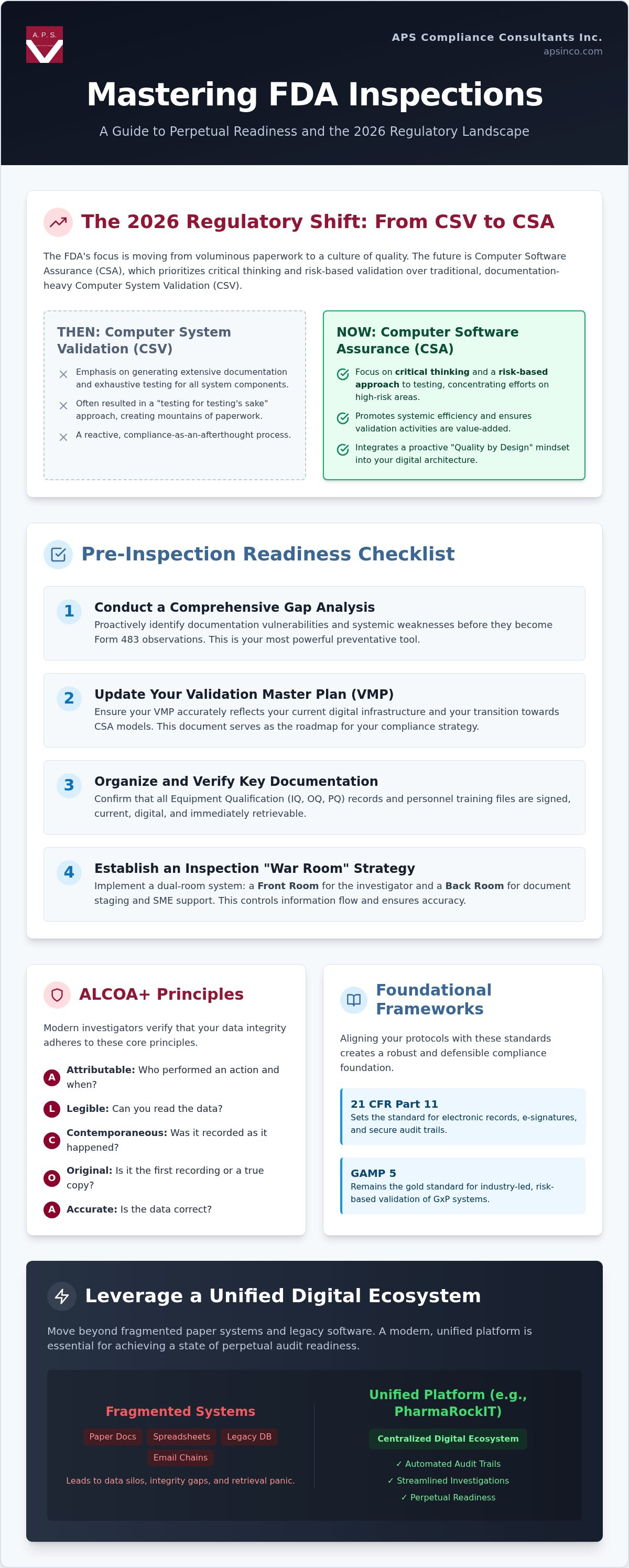
By 2026, the regulatory focus has shifted heavily toward Computer Software Assurance (CSA). This approach prioritizes critical thinking and risk-based testing over the mountain of paperwork required by traditional Computer System Validation (CSV). Investigators aren't just looking for signatures; they're verifying that your data adheres to ALCOA+ principles. Your records must be attributable, legible, contemporaneous, original, and accurate. Modern investigators expect a "Quality by Design" mindset, where compliance is built into your digital architecture rather than added as an afterthought.
The Shift Toward Digital Data Integrity
Gone are the days when stacks of paper printouts satisfied an auditor. In a digital-first environment, static records often lack the metadata required to prove integrity. If you've moved from paper to electronic systems, "True Copy" certification is vital. This process ensures that digitized versions of original records maintain the same content and meaning, including the critical metadata that tracks who touched the data and when.
Key Regulations to Review
To succeed, your team must be fluent in the 21 CFR Part 11 requirements for electronic records and signatures. These rules set the standard for audit trails and system security. Additionally, GAMP 5 remains the gold standard for industry-led risk-based validation. Aligning your internal protocols with these frameworks creates a robust foundation that simplifies how to prepare for an FDA inspection while reducing the risk of technical observations.
Pre-Inspection Checklist: Establishing Your Compliance Foundation
Success begins long before the investigator arrives. A thorough gap analysis is your most powerful tool for identifying documentation vulnerabilities before they become Form 483 observations. You must ensure your Validation Master Plan (VMP) reflects your current digital infrastructure, especially as you transition toward CSA models. This plan serves as your roadmap, explaining to auditors how you maintain control over your complex ecosystem.
Organizing your technical documentation is equally critical. Ensure all equipment qualification iq oq pq records are organized, signed, and immediately retrievable. Verify that personnel training records are digital, searchable, and current. Investigators often use training gaps as a thread to pull on larger systemic issues. Proactive preparation is the only way to manage the stress of a surprise visit.
Organizing the Inspection "War Room"
Establish a dual-room strategy to manage the flow of information. The Front Room serves as the investigator's primary workspace, while the Back Room acts as a command center for support staff and document staging. A clear communication protocol between these rooms prevents conflicting answers and ensures that only requested, vetted documents reach the investigator. This structure allows your team to review data for accuracy before it's presented, providing a vital layer of quality control during the high-pressure audit environment.
Computer System Validation (CSV) Readiness
Confirm that all GxP software aligns with its designated GAMP 5 category to justify your testing rigor. CSV is the documented evidence that a system consistently performs its intended function. Prepare your User Requirements Specifications (URS) and Traceability Matrices in advance. These documents prove that every critical function has been tested and verified. Learning how to prepare for an FDA inspection requires this level of granular detail. If you need help refining your foundation, our team can audit your current readiness state to ensure no detail is overlooked.
During the Audit: Managing Investigator Requests and SMEs
The investigator's arrival shifts your focus from preparation to execution. Success during this phase depends on your ability to manage information flow without hesitation. You must implement a "Request Tracking Log" to monitor every document or data set handed to the investigator. This log is the backbone of your defense; it allows the back-room team to anticipate the investigator's trajectory and prepare supporting evidence before it's even requested. It's a critical part of how to prepare for an FDA inspection while the clock is ticking.
Your IT and Quality staff must be ready to demonstrate electronic audit trails in real-time. If an investigator identifies a minor observation, address it immediately. Correcting an issue during the inspection demonstrates a proactive compliance culture and can often prevent a minor finding from escalating into a formal Form 483 observation. This agility shows that your quality systems are living, breathing processes rather than static files.
Navigating Electronic Record Requests
Modern inspectors expect direct, controlled access to your data. Have a "read-only" user account ready for the investigator to explore validated systems without the risk of accidental data alteration. When showcasing your lims software, be prepared to explain exactly how the system enforces re-authentication for electronic signatures. This technical transparency builds trust and proves your digital controls are robust and compliant with 21 CFR Part 11.
The Role of the SME
Subject Matter Experts (SMEs) are your most valuable assets during an audit. You should identify key personnel for validation, production, and quality control well in advance. Conduct mock interviews to reduce anxiety and ensure technical accuracy. Coach your SMEs to answer only what is asked, concisely and accurately. If you aren't sure if your team is ready for the hot seat, you can schedule a mock audit with our consultants to refine your defense strategy.
Leveraging Digital Tools for Perpetual Audit Readiness
The final evolution in learning how to prepare for an FDA inspection involves moving beyond periodic fire drills to a state of perpetual readiness. Manual, paper-based systems are inherently fragile during an audit. By transitioning to a unified digital ecosystem like PharmaRockIT, you eliminate the risk of missing signatures or illegible entries. These systems utilize automated audit trails with hierarchical event tracking, known as the DTALE engine. This technology provides:
Chronological mapping of every data interaction.
Instant verification of user identities and timestamps.
Simplified investigations into complex data deviations.
Implementing cmms validation for fda compliance allows you to automate equipment maintenance logs, removing another layer of human error from the equation. SaaS-based validation further streamlines the process, often reducing internal validation efforts by 10-15% compared to on-premise installations. This shift ensures 24/7 compliance while allowing your IT team to focus on core operations rather than server maintenance.
PharmaRockIT: A Modular Approach to Compliance
Change management is often the biggest hurdle to digital transformation. PharmaRockIT addresses this through modular rollouts of LIMS, Electronic Workbooks (EWB), and CMMS. This phased approach allows your team to adapt to new workflows without overwhelming daily operations. The PharmaRockIT LINK system creates a "Connected, Traceable, and Audit-Ready" environment where data flows seamlessly between modules, maintaining systemic integrity at every touchpoint.
Next Steps: Partnering with GAMP 5 Validation Experts
Establishing a digital foundation is a strategic investment in your facility's future. Our gamp 5 validation experts can help accelerate your readiness projects by up to 40% using refined methodologies and automated tools. We recommend a proactive gap analysis as your first step toward 2026 compliance. By identifying weaknesses now, you transform the question of how to prepare for an FDA inspection from a source of anxiety into a routine demonstration of operational excellence.
Achieving Continuous Compliance in a Digital World
Achieving a successful inspection outcome requires more than just organized files; it demands a validated digital ecosystem and a culture of continuous readiness. By shifting from traditional CSV to a risk-based CSA model, you reduce documentation burdens while strengthening your data integrity. Transitioning to unified systems like PharmaRockIT ensures that your audit trails are always accessible and your records remain ALCOA+ compliant. Mastering how to prepare for an FDA inspection means your team can handle investigator requests with absolute confidence and precision.
We specialize in accelerating compliance projects by up to 40% through deep expertise in GAMP 5 and 21 CFR Part 11 requirements. Our collaborative approach ensures your digital infrastructure is both innovative and rigorously compliant. Don't wait for an investigator to arrive before identifying your system's vulnerabilities. You can Request a Comprehensive FDA Readiness Gap Analysis from APS to secure your facility's future. With the right partner, regulatory scrutiny becomes an opportunity to showcase your operational excellence.
Frequently Asked Questions
How long does a typical FDA inspection last?
A typical FDA inspection lasts between three and five business days for routine surveillance. However, Pre-Approval Inspections or complex for-cause investigations can extend to several weeks depending on the facility's size and the audit's scope. Investigators typically arrive during normal business hours and follow a structured schedule. Knowing how to prepare for an FDA inspection effectively helps you manage this timeline by ensuring all requested data is immediately retrievable.
Can I refuse to provide the FDA investigator with certain documents?
You generally cannot refuse access to records required by GxP regulations, such as batch records, SOPs, or validation data. However, the FDA typically does not have legal authority to inspect financial data, sales records, or certain personnel files unrelated to training. It's vital to have a legal or compliance expert review requests for sensitive non-GxP information. Establishing clear boundaries early prevents investigators from straying into proprietary areas while maintaining a collaborative atmosphere.
What is the most common reason for receiving an FDA Form 483?
The most frequent cause for a Form 483 is the failure to follow written procedures or inadequate investigations into manufacturing deviations. Investigators look for systemic gaps where the reality of your operations doesn't match your stated protocols. Inconsistent data integrity and poor document control also rank high among common observations. Ensuring your team understands how to prepare for an FDA inspection through rigorous internal auditing can significantly reduce the likelihood of these findings.
How does Computer Software Assurance (CSA) differ from traditional CSV in 2026?
CSA differs from traditional CSV by shifting the focus from exhaustive documentation to critical thinking and risk-based testing. While traditional validation often treats all software features with equal scrutiny, CSA prioritizes testing for functions that directly impact patient safety or product quality. This modern approach reduces the volume of redundant paperwork. It empowers your team to use unscripted testing for low-risk systems, accelerating the validation lifecycle while maintaining high compliance standards.
What should I do immediately after the FDA investigator leaves the facility?
Immediately hold a comprehensive debriefing session with your core inspection team and SMEs. Review the Request Tracking Log to identify potential areas of concern discussed during the visit. If the investigator issued a Form 483, you must begin drafting your formal response immediately, as you only have 15 business days to submit it. This proactive stance shows the agency you take their observations seriously and are committed to rapid remediation.


Comments