

STARLIMS vs PharmaRockIT: Comparing LIMS for GMP Laboratories
The best-known LIMS isn’t automatically the best fit for a GMP laboratory. StarLIMS vs PharmaRockIT is a decision about more than feature lists: the platforms may have different scopes, so compare how each supports the laboratory’s actual processes rather than assuming they are interchangeable.
Look beyond brand recognition to see how routine workflows, controlled records, validation evidence, and ongoing system ownership align with your GxP responsibilities. PharmaRockIT LIMS supports QC sample lifecycles, specifications, testing workflows, and reporting. Its documented V-Model validation includes executed IQ and OQ with objective evidence. Use these facts as part of the evaluation, while basing the final decision on your intended use and site-specific processes.
This comparison explains how to assess workflow fit, data-integrity controls, validation documentation, implementation, and long-term operations. Use the practical framework to define laboratory requirements, evaluate validation evidence, and plan a sustainable approach to computer system validation and system ownership.
Table of Contents
STARLIMS vs PharmaRockIT: Start with the Laboratory's Actual Requirements
A fair comparison starts with what the laboratory needs, not with vendor rankings. Base the LIMS decision on sample lifecycle, specifications, testing workflows, reporting, user roles, and the people responsible for system operation. A Laboratory Information Management System (LIMS) manages laboratory information, but your intended use determines which capabilities matter in a GMP setting.
A requirements-led LIMS comparison in a GxP-regulated environment evaluates each platform against documented laboratory workflows, control needs, and operational responsibilities. Apply this principle to keep the StarLIMS vs PharmaRockIT assessment relevant to your processes.
What should a regulated laboratory compare first?
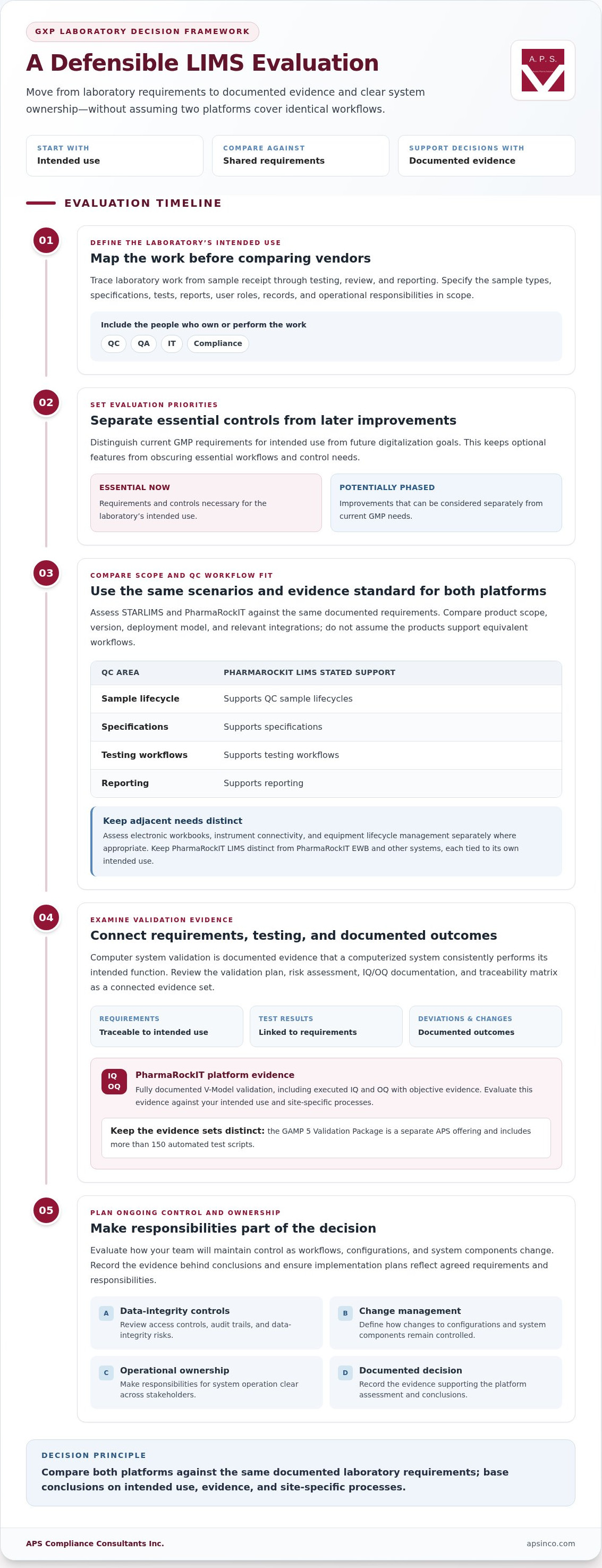
Map the work from sample receipt through testing, review, and reporting. Identify the QC sample types and specifications in scope, the tests performed, and the records each role creates or reviews. Include QC, QA, IT, and compliance perspectives to make workflow needs and ownership responsibilities clear before demonstrations or feature claims shape the decision.
Separate requirements into two groups: controls essential to intended use and improvements that can be phased in later. This makes it easier to distinguish current GMP needs from future digitalization goals and prevents optional features from distracting from essential workflows.
Why a vendor comparison is not automatically like-for-like
Comparisons can cover different product modules, implementation models, or types of supporting evidence. A vendor’s positioning or a review score from a comparison with another LIMS does not establish fit for your laboratory or prove that the same functions and responsibilities apply. Assess both platforms against the same requirements, and record the evidence behind each conclusion.
For each platform, compare the product scope, version, deployment model, and integrations relevant to your intended use. Keep the assessment tied to documented capabilities and evidence, rather than treating broad platform descriptions as proof that workflows are equivalent.
Compare STARLIMS and PharmaRockIT LIMS by QC Workflow and Platform Scope
Compare the platforms using the same QC scenarios, not broad feature lists. PharmaRockIT LIMS supports QC sample lifecycles, specifications, testing workflows, and reporting. Assess STARLIMS against the corresponding requirements using the same measures and evidence standard.
Laboratories can assess LIMS workflow fit by mapping the same intended-use scenarios to each platform and recording what is supported by documented evidence.
Map the sample lifecycle to required LIMS functions
Trace each sample from receipt to final reporting. Define the information needed at each stage, who performs or reviews the work, and how specifications relate to tests and results. Use relevant sample categories, such as raw materials, finished products, or environmental monitoring, as test scenarios where they apply to your laboratory. Compare the required steps and controls, not assumptions that either platform handles every category in the same way.
Sample lifecycle: PharmaRockIT LIMS supports QC sample lifecycles. Compare both platforms against your defined sample receipt, handling, and review steps.
Specifications: PharmaRockIT LIMS supports specifications. Assess both platforms against the specification requirements for your use cases.
Testing workflows: PharmaRockIT LIMS supports testing workflows. Compare the platforms using the QC testing scenarios in scope.
Reporting: PharmaRockIT LIMS supports reporting. Assess both platforms against the reports required by your laboratory and their intended use.
Assess broader laboratory needs without expanding LIMS scope
List adjacent needs separately, such as electronic workbooks, instrument connectivity, or equipment lifecycle management. Decide whether each belongs in the LIMS comparison, a separate system assessment, or a phased digitalization plan. Keep PharmaRockIT LIMS distinct from PharmaRockIT EWB and other systems, and evaluate each according to its own intended use rather than assuming shared functions.
APS supports project-specific workflow mapping and validation planning. Discuss your LIMS and validation requirements to give QC and quality stakeholders a clearer basis for comparing evidence and documenting decisions.
Evaluate Validation Evidence, Data Integrity, and Deployment Responsibilities
Feature fit is only part of the decision. Computer system validation is documented evidence that a computerized system consistently performs its intended function. In the StarLIMS vs PharmaRockIT evaluation, determine whether the evidence supports your intended use and how your team will maintain control as workflows, configurations, and system components change.
PharmaRockIT has fully documented V-Model validation, including executed IQ and OQ with objective evidence. Consider this platform evidence alongside your organization’s responsibilities for intended use and ongoing control. It is distinct from APS’s GAMP 5 Validation Package, which includes more than 150 automated test scripts.
What validation evidence should teams examine?
Review the validation plan, risk assessment, IQ/OQ documentation, and traceability matrix as a connected evidence set. Confirm that requirements link to test results and that deviations or changes have documented outcomes. A GAMP5 risk-based approach focuses validation activities on intended use and system risk, rather than applying the same testing depth to every function. Use the same evidence criteria to assess the documentation relevant to each platform’s scope.
How do data integrity and deployment affect ongoing ownership?
Assess access controls and audit trails against actual user roles and record workflows. Determine whether records remain attributable and whether controls support ALCOA+ principles. Define who will perform audit trail reviews, manage changes, and maintain validation documentation after release. These responsibilities continue throughout operation, not just during implementation.
Deployment also affects operational planning. If Canadian data sovereignty is relevant to your organization, include data location and jurisdiction in the assessment. APS prioritizes deployment of its solutions in the AWS Canada Central Region. Document how deployment decisions, system access, and change control fit your quality system and assigned responsibilities.
APS provides computer system validation services to align validation evidence with your laboratory’s intended use. Discuss your computer system validation requirements with the team.
Make the STARLIMS vs PharmaRockIT Decision with a Defensible Evaluation Plan
A defensible decision records why the selected platform fits intended use and how the organization will implement and maintain it. For StarLIMS vs PharmaRockIT, distinguish documented evidence from claims that remain unsubstantiated, then involve the people accountable for laboratory performance and GxP oversight.
Build a practical platform evaluation
Confirm requirements. Agree on the laboratory’s intended use, critical workflows, user roles, reporting needs, and essential controls.
Map workflows. Use representative QC scenarios to assess workflow fit, exceptions, review steps, and handoffs.
Review evidence. Record validation documentation, objective evidence, data-integrity controls, and deployment information. Separate supported capabilities from claims that lack evidence.
Assess stakeholder needs. QC should confirm operational usability; QA should assess controlled records and review responsibilities; IT should evaluate technical ownership and support needs; compliance should align the assessment with GxP processes and intended use.
Plan implementation. Document responsibilities for configuration, computer system validation, training, change management, and ongoing operation before rollout.
Plan a supported implementation and validation path
Ask each stakeholder to document agreement on intended use, unresolved questions, and acceptance criteria. Tie the decision record to specific workflows and evidence, rather than a general preference for one vendor. This gives the team a practical basis for implementation planning and future change assessment.
APS brings PharmaRockIT LIMS together with computer system validation and GxP operational expertise. The team works collaboratively with your staff to align deployment and validation activities with laboratory needs, connecting platform selection to the controls and responsibilities required for sustainable operation.
Discuss your LIMS and validation requirements with APS to build an evaluation and implementation approach around your organization’s intended use.
Turn Your Evaluation into a Sustainable GxP Decision
A platform decision should remain useful as laboratory priorities evolve. Keep a concise record of the decision rationale, assumptions, and conditions that could prompt reassessment, such as a change in intended use or a new QC workflow. This gives future stakeholders context and helps prevent undocumented changes in how the system supports regulated work.
Use the record as a living governance tool. Revisit it when operational needs change so your team can determine whether the current approach still supports its quality objectives and responsibilities.
Discuss your LIMS and validation requirements with APS to move forward with a clear basis for decision-making and sustainable GxP operations.
Frequently Asked Questions
Is STARLIMS better than PharmaRockIT for a GMP laboratory?
No single platform is right for every GMP laboratory. Before deciding, establish decision thresholds: which requirements are mandatory, what evidence is acceptable, and what gaps would prevent release. A StarLIMS vs PharmaRockIT assessment can then produce a documented rationale rather than a preference-based choice. Record exclusions and assumptions so the decision remains understandable as stakeholders or processes change.
Can PharmaRockIT LIMS support regulated QC workflows?
Suitability for a particular site depends on how the system is configured and used. Define user roles, review responsibilities, exception handling, and record-retention needs in the intended-use plan. Include training and procedure updates in implementation planning, then assess the configured workflow against documented requirements before routine use.
What should a STARLIMS vs PharmaRockIT comparison include?
Include transition considerations alongside platform assessment. Map data to be migrated, identify interface dependencies, and estimate the internal effort needed for configuration, training, and procedural updates. Document assumptions about existing records and connected systems, then assign an owner to each unresolved dependency. This brings implementation constraints into view alongside feature fit and makes the decision more useful for project planning.
Does buying a validated LIMS remove the need for computer system validation?
No. Supplier testing can provide useful evidence, but your organization still needs to assess how the configured system supports site procedures. Document configuration decisions, interfaces, local permissions, deviations, and approval to release the system for use. For example, a changed review sequence may affect who approves records, so assess and document that impact before the workflow enters production.
How can a laboratory reduce risk when selecting a LIMS?
Test routine and exception scenarios before finalizing implementation plans. For example, walk through a delayed sample or a corrected result and document how staff handle the event, which records are created, and who reviews them. Compare the process with laboratory procedures, assign owners to gaps, and resolve critical issues before they become configuration or training problems.



Comments