

GMP Data Integrity Risk Assessment: 2026 Guide
Approximately 70% of GMP audit observations in 2026 are linked to gaps in documentation control and audit trails, according to May 2026 data from Zamann Pharma Support. If you're feeling the pressure of an upcoming inspection, you aren't alone. Mapping complex data flows across hybrid paper and digital systems often feels like trying to hit a moving target, especially when different departments use inconsistent risk scoring. We understand that the fear of receiving an FDA 483 can be overwhelming; however, a robust data integrity risk assessment gmp doesn't have to be a source of stress. It's about moving from reactive fixes to a state of controlled momentum where your team feels empowered rather than burdened.
Secure your data lifecycle with confidence. This guide provides a methodical, GAMP 5-aligned framework to help you identify and mitigate risks before an auditor arrives. You'll learn how to build audit-ready documentation and prioritize remediation efforts effectively. We'll walk through a repeatable assessment template that ensures consistency across your entire facility, transforming complex regulatory requirements into a clear, actionable roadmap for long-term compliance.
Table of Contents
The Role of Risk Assessment in GMP Data Integrity
A data integrity risk assessment gmp serves as a strategic shield for your facility. It's the methodical process of identifying vulnerabilities throughout the data lifecycle that could jeopardize patient safety or product quality. This isn't just about following rules; it's about shifting toward the risk-based methodologies championed by ICH Q9 and GAMP 5. These frameworks empower you to focus your resources where they matter most, ensuring that your validation efforts are both efficient and effective.
The stakes are high. Inadequate assessments frequently result in costly regulatory citations, product recalls, and a devastating loss of organizational trust. We believe in the 'trustworthiness' principle, which asserts that data is only an asset if its accuracy and reliability are absolute. Without a clear risk strategy, your data becomes a significant liability that can stall production and invite unwanted scrutiny.
ALCOA+ and the Foundation of Risk Identification
The ALCOA+ principles act as the universal language for compliance, requiring that data be Attributable, Legible, Contemporaneous, Original, and Accurate. These five pillars form the basis of every audit trail review and system check. The '+' criteria, which include Complete, Consistent, Enduring, and Available, expand this scope to ensure that information remains reliable across its entire operational lifespan from initial entry to final archival.
Regulatory Expectations for 2026
As we move through 2026, the FDA and Health Canada have sharpened their focus on electronic record-keeping and the active management of audit trails. Regulators now expect to see evidence of proactive risk mitigation rather than reactive troubleshooting. They're looking for proof that you've mapped your data flows and secured every touchpoint. For a more detailed look at how to align your digital systems with these standards, see our 21 CFR Part 11 Requirements Guide.
Mapping the Critical Data Lifecycle: Identifying Vulnerabilities
Process mapping is your essential first step. You cannot secure what you cannot see. By visualizing how data moves from initial generation through to final archival, you pinpoint exactly where vulnerabilities reside. A thorough data integrity risk assessment gmp distinguishes between static data, such as fixed records, and dynamic data, including audit trails and metadata. Dynamic data carries a higher risk profile because it remains interactive and subject to modification, making it a primary focus for modern auditors.
Hybrid systems often present the greatest challenges to systemic integrity. Manual transcription points are notorious for "human error," creating gaps that regulators easily spot. Additionally, instrument-to-software interfaces act as critical failure points where data loss or corruption frequently occurs during transmission. If you're struggling to map these complex flows, our consultants can help you identify these hidden gaps and streamline your documentation.
Evaluating Legacy Benchtop Instruments
Many facilities still rely on legacy instruments that lack native network capabilities. Using RS232 or Serial data connections introduces significant risk because these formats are often insecure and difficult to track. We recommend implementing 'LINK' middleware solutions to securely acquire and digitize this legacy data. This ensures it integrates seamlessly into your validated environment without compromising the original record's accuracy.
Risk Scoring: Probability vs. Severity
Effective remediation requires a structured framework. Score each identified risk based on its potential impact on product quality and the likelihood of detection. High-severity risks that are difficult to detect demand immediate attention. This scoring methodology ensures your data integrity risk assessment gmp remains a focused, actionable tool for your leadership team. By moving beyond a "one-size-fits-all" approach, you prioritize remediation efforts and optimize your compliance spend effectively.
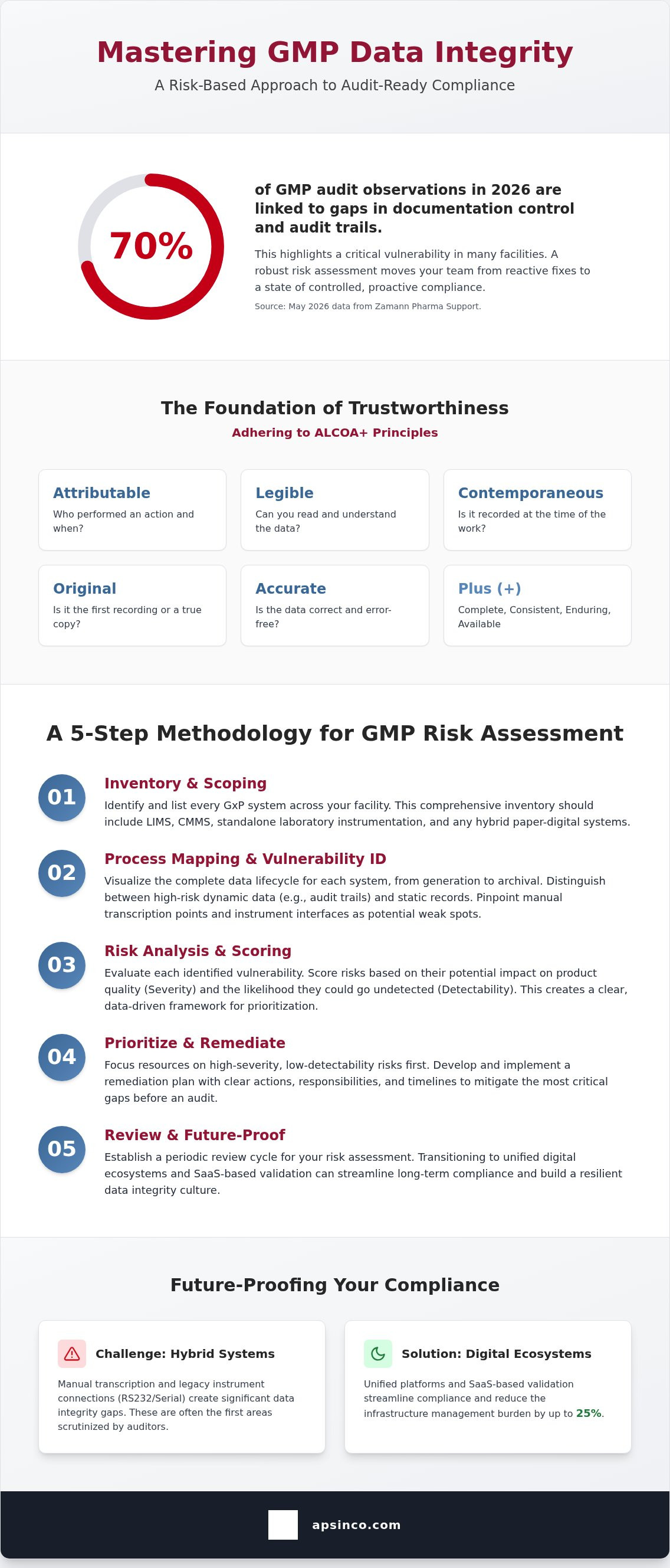
A 5-Step Methodology for Executing Your GMP Risk Assessment
Execution transforms regulatory theory into operational security. A structured approach ensures your data integrity risk assessment gmp remains both thorough and defensible under audit scrutiny. We recommend a methodical five-step process to maintain clarity and momentum throughout the project.
Step 1: Inventory and Scoping. Identify every GxP system in your facility, including LIMS, CMMS, and laboratory instruments.
Step 2: Data Flow Mapping. Document every manual and automated touchpoint where data is created, modified, or stored to visualize potential failure points.
Step 3: Gap Analysis. Compare these current states against ALCOA+ and data integrity consulting pharma standards to pinpoint non-compliance.
Step 4: Risk Mitigation Planning. Define specific technical and procedural controls, such as electronic signatures and frequent audit trail reviews.
Step 5: Documentation and Review. Finalize your assessment report and establish a periodic review cycle to ensure ongoing compliance as systems evolve.
Leveraging GAMP 5 for Validated Outcomes
This assessment doesn't exist in a vacuum. It directly informs the strategy used by GAMP 5 validation experts to define the depth of testing required. By translating identified risks into specific User Requirements Specifications (URS) and Traceability Matrices, you ensure your validation efforts focus on the most critical system functionalities. This alignment reduces waste and accelerates project timelines.
Addressing the Human Element
Technology alone isn't a silver bullet. You must implement procedural controls to mitigate both intentional and unintentional data manipulation. Role-based access control and two-factor authentication (2FA) are essential to reducing unauthorized access risks. These security layers foster a culture of accountability and ensure that only qualified personnel interact with sensitive data sets. If you're ready to secure your facility's future, contact our experts to start your assessment today.
Future-Proofing Compliance with Digital Ecosystems
Transitioning from a manual or hybrid state to a unified digital ecosystem is the final frontier of a modern data integrity risk assessment gmp. Siloed, "monolithic" systems create fragmented data trails that are notoriously difficult to defend during rigorous inspections. By integrating specialized tools like PharmaRockIT LIMS, the Electronic Workbook (EWB), and Alleye CMMS, you eliminate these gaps through a cohesive architecture. This collaborative approach ensures that data flows seamlessly between departments without the risk of corruption. Utilizing Canadian-hosted SaaS infrastructure not only secures data sovereignty for local compliance but also reduces the total infrastructure management burden by up to 25%. This shift empowers your team to focus on core production while we handle the technical complexities of system maintenance.
A modular implementation strategy allows you to remediate data integrity gaps progressively rather than attempting a high-risk "big bang" overhaul. This phased approach reduces CAPEX risk while ensuring each module is fully validated and compliant with current Health Canada and FDA expectations. It provides a structured path toward a fully paperless environment that grows with your facility's needs.
Automating Audit Trail Reviews
Manual reviews are often time-consuming and prone to human oversight. Our proprietary DTALE engine introduces 'Dynamic Temporal Audit Linking,' which tracks hierarchical event dependencies automatically to ensure no step is missed. AI-supported suggestions further minimize manual data entry errors in specifications by flagging inconsistencies in real-time. This level of automation transforms the audit trail from a static log into a proactive quality management tool that prevents errors before they occur.
Building an Audit-Ready Culture
We aim to move your organization away from traditional "inspection panic" toward a state of controlled momentum. Through automated reporting and continuous monitoring, you achieve a level of permanent audit readiness that instills confidence in every stakeholder. This provides the peace of mind that your facility is always prepared for a surprise regulatory visit. Empower your lab with a validated, paperless ecosystem by contacting APS today.
Achieving Permanent Audit Readiness in 2026
Mastering a data integrity risk assessment gmp is no longer just a regulatory hurdle; it's a strategic advantage that protects your products and your reputation. By mapping your data lifecycle and implementing a structured 5-step methodology, you move from reactive troubleshooting to a state of controlled momentum. Transitioning to unified digital ecosystems further future-proofs your operations against the evolving complexities of global inspections.
We're here to guide you through this transition with GAMP 5 expert-led assessments and 21 CFR Part 11 compliant digital solutions. Our proven approach can accelerate your validation timelines by up to 40%, allowing your team to focus on innovation while we manage the technical burden of compliance. Don't wait for a high-stakes audit to address hidden vulnerabilities in your facility. Secure Your GMP Data with a Professional Risk Assessment today. You have the expertise to lead your lab, and we're ready to ensure your data remains beyond reproach.
Frequently Asked Questions
What is the most common data integrity risk in GMP environments?
The most common risk is the reliance on hybrid systems where manual transcription between paper and digital records occurs. These manual touchpoints are prone to human error and lack the automated audit trails required by modern regulators. Identifying these gaps during a data integrity risk assessment gmp allows you to implement technical controls that secure the data lifecycle and prevent unauthorized modifications or deletions.
How often should a data integrity risk assessment be updated?
You should update your assessment at least annually or whenever a significant change occurs in your systems, processes, or regulatory environment. Periodic reviews ensure that your mitigation strategies remain effective as technology evolves. If you implement new software or upgrade existing laboratory instrumentation, a fresh evaluation is necessary to capture any new vulnerabilities that might impact your facility's overall compliance posture.
Can we perform a risk assessment on a validated legacy system?
Yes, performing an assessment on validated legacy systems is a critical requirement for maintaining long-term compliance. Many older systems lack native audit trails or secure user access controls, which are primary focus areas for current inspectors. By evaluating these systems now, you can identify where middleware or procedural controls are needed to bridge the gap between legacy functionality and 2026 regulatory expectations.
What is the difference between a data integrity audit and a risk assessment?
A data integrity audit is a reactive review of past records to confirm compliance, while a risk assessment is a proactive exercise to identify future vulnerabilities. While an audit looks for errors that have already occurred, a data integrity risk assessment gmp focuses on the "what if" scenarios. This forward-looking approach allows you to build stronger systems that prevent citations before an inspector ever sets foot in your lab.
How do SaaS systems impact the data integrity risk profile?
SaaS systems simplify infrastructure management but shift the risk profile toward vendor oversight and data residency requirements. You must ensure your provider maintains GAMP 5-aligned validation and meets local data sovereignty standards, such as Canadian-hosted infrastructure for domestic operations. While SaaS reduces your internal maintenance burden, it requires a robust Service Level Agreement to guarantee that data remains available, enduring, and consistently protected from external breaches.



Comments