

GMP Equipment Qualification Services: A 2026 Strategic Guide to Lifecycle Compliance
- 11 minutes ago
- 8 min read
What if your validation timeline wasn't the primary obstacle standing between your product and the patient? For many manufacturers, gmp equipment qualification services often feel like a series of endless, paper-heavy hurdles that invite transcription errors and delay market entry. You likely recognize the frustration of managing complex GAMP 5 categories while under the pressure of tight deadlines. It's a high-stakes environment where a single manual oversight can lead to a significant regulatory setback.
We're here to help you master the complexities of IQ, OQ, and PQ with a modern, risk-based approach that accelerates your path to audit readiness. By aligning with the 2026 FDA Computer Software Assurance (CSA) guidance and the latest EU GMP Annex 11 updates, you can transform compliance from a burden into a competitive advantage. This guide explores how digitalizing your lifecycle through tools like Alleye CMMS and PharmaRockIT eliminates manual data integrity gaps, ensuring your documentation is always inspection-ready while significantly reducing your speed-to-market.
Table of Contents
What Are GMP Equipment Qualification Services?
At its core, gmp equipment qualification services represent a documented, systematic approach to verifying that your laboratory or manufacturing systems operate consistently within defined parameters. In 2026, this process has evolved from a simple "check-the-box" exercise into a strategic pillar for operational excellence. It's about establishing the trustworthy data required to survive an audit and optimize production. Modern GMP qualification is a systematic, documented program that ensures every piece of equipment operates reliably according to its intended use, fundamentally upholding the ALCOA+ principles to ensure data is attributable, legible, contemporaneous, original, and accurate.
Beyond mere compliance, a robust qualification strategy mitigates risk by identifying potential points of failure before they impact your product. By moving toward a risk-based model, you ensure that your resources are focused where they matter most, allowing you to maintain systemic integrity without bloating your validation timelines.
Qualification vs. Validation: Clearing the Confusion
Precision matters in terminology. Qualification focuses specifically on the equipment or system itself, while validation encompasses the entire process. You can't validate a manufacturing process if the underlying hardware hasn't been qualified first. Specialized analytical instrument qualification services serve as the critical prerequisite within your broader validation master plan, ensuring that every sensor and motor performs exactly as the manufacturer intended. This sequential relationship creates a solid foundation for process validation, ensuring that your output is consistent and reproducible.
Regulatory Requirements: FDA, Health Canada, and EU GMP
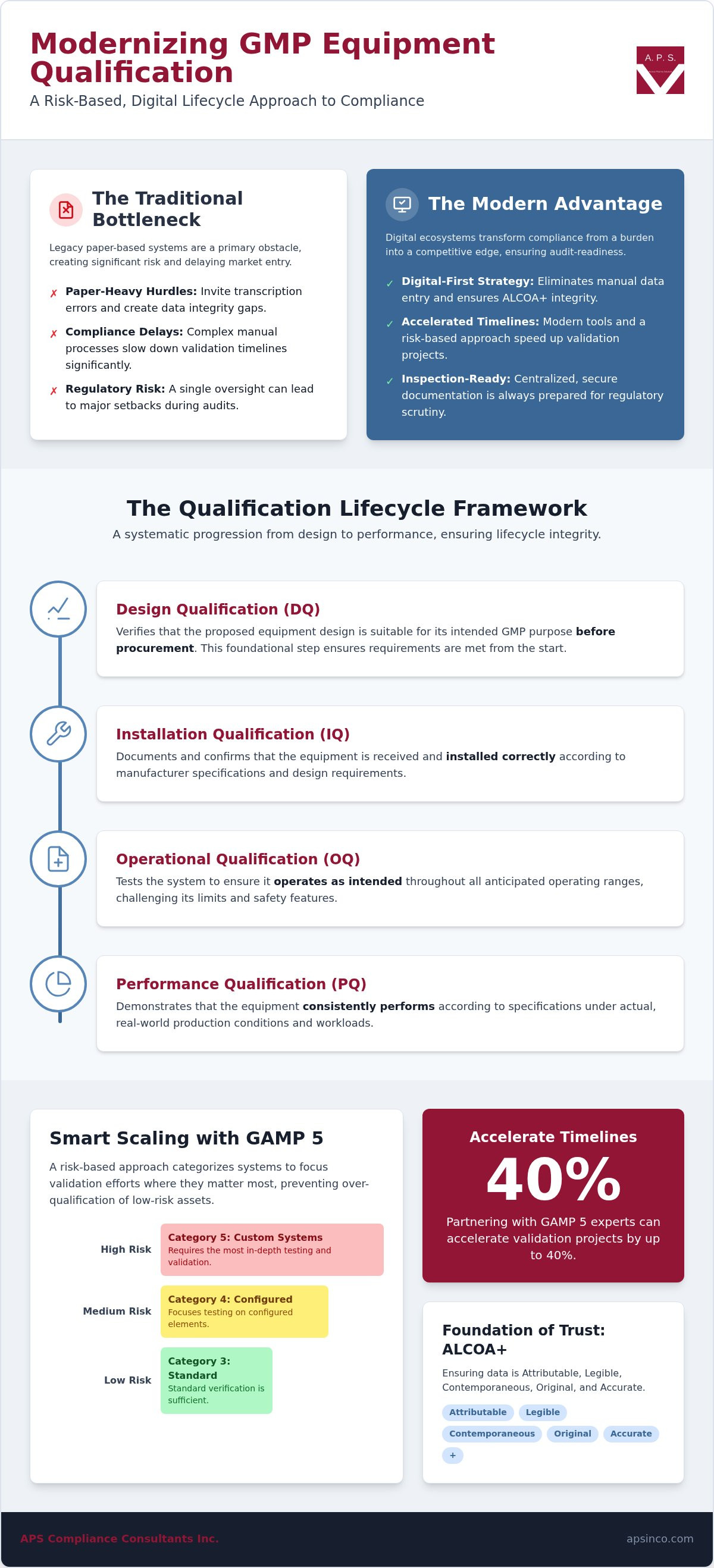
Global regulators like the FDA and EMA have heightened their expectations regarding 21 CFR Part 11 and EU GMP Annex 11. Health Canada specifically emphasizes audit readiness through rigorous data integrity oversight. By utilizing GAMP 5 risk-based categories, you can scale your qualification efforts based on the complexity and impact of the equipment. This prevents "over-qualifying" simple items while focusing resources on high-risk systems that directly influence product quality. It's a methodical flow that ensures your documentation stands up to the most intense regulatory scrutiny.
The IQ/OQ/PQ Framework: Ensuring Lifecycle Integrity
The four pillars of the IQ/OQ/PQ framework are the engine of modern gmp equipment qualification services. They transform technical specifications into regulatory proof through a structured lifecycle. Design Qualification (DQ) verifies that the proposed design is suitable for its intended GMP purpose before procurement. Installation Qualification (IQ) then documents that the equipment is received and installed according to manufacturer specifications. Operational Qualification (OQ) tests the system throughout all anticipated operating ranges, while Performance Qualification (PQ) demonstrates consistent performance under actual production conditions. This methodical progression ensures that every asset is fit for use before it touches a single batch of product.
Implementing a Risk-Based GAMP 5 Approach
Effective gmp equipment qualification services rely on GAMP 5 categorization to scale effort appropriately, ensuring you don't over-invest in low-risk systems. By classifying assets into Category 3 (standard), 4 (configured), or 5 (custom), you determine the necessary depth of testing. This risk-based approach uses formal assessments to focus resources on Critical Quality Attributes (CQAs), which effectively reduces unnecessary testing and data clutter. Integrating equipment qualification iq oq pq into a digital strategy ensures these assessments remain dynamic and audit-ready at all times.
The Role of the Validation Master Plan (VMP)
Your facility requires a robust validation master plan development strategy to maintain high-level oversight. The VMP acts as the definitive roadmap for all equipment qualification activities, defining responsibilities, timelines, and acceptance criteria at the enterprise level. This top-down approach ensures that every individual project aligns with global quality objectives and technical standards. If you're looking to modernize your current approach, partnering with a specialist can help you bridge the gap between legacy paper systems and digital compliance.
Beyond Paper: Digitalizing Your Qualification Strategy
Efficiency in 2026 isn't just about speed; it's about systemic accuracy. Legacy "fat" systems are often bloated with manual paperwork that invites transcription errors and regulatory risk. By shifting to a "Lean" digital ecosystem like PharmaRockIT, you eliminate the manual records that often compromise gmp equipment qualification services. PharmaRockIT LINK provides secure, automated data acquisition directly from benchtop instruments. This ensures your primary data remains untainted by human error, creating a seamless path from the laboratory bench to the final audit report.
Calibration shouldn't be a reactive afterthought. Utilizing Alleye CMMS allows you to manage the entire maintenance lifecycle through automation. This keeps your assets in a constant "validated state," preventing the compliance drift that often occurs between formal requalification milestones. Our "Zero-Footprint" SaaS solutions are particularly powerful, reducing the typical validation effort from 35% down to just 15%. This modular implementation allows you to spread CAPEX while accelerating your speed-to-market.
Solving the Data Integrity Gap with ALCOA+
ALCOA+ principles are the non-negotiable foundation of modern compliance. Our proprietary DTALE engine provides hierarchical event tracking and robust support for complex investigations. By centralizing audit trails, we ensure every record is attributable, legible, and contemporaneous. These timestamped records are essential for surviving 2026 audits, where regulators now prioritize the integrity of electronic records over static paper summaries. Consult with our team to see how the DTALE engine can secure your data ecosystem.
Streamlining Maintenance with CMMS Integration
Stop waiting for equipment to fail. Integrated CMMS allows you to move from reactive repairs to predictive, validated maintenance schedules, which is a core component of modern gmp equipment qualification services. This ensures equipment remains in its qualified state, even during high-intensity production cycles. By monitoring equipment park KPIs and utilizing automated task planning, you can significantly reduce unplanned downtime and maximize the lifespan of your critical assets. This proactive approach turns maintenance from a cost center into a strategic advantage.
Strategic Advantages of Partnering for GMP Compliance
Partnering for gmp equipment qualification services isn't just about outsourcing tasks; it's about securing a strategic ally. By leveraging pre-validated templates and deep GAMP 5 expertise, you can accelerate your project timelines by up to 40%. This efficiency doesn't come at the cost of quality. Instead, it transforms your laboratory from a traditional cost center into a hub of digitalized excellence. For companies operating in North America, the value of local Canadian support is immense. We provide bilingual expertise in English and French, backed by Montreal-based data residency to satisfy strict regional compliance requirements.
We understand that budget constraints are real. Our phased, modular implementation allows you to spread CAPEX over time while achieving immediate compliance wins. Whether you start with Alleye CMMS or PharmaRockIT LIMS, each step builds toward a fully integrated, audit-ready ecosystem. This approach ensures you aren't overwhelmed by a massive "rip-and-replace" project, but rather guided through a controlled momentum toward total systemic integrity.
Expert Consulting vs. Standalone Software
Off-the-shelf products often fail in highly regulated environments because they lack the necessary contextual configuration. Our medical device validation consultants bridge the gap between hardware and software, ensuring every system is tailored to your specific regulatory needs. We leverage decades of principal experience to ensure you're prepared for Health Canada and FDA inspections. Supported GMP solutions simply outperform standalone software by providing the technical and logical justification required during rigorous audits.
Next Steps: Readiness and Gap Analysis
Your journey begins with a comprehensive regulatory gap analysis. This identifies immediate risks within your equipment park and provides a clear roadmap for remediation. You don't have to digitize everything at once. Start with a single module, like our PharmaRockIT Electronic Workbook, to see immediate data integrity improvements. We invite you to contact APS Compliance Consultants for a customized validation strategy that fits your operational goals and budget.
Securing Your Future with Digitalized Compliance
Mastering your qualification lifecycle in 2026 requires more than a simple checklist; it demands a strategic shift toward digitalized integrity. By moving away from manual, paper-based systems, you secure your data against transcription errors and ensure every asset remains in a constant validated state. Adopting a risk-based approach allows you to focus resources on critical quality attributes, which effectively reduces unnecessary testing and documentation bloat. This methodical transition ensures your facility is prepared for the rigorous scrutiny of modern global regulators.
Our gmp equipment qualification services provide the authoritative expertise needed to navigate these technical complexities with confidence. We help you reduce validation effort by up to 20% through our "Zero-Footprint" SaaS solutions, while our PharmaRockIT templates have supported a 100% audit success rate for our partners. With our Montreal-based bilingual expert support, you're never navigating the regulatory landscape alone. We're ready to help you transform your laboratory into a model of operational excellence and long-term reliability.
Ready to accelerate your validation project? Contact APS for expert GMP qualification services.
Frequently Asked Questions
What is the difference between IQ, OQ, and PQ in GMP?
IQ verifies that equipment is installed according to manufacturer specifications. OQ tests the system's operational boundaries and functional performance. PQ ensures the system consistently produces results meeting specifications under actual production conditions. These three stages form the backbone of gmp equipment qualification services, ensuring that every asset is technically sound, functionally capable, and operationally reliable within your specific GMP environment.
How long does the equipment qualification process typically take?
Timelines vary significantly based on equipment complexity and GAMP 5 category, ranging from a few days for simple instruments to several months for custom manufacturing lines. Utilizing pre-validated templates can accelerate these compliance projects by up to 40%. A risk-based approach further streamlines the schedule by focusing testing on critical quality attributes, allowing you to bypass redundant protocols while maintaining total regulatory integrity.
Can we use SaaS software for GMP equipment qualification?
You can absolutely utilize SaaS solutions for equipment qualification, and doing so often reduces validation effort from 35% down to 15%. Our "Zero-Footprint" SaaS advantage allows for rapid deployment without the heavy infrastructure requirements of legacy systems. Solutions like PharmaRockIT LIMS or Alleye CMMS provide the digital foundation needed to maintain a constant validated state while ensuring your data residency remains secure and compliant.
What are the consequences of failing an equipment qualification audit?
Failing an equipment qualification audit can lead to severe regulatory actions, including FDA 483 observations, Warning Letters, or immediate production halts. Beyond legal penalties, manufacturers face significant brand damage and the high cost of remedial validation. Implementing robust gmp equipment qualification services prevents these outcomes by ensuring your documentation is always audit-ready, accurate, and attributable, effectively shielding your operations from the risks of non-compliance.
How does GAMP 5 impact equipment qualification services?
GAMP 5 introduces a risk-based framework that categorizes equipment to determine the necessary depth of qualification. By distinguishing between standard, configured, and custom systems, you can scale your testing efforts to match the complexity and impact of the asset. This methodology eliminates unnecessary documentation for low-risk equipment, allowing your team to focus critical thinking and resources on high-impact systems that directly influence patient safety and product quality.


Comments