

LIMS Software Selection Guide: Compliance and Efficiency in 2026
Updated: Aug 7
In 2024, FDA 483 observations related to data integrity reached a five-year high, with many deficiencies linked directly to manual data entry and incomplete audit trails. If your team is still battling a legacy lims software that feels too "fat" to configure or too slow to validate, you aren't just losing time; you're risking your regulatory standing in an increasingly scrutinized landscape. It's a common struggle: validation projects often spiral out of control, exceeding both budgets and timelines before a single sample is even processed.
You deserve a system that empowers your team rather than burdening them with unnecessary complexity. In this guide, we'll show you how to evaluate and select a lean digital ecosystem that ensures 21 CFR Part 11 compliance while significantly accelerating your laboratory throughput. We'll explore the shift toward modular, cloud-native platforms that prioritize ALCOA+ principles and faster Certificate of Analysis (CofA) emission, allowing you to move from the benchtop to the boardroom with total confidence and systemic integrity.
Table of Contents
Evaluating LIMS Software: Beyond Basic Sample Tracking in 2026
A modern lims software platform is far more than a digital ledger for sample tracking. It's a secure, end-to-end ecosystem that governs the entire sample lifecycle, from initial reception to the final emission of a Certificate of Analysis (CofA). In the high-stakes world of GxP laboratories, your primary product isn't actually the chemical or biological entity you're testing; it's the "Trustworthy Data" that proves its quality. Without data integrity, the physical product has no market value.
Whether your laboratory is processing standard compounds or conducting research into specialized areas like cognitive enhancers, you can learn more about the scientific reviews that guide today's research-grade standards.
To ensure the highest precision when working with these compounds, researchers can learn more about ReadyPep and their specialized pre-filled research pens.
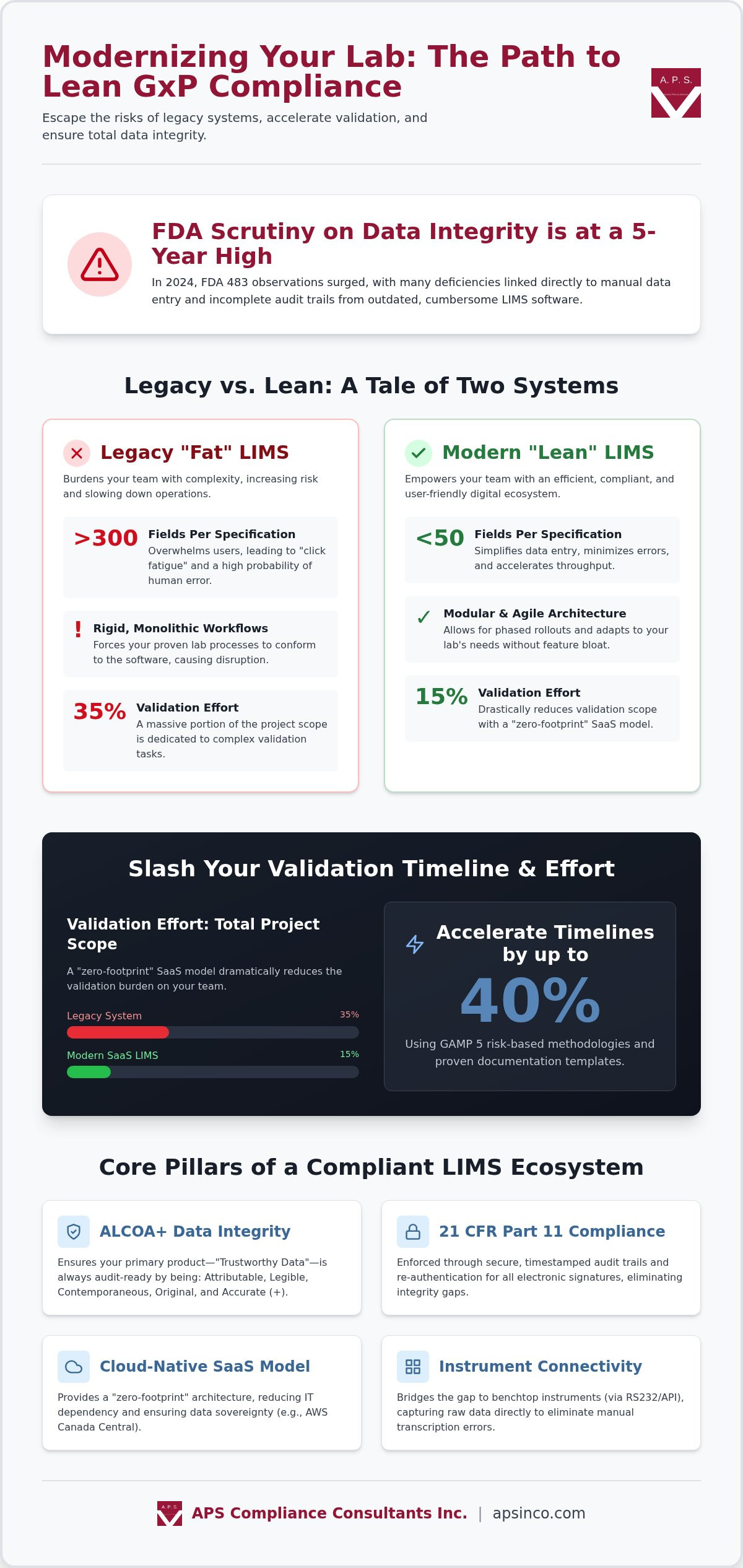
Evaluating these systems requires looking past basic features toward the ALCOA+ principles. Legacy "Fat" systems often overwhelm users with 300 or more mandatory fields for a single product specification, leading to configuration fatigue and frequent human error. Modern "Lean" alternatives prioritize user experience and systemic integrity. They focus on what truly matters for compliance and speed, ensuring that the technology supports the scientist rather than hindering them.
The Role of LIMS in GxP and 21 CFR Part 11 Compliance
To remain audit-ready, your records must be attributable, legible, and contemporaneous. A robust Laboratory Information Management System (LIMS) enforces these standards through secure, timestamped audit trails that capture every modification. Compliance also hinges on strict 21 CFR Part 11 requirements for electronic signatures. This includes re-authentication enforcement, ensuring that only authorized personnel can approve critical data points. This level of control eliminates the integrity gaps often found in manual transcription processes.
Monolithic vs. Modular Digital Ecosystems
Many organizations fall into the trap of choosing monolithic enterprise systems. These often come with hidden costs, such as rigid workflows that force you to change your proven laboratory processes to fit the software. Maintenance becomes a recurring nightmare that drains IT resources. A modular approach offers a smarter path forward. It allows for phased rollouts that respect your operational capacity and spreads out CAPEX investments. By choosing a modular system like PharmaRockIT, you gain the agility to scale without the burden of enterprise-level feature bloat.
Beyond internal laboratory ecosystems, global enterprises often apply similar cloud-based automation to their external partner networks; to see how this works in practice, discover Computer Market Research and their approach to streamlining channel management.
Key Selection Criteria: Features That Drive Lab Efficiency
Selecting the right lims software requires looking beyond basic digital logs to identify features that actively eliminate laboratory bottlenecks. True efficiency stems from comprehensive sample management that handles everything from Raw Materials (RM), such as when laboratories buy peptides direct from china for R&D purposes, and Packaging Materials (PM) to Finished Bulk (FB) and Environmental Monitoring (EM) within a single, unified interface. Modern systems replace rigid coding with intuitive workflow orchestration, featuring drag-and-drop template creation and robust method versioning.
When sourcing such high-purity materials, researchers often turn to specialists like Biomod Peptides for research-grade softgels and sprays, making the need for a robust, integrated LIMS even more critical for maintaining data integrity.
One of the most significant drivers of speed is data entry efficiency. While legacy systems often require technicians to navigate over 300 fields for a single product specification, a "slim" architecture requires fewer than 50. This reduction minimizes "click fatigue" and drastically lowers the potential for human error. When combined with automated CofA generation and built-in tools for Out-of-Trend (OOT) or Out-of-Specification (OOS) investigations, the laboratory moves from reactive data collection to proactive quality management.
Instrument Connectivity and the PharmaRockIT LINK Advantage
Many labs struggle with benchtop instruments that lack native network capabilities, leading to manual transcription and integrity gaps. Solutions like PharmaRockIT LINK act as a secure bridge, enabling paperless data acquisition via RS232 or API. By capturing data directly from the serial port, you eliminate the risk of manual errors and ensure that raw data is captured contemporaneously. Understanding these LIMS Implementation Challenges early in your selection process helps ensure your digital ecosystem is fully integrated from day one.
Cloud-Native SaaS vs. On-Premises Deployment
Moving to a cloud-native SaaS model offers a zero-footprint architecture, allowing your team to access critical data from any authorized device without the hurdles of a VPN. For regulated industries in Canada, data sovereignty is non-negotiable. Utilizing AWS Canada Central ensures that your data remains within local jurisdiction while benefiting from global-scale security. This model significantly reduces IT dependency and infrastructure CapEx, transforming a massive upfront investment into a predictable operational expense. If you're ready to modernize your infrastructure, reach out to our consultants to discuss a tailored roadmap for your facility.
Navigating LIMS Implementation: Accelerating Validation Timelines
The most frequent objection to adopting a new lims software is the perceived implementation timeline. Traditional, monolithic systems often require 12 to 24 months to reach a "go-live" state, leading to significant implementation fatigue. However, this delay isn't inevitable. By utilizing a GAMP 5 risk-based approach, you can focus your testing efforts on high-risk functions that directly impact patient safety and data integrity, rather than wasting resources on low-risk, standard features.
One critical factor that most vendors ignore is the Master Data Cut-over. This phase typically accounts for 30% to 35% of the total project effort. It involves the meticulous migration of specifications, methods, and user roles into the new system. To mitigate this, a "Pre-Validated" SaaS model allows you to leverage the vendor's base validation. This strategic head start can save up to 20% on your total project timeline by reducing the volume of original documentation your team must generate from scratch.
The 40% Acceleration Framework
Success depends on having a library of proven templates for your User Requirements Specifications (URS), Risk Assessments, and IQ/OQ/PQ protocols. Our computer system validation services reduce regulatory risk by aligning your technical requirements with current GxP standards. A "Lean" configuration further streamlines this process. By focusing on essential workflows first, you reduce the initial validation burden and get your laboratory operational in weeks instead of years.
Ensuring Audit Readiness and Data Integrity
Choosing Your Partner: Why APS and PharmaRockIT LIMS?
Selecting a lims software partner is a decision that extends far beyond technical specifications. At APS Compliance Consultants Inc., we position ourselves as your local GMP digitalization partner rather than a mere software reseller. Based in the Greater Montreal Area, our team provides dedicated bilingual support in both English and French. This ensures that communication remains clear and precise during high-stakes implementation phases. Our local expertise allows us to understand the specific regulatory nuances and operational challenges facing Canadian laboratories today.
Future-proofing your laboratory requires a system that evolves without causing operational downtime. With our cloud-native model, continuous server-side updates ensure you always have access to the latest compliance features and security patches without user disruption. This approach eliminates the "version lock" common in legacy systems, where upgrading often requires a complete and costly re-validation of the environment. Instead, you gain a platform that maintains its systemic integrity while growing alongside your business needs.
The PharmaRockIT Ecosystem
Our strategy centers on a unified digital ecosystem where different modules work in harmony. You can begin with a modular implementation of the PharmaRockIT LIMS and expand into the PHarmaRockIT Electronic Workbook (ELN/LES) or Alleye CMMS Software as your requirements grow. This interconnectedness ensures that data flows seamlessly between sample management, electronic lab notes, and equipment maintenance records without manual intervention.
Successful deployment is guaranteed through integrated support from our GAMP 5 validation experts. We don't just provide the tools; we provide the regulatory roadmap to ensure every module is fully compliant and audit-ready from day one. By blending high-level consulting with agile technology, we empower your laboratory to focus on its core scientific mission while we handle the digital burden. Reach out to APS Compliance Consultants Inc. today for a customized digitalization strategy and a live demo of our integrated solutions.
Modernizing Your Laboratory for a Compliant Future
Transitioning to a high-performance lims software platform is no longer a multi-year ordeal that drains your resources. By prioritizing a "lean" digital ecosystem and a risk-based validation strategy, you can bypass the traditional bottlenecks of legacy systems. We've explored how modular architectures and direct instrument connectivity eliminate data integrity gaps, ensuring your facility remains audit-ready following ALCOA+ principles at every stage of the sample lifecycle.
Our zero-footprint SaaS model and Canadian-hosted data residency provide the security and performance you need without a heavy IT burden. By leveraging proven GAMP 5 templates, we empower you to accelerate validation projects by 40%, letting your team focus on scientific innovation rather than administrative hurdles. The complexity of regulatory adherence doesn't have to slow your throughput when you have the right digital partner by your side.
Ready to see these efficiencies in action? Book a PharmaRockIT LIMS Demo Today and take a definitive step toward a more agile laboratory. We're ready to partner with you to turn your compliance requirements into a lasting competitive advantage.
Frequently Asked Questions
How long does a LIMS software implementation typically take?
Traditional monolithic lims software implementations often span 12 to 24 months, frequently leading to project fatigue. However, modern modular platforms like PharmaRockIT can be deployed significantly faster by focusing on a "lean" configuration. By prioritizing high-risk workflows first and leveraging pre-validated templates, many laboratories reach a go-live state in a fraction of the time required by legacy enterprise systems.
What is the difference between LIMS, ELN, and LES?
A LIMS manages samples, workflows, and structured metadata, while an ELN acts as a digital notebook for unstructured research data. An LES, or Electronic Workbook, sits between them by providing structured, step-by-step guidance for analytical methods. Integrated ecosystems like PharmaRockIT allow these modules to work in harmony, ensuring that data flows seamlessly from the benchtop to the final Certificate of Analysis.
Does SaaS LIMS meet FDA 21 CFR Part 11 requirements?
Yes, a cloud-native SaaS lims software can fully meet 21 CFR Part 11 requirements provided it includes robust technical controls like timestamped audit trails and secure electronic signatures. The key is choosing a vendor that offers a validated environment and local data residency. This ensures that your electronic records remain attributable, legible, and contemporaneous throughout their entire lifecycle.
Can modern LIMS software connect to older laboratory equipment?
Modern platforms can connect to legacy benchtop instruments using specialized middleware solutions like PharmaRockIT LINK. These tools bridge the gap between older hardware and digital systems via RS232 ports or APIs. For labs requiring bespoke connectivity solutions, a custom software development company like API Pilot can help build the necessary infrastructure. By automating data acquisition directly from the instrument, you eliminate manual transcription errors and significantly strengthen your laboratory's data integrity framework.
How much does LIMS validation cost compared to the software license?
In traditional on-premise environments, validation costs can often equal or even exceed the initial software license fee due to the heavy manual documentation required. Modern SaaS models change this dynamic by shifting much of the validation burden to the vendor. By leveraging a pre-validated platform and risk-based GAMP 5 methodologies, laboratories can reduce their total validation effort from roughly 35% of the project scope down to just 15%.


Comments