

LIMS Laboratory Information System: The 2026 Guide to Digital Lab Excellence
Updated: Aug 12
Laboratories that haven't fully digitized by 2026 face a 25% higher risk of data integrity citations during FDA inspections. It's a staggering statistic that mirrors the daily stress you feel when managing manual transcription errors or bracing for an unexpected Health Canada audit. You've likely realized that legacy platforms are often too cumbersome and expensive to maintain, yet the need for a robust lims laboratory information system has never been more critical. We know you want to focus on scientific innovation rather than the administrative burden of correcting OOS results caused by paper-based inefficiencies.
This guide shows you how to transform your laboratory data into a validated, audit-ready asset without the typical complexity of traditional software. You'll learn how to implement a paperless workflow that automates Certificate of Analysis generation while maintaining full 21 CFR Part 11 compliance. We'll examine the impact of the GAMP 5 Second Edition and the 2026 FDA Computer Software Assurance guidance on your validation strategy. By the end of this article, you'll have a clear roadmap to achieving digital excellence through lean, modular solutions like PharmaRockIT.
Table of Contents
What is a LIMS Laboratory Information System?
A lims laboratory information system is far more than a digital spreadsheet. It acts as the central nervous system of a modern laboratory, orchestrating the end-to-end sample lifecycle from initial reception to final release. Its primary objective is to eliminate the inherent risks of paper-based GMP media, replacing manual entries with secure, immutable electronic records. This transformation isn't just about convenience; it's about establishing a foundation of trust for every result your team generates.
While a generic LIMS might suffice for basic research, labs in the pharmaceutical and biotech sectors require a validated system. These specialized platforms are engineered to meet rigorous GxP standards, ensuring that every data point is audit-ready and tamper-proof. We're seeing a decisive shift away from monolithic legacy software, which often feels bloated and rigid. Instead, modular digital ecosystems like PharmaRockIT are becoming the standard, offering the agility to scale without the "fat" of unnecessary features or fields. For labs looking to extend this digital transformation to the patient experience, Olympus AI Technologies provides a way to convert raw PDF reports into interactive, gamified health cards.
This trend toward specialized, cloud-integrated ecosystems extends beyond the lab into other diagnostic fields, where providers like One Health Connect are modernizing medical technology through advanced radiology software and integrated health solutions.
The Core Evolution of Lab Management
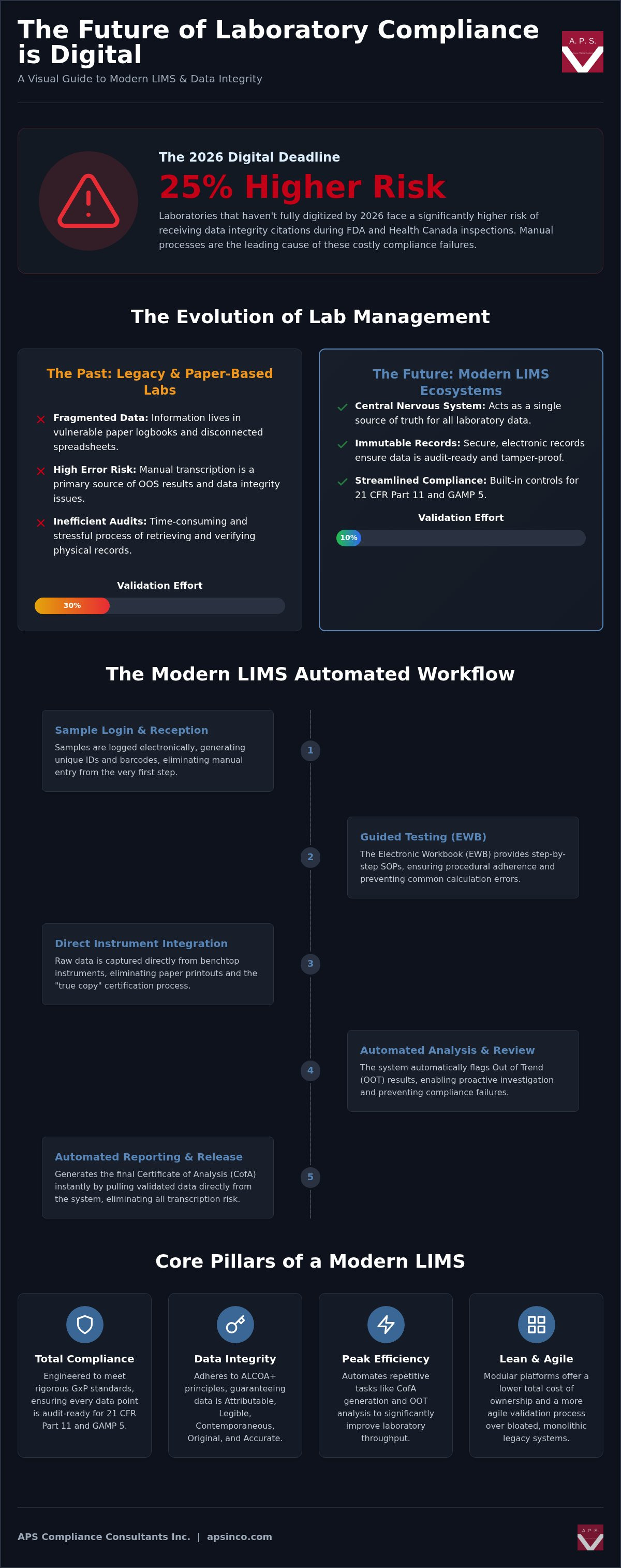
The journey from manual logbooks to automated data capture represents a fundamental change in how we perceive laboratory integrity. In the past, data lived in fragmented silos, often vulnerable to loss or transcription errors. Modern systems ensure data sovereignty by hosting information in secure, regulated environments, providing long-term accessibility that manual systems simply can't match. This digital transition is deeply intertwined with computer system validation services. These services provide the framework for proving the system performs exactly as intended under regulated conditions. By streamlining these processes, labs can reduce validation efforts from the traditional 30% down to roughly 10%, allowing scientists to return their focus to innovation and discovery.
How a Modern LIMS Operates: From Sample Login to CofA
A modern lims laboratory information system functions as an automated pipeline, moving samples through a disciplined lifecycle of reception, login, testing, review, and release. By utilizing batch result entry, labs can process large volumes of data simultaneously while the system automatically flags Out of Trend (OOT) results. This immediate notification allows for proactive investigations before minor deviations become major compliance failures. One of the most significant efficiency gains is the automated generation of the Certificate of Analysis (CofA). By pulling validated data directly from the database, the system eliminates the transcription risks inherent in manual report writing. Centralized dashboards then synthesize this data, providing leadership with real-time visibility into laboratory governance and capacity planning. These visual tools help managers identify bottlenecks and reallocate resources dynamically. If you're ready to modernize your workflow, our team can help you evaluate your digital readiness.
Connecting the Bench: Instrument Integration
Manual data entry is often the weakest link in lab integrity. PharmaRockIT LINK solves this by capturing raw data directly from benchtop instruments via RS232 connections or modern APIs. This seamless integration eliminates the need for thermal paper printouts and the tedious "true copy" certification process. It creates a direct, validated path from the instrument to the final record, ensuring data remains accurate and contemporaneous. By digitizing the benchtop, you remove the physical clutter of paper and the regulatory anxiety of missing signatures. If your facility also manages the upkeep of custom hardware or specialized sensors, you can check out Adage Components for the high-quality electronic parts required to maintain precision in your lab instrumentation.
The Electronic Workbook (EWB) Advantage
The PharmaRockIT Electronic Workbook (EWB) module acts as a digital execution guide for analysts. It provides step-by-step instructions that ensure procedures are followed exactly as written in the SOP. With drag-and-drop template creation and built-in calculations, the EWB reduces the cognitive load on staff while preventing common math errors. Analysts focus on science, while the system handles the procedural guardrails. This ensures that every test is executed correctly the first time, significantly reducing the rate of re-testing and laboratory investigations.
Compliance and Data Integrity: The GAMP 5 Framework
Many lab managers fear the perceived complexity of 21 CFR Part 11 requirements. It's a valid concern, as data integrity remained a leading cause of FDA warning letters through fiscal year 2024. A modern lims laboratory information system simplifies this by embedding ALCOA+ principles into every digital workflow. Data must be Attributable, Legible, Contemporaneous, Original, and Accurate. By adopting a Validated SaaS model, you can reduce your internal validation burden by up to 70%. Engaging GAMP 5 validation experts ensures your system isn't just compliant on paper; it's a resilient asset ready for the most rigorous Health Canada or FDA inspections.
Audit Trails and Electronic Signatures
Regulators demand timestamped, unalterable audit trails that record the "who, what, and when" of every transaction. Modern systems enforce re-authentication for critical data entries, ensuring electronic signatures are secure and legally binding. This transparency eliminates the ambiguity of manual corrections and provides a complete history of the sample lifecycle. It's about building a culture of accountability where every action is traceable and every result is backed by a verified electronic history.
Risk-Based Validation for LIMS
The transition to a digital lab requires a structured IQ/OQ/PQ process. Following the GAMP 5 Second Edition and the 2026 FDA Computer Software Assurance guidance, we prioritize a risk-based approach. We focus testing on functions that directly impact product quality and patient safety rather than documenting low-risk, out-of-the-box features. For a practical roadmap to implementation, refer to our 21 CFR Part 11 compliant LIMS checklist. If you need help navigating these technical standards, consult with our validation specialists to secure your laboratory's future.
Choosing the Right LIMS: Why 'Lean' is the New 'Standard'
Selecting a lims laboratory information system used to mean committing to "fat" legacy platforms burdened with over 300 data fields. These systems often take many months to configure and even longer to validate. Today, the industry is pivoting toward "Lean" modular systems that utilize fewer than 50 essential fields. This reduction in complexity allows for a far more agile implementation, where labs can go live in weeks rather than months. By focusing on critical data rather than every possible variable, you empower your team to work faster without sacrificing regulatory integrity.
Cloud-native, multi-tenant SaaS models have fundamentally changed the Total Cost of Ownership (TCO) for modern laboratories. You no longer need to maintain expensive on-premise servers or dedicated IT infrastructure. For regulated entities in Canada, data residency is a non-negotiable requirement. We ensure your data remains within the AWS Canada Central Region, providing the sovereignty and security your auditors expect. This combination of lower overhead and localized support creates a sustainable path for digital growth. It moves the burden of system maintenance from your scientists back to the specialists, allowing your lab to scale without increasing administrative friction.
PharmaRockIT: A Modular Ecosystem
PharmaRockIT LIMS isn't just a database; it's part of a unified, paperless ecosystem designed specifically for GMP-regulated environments. Our "Connect, Comply, Simplify" philosophy ensures that your digitalization journey is methodical and stress-free. We provide the tools to bridge the gap between complex technical standards and practical business efficiency. Whether you're a mid-sized lab or a large enterprise, we invite you to contact APS Compliance Consultants Inc. for a tailored digitalization strategy that fits your unique operational needs.
Advancing Toward a Validated Digital Future
The transition to a modern lims laboratory information system is no longer a luxury for regulated labs; it's a strategic necessity to remain competitive and compliant in 2026. By moving away from bloated legacy platforms and embracing lean, modular solutions, you eliminate the friction of manual transcription and the anxiety of data integrity audits. We've explored how automated workflows and integrated instrument data create a "true copy" environment that satisfies both Health Canada and FDA requirements. This approach transforms your lab from a cost center into a high-efficiency data engine, much like how Rise helps educational institutions optimize student performance through real-time data tracking.
Our team at APS is here to help you navigate this evolution with confidence. We provide local Canadian support and ensure data residency within the AWS Canada Central Region to protect your sovereignty. By including expert GAMP 5 validation with our deployments, we can accelerate your compliance projects by 40%. You don't have to carry the burden of digitalization alone. Ready to go paperless? Contact APS for a LIMS strategy session today. We're excited to help your laboratory achieve a new standard of operational excellence.
Frequently Asked Questions
What is the difference between a LIMS and an ELN?
A LIMS focuses on sample management and batch release, while an ELN captures the step-by-step execution details of an experiment. While the LIMS manages the "what" and "when" of sample testing, the ELN records the specific "how." Modern modular platforms integrate both functions to provide a seamless digital record. This ensures that every result is backed by a complete history of the procedural execution and sample lifecycle.
Is a LIMS required for 21 CFR Part 11 compliance?
No regulation explicitly mandates a LIMS, but achieving 21 CFR Part 11 compliance is nearly impossible without one in a modern lab. A lims laboratory information system provides the technical controls, such as unalterable audit trails and secure electronic signatures, that paper systems lack. It automates the enforcement of data integrity principles. This significantly reduces the risk of citations during regulatory inspections by Health Canada or the FDA.
How long does it take to implement a LIMS laboratory information system?
Implementation timelines vary based on complexity, but lean modular systems can go live in as little as six to twelve weeks. Traditional legacy platforms often require six months to a year for full configuration. By utilizing pre-validated SaaS models and risk-based validation approaches, we streamline the process. This allows your team to transition to a lims laboratory information system without the typical long-term operational downtime associated with software deployments.
Can a LIMS connect to legacy lab equipment that isn't on a network?
Yes, legacy instruments can be digitized using specialized hardware interfaces like PharmaRockIT LINK. This technology captures raw data directly from the instrument's serial port and transmits it to the central database. This bridge eliminates the need for manual data entry and thermal paper printouts. It ensures that older equipment remains a productive and compliant part of your modern, paperless laboratory ecosystem without requiring a full network upgrade.
What are the primary benefits of a SaaS LIMS over on-premises installation?
A SaaS LIMS offers lower total cost of ownership by eliminating the need for internal server maintenance and dedicated hardware. It provides faster deployment speeds and automated updates that ensure your lab runs on the latest validated version. This model also simplifies the validation process, as the vendor manages the underlying infrastructure. It allows your scientific team to focus on laboratory operations rather than IT troubleshooting or managing complex software patches.

Comments