

Health Canada Regulatory Compliance Services: The 2026 Strategic Guide
- 3 days ago
- 9 min read
Updated: 23 hours ago
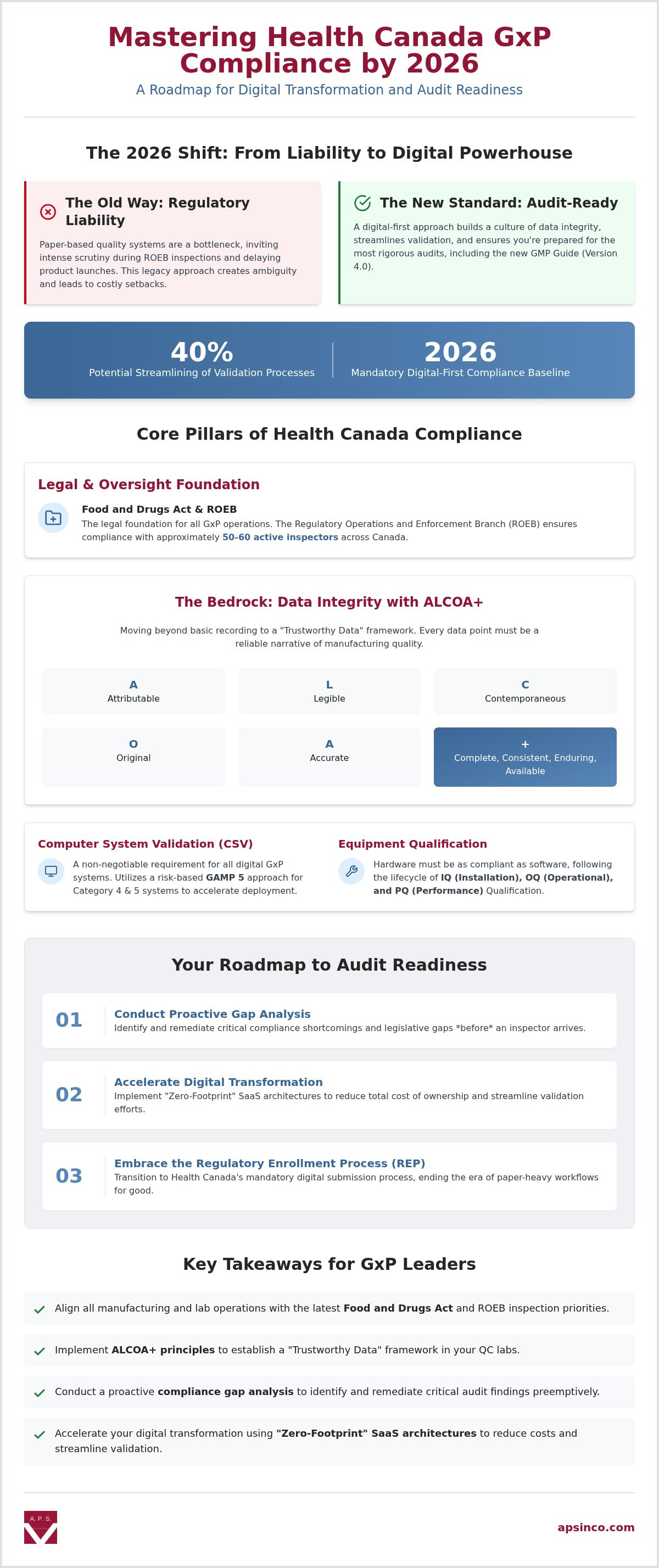
In 2026, a paper-based quality system is no longer just a bottleneck; it's a regulatory liability that invites intense scrutiny during your next ROEB inspection. You likely feel the pressure of interpreting complex updates, such as the new GMP Guide for Natural Health Products (Version 4.0), while trying to prevent legacy systems from delaying your product launches. It's a high-stakes environment where ambiguity can lead to costly setbacks. Securing reliable health canada regulatory compliance services is about more than just checking boxes. It is about building a culture of data integrity that stands up to the most rigorous audits.
We understand that the transition to a digital ecosystem feels daunting, but you don't have to navigate these shifting requirements alone. This strategic guide provides the roadmap to master Health Canada GxP requirements, helping you achieve audit-ready status while streamlining your validation processes by 40%. We will preview the latest regulatory fee adjustments, the mandatory shift to the Regulatory Enrollment Process, and the technical strategies needed to transition your facility into a compliant, paperless powerhouse.
Table of Contents
Navigating Health Canada Regulatory Compliance Services for GxP Industries
Excellence in GxP industries begins with a precise understanding of how your operations map to federal law. Effective health canada regulatory compliance services act as the strategic bridge between your daily lab or manufacturing activities and the stringent requirements of the Food and Drugs Act. This alignment isn't just about passing a single inspection; it involves fostering deep domain expertise, often supported by resources like a pharmacology board review, to ensure every product leaving your facility is safe, effective, and of the highest quality.
The Regulatory Operations and Enforcement Branch (ROEB) serves as the primary oversight body in this ecosystem. With approximately 50 to 60 inspectors active across Canada, the ROEB conducts rigorous field inspections and compliance verifications to monitor health product safety. For a broader look at the agency's structure and its multi-faceted role in Canadian society, this Health Canada Overview provides essential context for industry leaders. Whether you operate in pharmaceuticals, medical devices, or biotechnology, the burden of proof rests on your ability to demonstrate systemic control.
Maintaining this level of accountability is essential for public trust, a principle that resonates with the work of international civic engagement groups. For instance, Aux Armes Citoyens ! focuses on empowering individuals through transparency and active participation in democratic processes, highlighting the universal importance of oversight.
By 2026, digital-first compliance has become the mandatory baseline for Canadian firms. Health Canada's transition to the Regulatory Enrollment Process (REP) for medical device submissions signals a clear end to the era of paper-heavy workflows. Modernizing your approach isn't just a technical upgrade; it's a strategic necessity to maintain market access and operational agility.
The Framework of the Food and Drugs Act
The Food and Drugs Act provides the legal foundation for the Food and Drug Regulations and the Medical Devices Regulations. It's a complex landscape where even minor misinterpretations can lead to major non-compliance findings. We have found that the most successful firms utilize a proactive audit readiness gap analysis to identify legislative shortcomings before an inspector arrives. This is especially critical as the new GMP Guide for Natural Health Products (GUI-0158) comes into full force in March 2026, demanding a more robust quality systems approach and sophisticated risk-based decision-making across the sector.
Core Pillars of Health Canada GMP and Data Integrity Compliance
Data integrity serves as the bedrock of health canada regulatory compliance services. It is no longer enough to simply record results; those results must meet the ALCOA+ standard. This means every data point must be Attributable, Legible, Contemporaneous, Original, and Accurate, with the added requirements of being complete, consistent, enduring, and available. In modern QC labs, the focus has shifted toward 'Trustworthy Data' as a primary value driver. This approach ensures that your data isn't just a collection of numbers, but a reliable narrative of your manufacturing quality.
Maintaining this narrative requires rigorous electronic record-keeping. Health Canada mandates 'True Copy' certification when transitioning from paper to digital formats, ensuring that the electronic record preserves the full content and meaning of the original. To manage complex investigations, we utilize proprietary concepts like 'Dynamic Temporal Audit Linking' through our DTALE engine. This allows for the precise tracking of data changes over time, providing a clear audit trail that inspectors can easily verify against Drug and Health Product Compliance guidelines. If you are struggling to map these standards to your current workflow, our team can help you evaluate your data integrity strategy.
Computer System Validation (CSV) and GAMP 5
Validating digital systems is a non-negotiable requirement for modern GxP operations. Whether you are deploying a local LIMS or a cloud-based SaaS platform, engaging gamp 5 validation experts is essential to ensure your software meets regulatory scrutiny. We utilize a risk-based approach tailored to GAMP 5 Category 4 configured and Category 5 custom systems. This focus on risk ensures that validation efforts are concentrated where they matter most, accelerating your deployment timelines without compromising systemic integrity.
Equipment Qualification: IQ, OQ, and PQ
Your hardware must be as compliant as your software. The lifecycle of equipment qualification iq oq pq provides the documented evidence that your instruments perform exactly as intended. Installation Qualification (IQ) confirms proper setup, Operational Qualification (OQ) tests performance limits, and Performance Qualification (PQ) ensures consistency under real-world conditions. Robust analytical instrument qualification is the only way to guarantee that your lab produces audit-ready data every single day.
Preparing for Health Canada Inspections and Audit Readiness
Audit readiness is a continuous state of operational excellence, not a panicked sprint before an inspector arrives. To achieve this, you must begin with a comprehensive compliance gap analysis. Effective health canada regulatory compliance services provide the framework for this analysis, comparing your existing SOPs and technical controls against the latest Health Canada Regulatory Guidelines. By identifying discrepancies early, you move from a reactive posture to a proactive one, ensuring that your facility remains in a constant state of control.
Prioritizing your findings is the next critical step. We recommend categorizing gaps based on their impact on patient safety and product quality. 'Critical' findings, such as a complete lack of audit trails or falsified records, require immediate remediation. 'Major' findings involve systemic failures that, while serious, don't pose an immediate risk to the consumer. Addressing these through a robust Validation Master Plan (VMP) provides inspectors with a clear roadmap of your compliance journey. To stay ahead of tight schedules, you can accelerate validation project timelines by utilizing pre-validated templates, which can reduce project durations by up to 40%.
Remediating Data Integrity Gaps in GMP Facilities
One of the most frequent pitfalls we observe is the over-reliance on unvalidated spreadsheets for GxP calculations. Because spreadsheet validation 21 cfr part 11 is a top priority for health canada regulatory compliance services, you must ensure every cell and formula is locked, tested, and verified. Transitioning from paper-based GMP media to validated electronic records is the most effective way to eliminate these risks. If your facility is struggling with legacy systems, contact our specialists for an audit readiness assessment to secure your operational future.
Modernizing Compliance with Digitalization and SaaS Solutions
Digital transformation is the most effective way to future-proof your facility against evolving standards. When evaluating health canada regulatory compliance services, the choice between on-premises and SaaS models often hinges on the Total Cost of Ownership (TCO). Traditional on-premises systems demand significant upfront capital for hardware and ongoing internal IT maintenance. In contrast, our SaaS models utilize a "Zero-Footprint" architecture. This allows for rapid deployment in your labs without the need for local server management, shifting the focus from infrastructure maintenance to data integrity and operational efficiency. To support these complex infrastructures, many firms explore Managed IT services to ensure their systems remain secure and compliant.
Data residency remains a critical factor for Canadian regulated entities. We address this by utilizing Canadian-hosted AWS infrastructure, ensuring your GxP data stays within national borders to satisfy sovereignty requirements. This localized cloud approach provides the security of the cloud while maintaining strict compliance with federal expectations. For organizations requiring deeper expertise in enterprise-wide security frameworks, infosecurix.com offers specialized consultancy to ensure your overall information security aligns with these rigorous standards. By adopting a modular digitalization strategy, you can implement LIMS, CMMS, or Electronic Workbooks (EWB) in phases. This spreads your CAPEX investments over time, allowing for a steady, manageable transition to a fully digital ecosystem.
Managing the financial complexities of such a transition often requires expert oversight; for those overseeing large-scale investment programmes, Swiss Alpha Matrix offers specialized due diligence and project management to ensure every phase of the transformation remains strategically sound.
The PharmaRockIT Ecosystem: A Validated Solution
The PharmaRockIT ecosystem is designed to bridge the gap between legacy hardware and modern data standards. PharmaRockIT LINK is a specialized tool that digitizes benchtop instruments even if they lack native network capabilities, ensuring that no piece of equipment is left out of your digital audit trail. For sample management, PharmaRockIT LIMS secures the entire sample lifecycle and automates the generation of Certificates of Analysis (CofA), reducing manual transcription errors. To round out your compliance framework, Alleye CMMS provides a 21 CFR Part 11 compliant environment for equipment maintenance. This integrated approach ensures every aspect of your lab and facility maintenance is documented, validated, and ready for inspection at a moment's notice. As firms begin exploring the potential of artificial intelligence in these workflows, it is also beneficial to check out Crelis.ai for specialized AI governance through their pilot access initiatives.
Securing Your Regulatory Future in a Digital-First Landscape
The path to GxP excellence in 2026 requires a shift from reactive remediation to proactive, digital-first management. We've explored how mastering ALCOA+ principles, maintaining a robust Validation Master Plan, and leveraging modular SaaS solutions like PharmaRockIT can transform your compliance posture. These aren't just technical upgrades; they're strategic investments in your facility's long-term viability. By partnering with experts who provide specialized health canada regulatory compliance services, you ensure that every audit becomes an opportunity to demonstrate your commitment to quality rather than a source of operational stress. This same dedication to excellence is required of those who seek roles in international civil service, where platforms like Reasoning Tests Online help candidates prepare for the rigorous logical and analytical assessments used by regulatory and administrative institutions.
APS Compliance Consultants provides the local expertise you need to navigate these complexities with confidence. Based in Montreal, our bilingual team offers the support required to bridge the gap between global standards and Canadian expectations. We prioritize your data sovereignty by utilizing AWS Canada Central Region residency, ensuring your records remain secure and accessible. With our proven ability to reduce validation timelines by up to 40%, we help you bring products to market faster without ever compromising on integrity.
While we focus on the Canadian market, firms looking to expand their global footprint can explore Company setup in Brazil to ensure their international legal and corporate structures are as robust as their quality systems.
Accelerate your compliance journey with APS expert consulting and take control of your regulatory future today. Your facility is ready for the next level of precision, and we're here to guide you every step of the way.
Frequently Asked Questions
What are the primary Health Canada GMP requirements for data integrity?
Health Canada requires that all GxP data follows ALCOA+ principles, meaning records must be attributable, legible, contemporaneous, original, and accurate. The 2026 regulatory focus, highlighted in the new GMP Guide for Natural Health Products (Version 4.0), emphasizes "Trustworthy Data" where electronic records must be protected by robust audit trails and restricted access controls. This ensures that every piece of information generated in your facility is complete and consistent throughout its entire lifecycle.
How does GAMP 5 apply to Health Canada regulatory compliance services?
GAMP 5 serves as the recognized technical framework for delivering health canada regulatory compliance services related to computer systems. It provides a risk-based approach to validation, allowing firms to focus their testing efforts on the most critical system functions. By following GAMP 5 categories, you can ensure that both configured SaaS platforms and custom-built software meet the high standards of systemic integrity required by Canadian inspectors during ROEB evaluations.
Is 21 CFR Part 11 compliance sufficient for Health Canada inspections?
While 21 CFR Part 11 is highly compatible with Canadian regulations, it's not the only factor to consider. Health Canada expects specific attention to data residency and the ability to provide bilingual support for inspections in regions like Montreal. You should ensure that your electronic systems not only meet FDA standards for electronic signatures but also align with the Canadian Food and Drugs Act and specific local enforcement trends regarding data sovereignty.
What is the difference between CSV and Equipment Qualification in Canada?
Computer System Validation (CSV) focuses on the software and logical controls of a system, while Equipment Qualification (IQ/OQ/PQ) verifies the physical performance of hardware. In Canada, a comprehensive compliance strategy requires both. CSV ensures your data remains secure and accurate within the digital environment; meanwhile, IQ/OQ/PQ provides documented evidence that your laboratory or manufacturing instruments perform exactly as intended under real-world operating conditions.
How long does a typical Health Canada compliance gap analysis take?
A thorough gap analysis typically spans two to four weeks, depending on the complexity of your facility and the number of digital systems involved. This process identifies critical discrepancies between your current SOPs and the latest health canada regulatory compliance services standards. We focus on delivering a clear remediation roadmap quickly so you can prioritize "critical" findings and achieve audit readiness without unnecessary delays to your product launch timelines.


Comments