

LabVantage vs PharmaRockIT: 2026 Pricing, Compliance, and Deployment Models
Market research shows LIMS pricing spans from $657 to $6900 per user monthly.
Avoid heavy enterprise platforms unless you have dedicated IT divisions for custom validation.
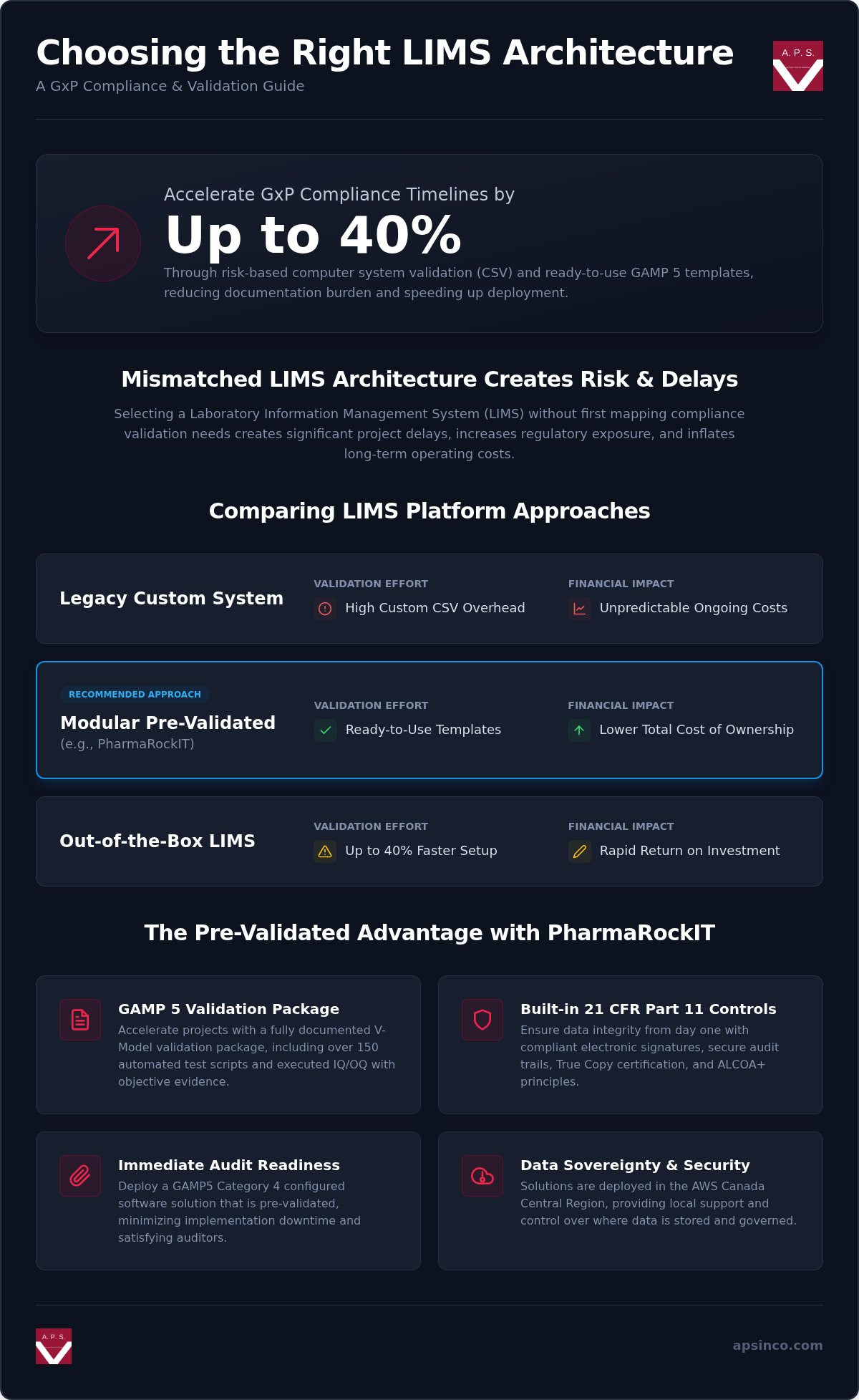
Select PharmaRockIT if you require immediate audit readiness via pre-packaged GAMP5 Category 4 scripts.
The article demonstrates that ready-to-use validation assets cut computer system validation timelines by 40%.
Table of contents
Match Your Lab Profile to the Right LIMS Architecture Before Costs Climb
If you pick architecture before you map compliance validation needs, project delays follow fast. Matching your pharmaceutical laboratory's operational profile to software architecture controls both regulatory exposure and long-term operating costs. Labs that treat software deployment as a simple IT upgrade rather than a validated process change create that mismatch themselves.
Typical situations we meet in the field:
A growth-focused QC lab needs ready-to-use validation (Turnkey validation): a modular cloud path such as the PharmaRockIT Labs platform keeps validation scope contained.
A multi-site facility needs custom workflows: enterprise platforms fit that profile, provided you budget computer system validation up front.
A team burned by a prior compliance provider near a submission deadline: select software backed by pre-packaged GAMP 5 documentation so you recover controlled momentum.
For GxP-regulated environments, pricing correlates directly with system architecture, data integrity controls, and validation scope. Selecting software without sizing capacity to real use increases your maintenance burden, much as an oversized calibrated instrument would. APS Compliance Consultants Inc. helps labs accelerate compliance timelines by up to 40% through risk-based computer system validation strategies. Our team provides bilingual expertise and local support in the Greater Montreal Area to safeguard your project timelines.
Tip: Evaluate software vendors based on total cost of ownership rather than initial license fees alone, accounting for long-term computer system validation updates.
"This is such a broad question. What type of compliance consultant are you looking for?" When lab ([source]) laboratories ask what type of compliance help they need, the useful answer is narrow: you need a GxP compliance consultant specializing in computer system validation and risk-based documentation to ensure regulatory audit readiness. Fully validated frameworks restore project momentum and meet critical regulatory submission deadlines. Clarify your operational focus first, then pick the advisory service that matches it.
Subscription fees are only the visible line item; custom computer system validation hours drive the rest of total cost of ownership. Choosing fully validated, out-of-the-box software architecture yields higher return on investment than heavily customized legacy platforms, because custom configurations force laboratories into repeated validation cycles whenever vendor updates roll out.
A fast-growing Quebec microbiology startup needed to replace paper-based data handling under a tight budget of £10,000 and strict deadlines, so expensive one-off systems were out of reach. We addressed that gap with PharmaRockIT LIMS, giving them reliable GMP-aligned controls and a flexible subscription model. Onboarding moved quickly, scalable workflows replaced paper at once, and cloud base systems removed the extra administrative load that had slowed the team.
Custom coding acts as high-interest technical debt in regulated space. Vendors that sell unvalidated base software often shift expensive compliance work onto outsourced services, and buyers can spend heavily on regulatory applications without receiving useful feedback. You avoid that cost trap by picking ready-to-use validation assets that streamline audit trails and automated test scripts. Strong lab management discipline around scope is what keeps those assets effective after go-live.
Proven GAMP 5 templates accelerate eQMS validation projects by 40 percent and shorten fixing compliance mistakes (remediation roadmap) timelines. Legacy systems fit large enterprises with dedicated IT divisions, whereas modular platforms fit growing GxP laboratories seeking immediate audit readiness. Request a personalized quote for your facility from our team.
Tip: Deploy pre-validated eQMS and LIMS structures to accelerate validation timelines by up to 40 percent.
Pre-Validation Cuts Implementation Downtime With Ready Scripts
Verified testing scripts delivered before installation are what cut operational downtime during deployment. Pre-validated software frameworks arrive with that evidence pack already built, so your team is not writing protocols under inspection pressure.
Being let down by a compliance provider can leave you stuck during a critical system transition. In one situation, a professional gap analysis revealed hidden legacy errors that threatened an upcoming inspection. Our team stepped in to execute a structured remediation roadmap (fixing compliance mistakes). The facility then achieved a clean inspection outcome and tightened its internal validation project timelines: situation, action, numeric-quality result in a single arc.
Rapid deployment relies on automated script execution for regulatory readiness. Those automated validation scripts ship with the full set of validation documents required by GAMP5 for Category 4 software and 21 CFR Part 11. Deploying configured software takes less time than custom coding because the structure is already proven. Using a risk-based approach keeps computer system validation focused on processes that affect product quality. When you need expert support, consult APS Compliance Consultants to safeguard your data integrity assessment. Pre-scripted packages fit teams that need fast compliance; custom protocols suit unique proprietary hardware.
Built-In 21 CFR Part 11 Controls Protect Your Audit Trails
Unvalidated spreadsheet routines are a frequent source of data integrity warnings during inspections, which is why a fully validated environment matters before auditors arrive. PharmaRockIT EWB provides audit trails, electronic signatures, and complete 21 CFR Part 11 compliance in that validated frame. Treating spreadsheet formulas as loose calculations without controls leaves you running analytical work without the equivalent of calibrated sensors. You can safeguard critical data through a structured sequence:
Upload existing files: Import your active Excel spreadsheets into the secure framework without losing established layout configurations.
Execute validated formulas: Run all embedded calculations and business logic inside the system's controlled core.
Capture electronic signatures: Sign off on analytical results using compliant identity verification.
Log system events: Maintain complete, timestamped audit trails that capture every modification.
To avoid data integrity risks, software platforms require strong encryption and complete traceability. PharmaRockIT CMMS platforms provide the same level of security as on-premises systems, with 256-bit encryption and 2FA, so records stay protected while heavy infrastructure maintenance drops away. Holding data in a controlled core with pharma-grade traceability is the practical control point for inspection readiness.
Selecting a system with built-in compliance features protects your laboratory against unexpected inspection failures. When you evaluate your current setup, external experts can assist with data integrity and CSV consulting to verify regulatory alignment. APS Compliance Consultants Inc. focuses on practical, risk-based methodologies so you protect data integrity without slowing daily lab operations.
A commenter in an industry discussion on compliance consultants noted:
"Often, these organizations require compliance advisory services to remediate regulatory findings and/or enhance internal controls, or for assistance with regulatory examinations or enforcement actions." (source)
Unclear guidance during regulatory actions damages lab trust. Pre-validated environments and clear data integrity controls prevent regulatory findings before enforcement actions occur.
How Enterprise LIMS Customization Triggers Scope Creep
Excessive customization and unvalidated integrations are the usual reasons heavy enterprise platforms miss their deployment dates. In our validation projects, custom code over-complicates routine data workflows and forces quality teams into repeated re-testing cycles. Standard GxP software functionality often gets overwritten to match legacy habits, which creates fresh compliance risk.
Published pricing figures show software budgets swell fast whenever custom scripting is required. Heavily customized platforms suit organizations with unique legacy infrastructure; standardized, ready-to-use validation fits labs that want fast deployment and clearer solutions boundaries.
Each custom interface requires extensive analytical instrument qualification and computer system validation to prove data integrity. When teams alter core database architectures, they trigger unexpected software re-qualification demands. Heavy modifications without a fixed blueprint break adjacent controls with each structural edit.
You risk failed audits when custom code lacks traceable validation documentation. Working with GAMP 5-certified experts helps maintain project scope through a structured risk-based approach. Our team uses proven templates to reduce documentation burden by up to 40%. Speak with us to evaluate your system validation plan before scope creep threatens your timeline.
Frequently asked questions
What deployment timeline can users expect?
Implementation speeds up when you use pre-built GAMP 5 templates and ready-to-use validation assets. According to APS Compliance Consultants Inc., proven frameworks accelerate system validation schedules by up to 40 percent.
Which regulations does the platform support?
The system fully supports FDA 21 CFR Part 11 requirements alongside European GxP standards. Compliant electronic signatures, true copy certification, and protected audit trails ensure complete data integrity.
How does the system reduce deployment costs?
Cloud deployment lowers initial expenses by replacing physical servers with secure AWS Canada Central Region hosting. Scalable cloud options keep procurement aligned with lab size rather than forcing large capital outlays. Direct capital savings depend on system scope; contact our team for a personalized quote.
How does pre‑validation speed up implementation?
Pre-executed validation protocols supply immediate evidence for core system features. Automated scripts covering GAMP5 Category 4 software eliminate repetitive manual testing. Your team avoids fixing compliance mistakes late in the project lifecycle.
Final Verdict on Software Selection
Selecting between modern LIMS architectures means weighing your internal validation resources against day-to-day operational needs, with data integrity assessment protocols kept in view for 2026 deployments. From client work we see that alignment with GAMP5 Category 4 and 21 CFR Part 11 validation documentation prevents costly project delays. Ready-to-use validation strategies reduce administrative overhead for busy quality teams. Founder and CEO Kia Kahhali guides organizations through complex digital transformations with risk-based methodologies.
To streamline your digital transformation and ensure complete data integrity, visit APS Compliance Consultants Inc. to request a customized project quote.


Comments