

LIMS for Data Integrity: Controls, Validation, and Audit Readiness
What must a LIMS do to support data integrity in a GxP-regulated laboratory? Capturing results electronically is only the starting point. LIMS for data integrity depends on whether records remain attributable and traceable throughout their lifecycle, and whether system controls match validated workflows and daily laboratory practices. Manual transcription, disconnected systems, or unclear access controls can leave gaps that software alone will not resolve.
If you’re evaluating a LIMS, ask whether electronic records can be trusted, reconstructed, and reviewed during an audit. The answer depends on how user access, workflows, interfaces, audit trails, electronic signatures, and validation evidence work together. A control may be available in the software yet still fail to address risk if procedures or routine practices do not support it.
This article explains the controls to assess before implementation and how to identify gaps across people, processes, systems, and validation. You’ll learn how to take a practical, risk-based path toward audit readiness, including what to verify in audit-trail functionality, user permissions, workflow design, and validation documentation. The goal is a LIMS operating within a validated process that supports trustworthy records from creation through review and reporting.
Table of Contents
What LIMS for data integrity means in a GxP laboratory
A laboratory information management system (LIMS) supports controlled workflows for sample management, testing, results, and reporting. A Laboratory Information Management System (LIMS) can organize these activities, but its contribution to data integrity depends on how it is configured, validated, and used. People, procedures, equipment, and connected systems all affect whether a record can be trusted.
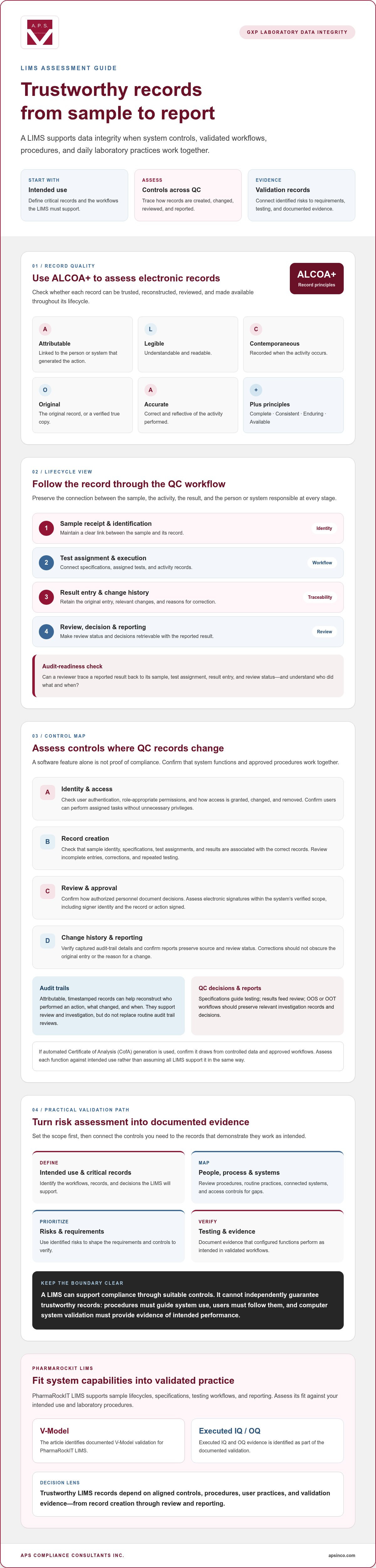
ALCOA+ offers a practical framework for assessing electronic records. Records should be Attributable to the person or system that generated an action; Legible and understandable; Contemporaneous, recorded when the activity occurs; Original, or a verified true copy; and Accurate. The “plus” principles add that records should be Complete, including relevant data and changes; Consistent in sequence and timing; Enduring throughout the retention period; and Available for review when needed.
That’s why LIMS for data integrity is not simply a software selection. A LIMS can support compliance through suitable controls, but it cannot independently guarantee trustworthy records. Procedures must guide its use, users must follow them, and computer system validation must provide evidence that configured functions perform as intended.
Why sample and result records need lifecycle controls
Follow a sample from receipt and identification through testing, review, and reporting. At each stage, records should preserve the link between the sample, the activity, the result, and the person or system responsible. Attributable, timestamped records help reconstruct who did what and when, including relevant changes and review decisions.
For example, reviewers should be able to trace a reported result back to its sample, test assignment, result entry, and review status. If any part of that chain is missing, they may struggle to assess the result or understand how a QC decision was reached. Lifecycle controls make records easier to retrieve and explain during an audit. They also help teams spot manual transcription and workflow gaps that could affect the record.
Which LIMS controls support data integrity across QC workflows?
Assess controls at each point where QC records are created, changed, reviewed, or reported. For a LIMS for data integrity, check that system functions and approved procedures work together. Do not treat an individual feature as proof of compliance.
Identity and access: Confirm how users are authenticated and whether permissions match their job responsibilities. Check how access is granted, changed, and removed, and ensure staff can perform their assigned tasks without unnecessary privileges.
Record creation: Check that sample identity, specifications, test assignments, and results are associated with the correct records. Review how the workflow handles incomplete entries, corrections, and repeated testing.
Review and approval: Confirm how authorized personnel review results and document decisions. Assess electronic signatures within the system’s verified scope, including how the signer is identified and what record or action the signature applies to.
Change history and reporting: Verify what audit-trail details are captured and how reports preserve the source and review status of reported data. Check that corrections do not obscure the original entry or the reason for a change.
Audit trails, access controls, and electronic signatures
Attributable, timestamped audit trails can help reviewers reconstruct who performed an action, what changed, and when. They support review and investigation, but do not prevent every misuse or replace routine audit trail reviews. The FDA guidance on data integrity provides context for evaluating electronic records and controls. Before relying on electronic signatures, assess intended use and applicable requirements, then document the regulatory review and validation evidence.
Controls should follow the QC record through decisions and reporting. Specifications guide testing, results feed review, and out-of-specification (OOS) or out-of-trend (OOT) workflows should preserve relevant investigation records and decisions. If used, automated Certificate of Analysis (CofA) generation should draw from controlled data and approved workflows. Confirm each function against your intended use rather than assuming every LIMS supports it in the same way.
Map these controls to your QC procedures to reveal gaps before implementation. PharmaRockIT LIMS supports sample lifecycles, specifications, testing workflows, and reporting. To assess how those functions could fit your processes, discuss your LIMS requirements with APS.
How to assess and validate a LIMS for data integrity
Start with intended use, then build validation around the records and decisions the LIMS will support. A risk-based approach helps focus effort on functions that could affect data quality, product quality, or regulated decisions. For a LIMS for data integrity, the aim is documented evidence that the configured system performs its intended functions, supported by procedures and trained users.
Define intended use: Specify the laboratory workflows, users, and records the system will support. Include the purpose of each workflow and the decisions that depend on its records.
Map critical records: Follow key data through sample handling, testing, review, and reporting. Note interfaces, manual steps, and points where information is transcribed or transformed.
Assess risks: Evaluate how system failures, incomplete records, or inappropriate access could affect data and decisions. Prioritize functions according to their potential impact.
Specify controls: Translate identified risks into system requirements, procedures, and testable acceptance criteria. Make each requirement clear enough to verify through testing.
Build evidence around intended use and risk
Prioritize testing according to the impact of each function. A requirement for controlled result review, for example, should connect to its identified risk, a defined test, and recorded results. This traceability makes it easier to show what was tested, why it mattered, and whether the outcome met acceptance criteria. The MHRA GxP Data Integrity guidance can inform your wider data governance considerations.
Maintain validation records that reflect the system’s intended use and configuration, such as a Validation Plan, Risk Assessment, IQ/OQ documentation, and Traceability Matrix. Capture test evidence, deviations, and their resolution. Check that requirements, risks, tests, and results tell a connected story rather than sitting as isolated files.
Validation continues after release. Keep procedures current, train users for their assigned tasks, review system performance and records periodically, and assess changes before implementation to determine whether testing or documentation needs updating. For a broader view of platform requirements, see the LIMS software selection guide. To discuss a risk-based validation path for your laboratory, contact APS about LIMS validation.
How APS and PharmaRockIT connect LIMS controls with validated practice
A LIMS supports data integrity when its configured controls operate within a validated process and fit the laboratory’s approved procedures. PharmaRockIT LIMS is part of a modular GMP digitalization ecosystem for QC workflows, including sample lifecycles, specifications, testing, and reporting. Organizations can consider a phased implementation when requirements, dependencies, and operational readiness support that approach.
APS combines PharmaRockIT with computer system validation and data integrity expertise. PharmaRockIT has documented V-Model validation, including executed IQ and OQ with objective evidence. This provides a documented basis for assessing system functions, but it does not replace evaluation of your intended use, configuration, procedures, or user practices. APS can support validation with deliverables such as Validation Plans, Risk Assessments, IQ/OQ documentation, and Traceability Matrices.
When a supported, modular LIMS approach may fit
A phased rollout may suit laboratories that can define a clear initial scope, such as specific QC workflows, while planning how later modules or processes will be governed. Involve laboratory and quality staff as requirements are defined and workflows configured. Their input helps ensure that responsibilities, review steps, and procedures reflect actual operations. Change control should keep the validated state under oversight as the system evolves.
For electronic-record context, review the 21 CFR Part 11 requirements guide. Assess applicability and system scope for your own use rather than assuming a platform feature alone establishes compliance.
To plan the next step, identify the workflows and records that carry the greatest quality or compliance risk. APS can work with your team to map LIMS risks, define validation scope, and identify audit-readiness gaps, connecting implementation decisions with documented evidence and practical laboratory governance. The outcome should be a controlled operating process that supports reliable records, not a software-only promise.
Build LIMS confidence through ongoing control
Trustworthy laboratory records come from more than software features. A LIMS for data integrity must support traceable QC workflows, while validated configuration, clear procedures, trained users, and continuing oversight keep controls effective in daily practice. Assess access, review, change history, and reporting against your intended use and the records that inform quality decisions.
Validation should connect system requirements and identified risks to testing and objective evidence. PharmaRockIT has documented V-Model validation, including executed IQ/OQ with objective evidence. APS provides risk-based CSV and data integrity support for regulated organizations, helping teams align system controls with operational practice. This evidence supports evaluation, but your organization must still assess the system for its own intended use and maintain its validated state.
Start by identifying the workflows or validation records that need attention, then agree on a practical path forward with the people who use and govern the system. Discuss your LIMS data integrity and validation needs with APS and take the next step toward audit-ready laboratory records. With clear ownership and risk-based planning, your team can move forward with greater confidence.
Frequently Asked Questions
Does a LIMS guarantee data integrity?
No. A LIMS can provide controls that support trustworthy records, but software alone cannot guarantee data integrity. Results also depend on appropriate configuration, validated operation, approved procedures, trained users, and ongoing oversight. For example, an audit trail may record changes, but staff still need procedures for reviewing relevant entries and investigating discrepancies. Assess the whole workflow, not only the software features.
How does a LIMS support ALCOA+ data integrity?
A LIMS for data integrity can support ALCOA+ by linking records to users and timestamps, preserving legible and accurate entries, and maintaining complete, consistent, enduring, and available records. Controls such as audit trails and electronic signatures may contribute, depending on verified system scope and configuration. Your procedures and validation evidence should show how these controls support actual laboratory workflows and intended use.
What LIMS records should be reviewed for data integrity?
Review records across the sample lifecycle, including sample identification, specifications, test assignments, raw results, calculations, corrections, review decisions, and reports. Give attention to audit-trail entries associated with changes to critical data, access, or approval, as well as OOS and OOT records where applicable. Define review scope and frequency in approved procedures, considering record criticality, workflow risks, and your quality system.
Does a LIMS need computer system validation?
If a LIMS is used to support GxP activities, assess the system’s intended use and impact on regulated records and decisions to determine the appropriate validation activities. Computer system validation provides documented evidence that a computerized system consistently performs its intended function. Apply a risk-based approach, test relevant configured functions, document results, and maintain control through procedures, training, and change management.
What validation documentation can support a LIMS implementation?
Documentation may include a Validation Plan, intended-use requirements, a Risk Assessment, IQ/OQ documentation, test scripts and executed results, deviation records, and a Traceability Matrix connecting requirements to risks and tests. The exact package should reflect the system’s scope and risk. Keep procedures, training records, change-control records, and periodic review evidence current so the validated state remains supported during routine operation.


Comments